In this episode, Don interviews Danelle Winfield who shares her career path, event presentation philosophy, and reveals best practices that have helped position the Los Angeles Sparks as a leader in the WNBA. Listen as Danelle speaks passionately about understanding your audience, developing team chemistry with staff, the importance of passing knowledge forward and more!
Season 1 • Episode 8
Building A Winning Events Teams
Transcript
The transcript below has been lightly edited for readability and clarity. Click any starting timestamp to jump to that exact point in the YouTube video.
Podcast Introduction
[00:00] Don Costante:
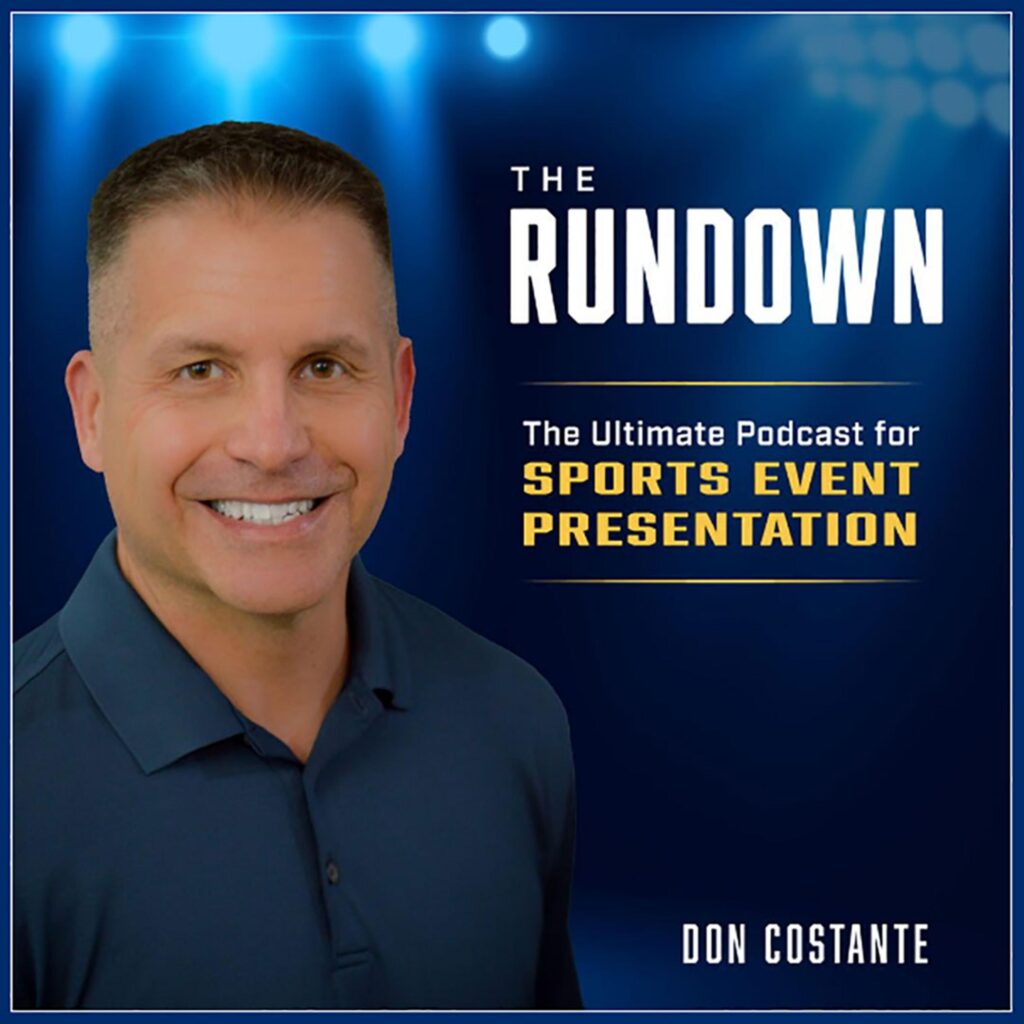
Welcome to the Rundown podcast hosted by Don Costante, a sports and event management expert with over 25 years experience. This unique podcast provides an opportunity to hear from some of the best professionals in the industry. You’ll get valuable insight and perspective on what it takes to deliver authentic experiences, activate brands, and most importantly, connect with audiences. All on the Rundown podcast. Let’s get started.
The WNBA Season and the Los Angeles Sparks
[00:26] Don Costante:
On July 25th, the WNBA tipped off its 24th season. Wow. 24 years. And currently they have 12 teams competing for a championship in Bradenton, Florida at the IMG Academy due to COVID-19. One of the elite teams in the WNBA is the Los Angeles Sparks. In addition to winning three WNBA titles, the Sparks were awarded the 2019 WNBA Franchise of the Year, which recognized them for being number one in entertainment, satisfaction, and service. Today, my guest is Danelle Winfield, the person responsible for creating the Sparks event presentation. Danelle currently serves as the Senior Director of Game Operations, Entertainment, and Promotions. In this episode, Danelle shares her career path, event presentation philosophy, and reveals best practices that have helped position the Los Angeles Sparks as a leader in the WNBA. Listen as Danelle speaks passionately about understanding the audience, developing team chemistry with staff, and the importance of passing knowledge forward. I’m ready to get started. Let’s meet Danelle Winfield. Hi, Danelle. It’s great to have you on the Rundown.
Meet Danelle Winfield
A Long History of Working Together
[01:39] Danelle Winfield:
Thank you. I’m excited.
[01:42] Don Costante:
You know, you and I go back several years. I think I met you first in 2013 when you joined my staff to work the NBA All-Star that year. Since then, we’ve done a lot of events. I mean, we’ve done Major League Baseball and NBA All-Star events. We’ve done football bowl games. We’ve done golf industry shows. I mean, it’s been a fun seven and a half years, hasn’t it?
[02:02] Danelle Winfield:
Yes, it definitely has. And it’s blown by, Dan. And I appreciate the opportunity to be able to do all these events with you and your team.
[02:10] Don Costante:
Well, it’s just nuts. I mean, time goes by so fast. But let’s talk about your path. How have you gotten to where you are today as Senior Director of Game Operations, Entertainment, and Promotions for the Los Angeles Sparks?
Danelle’s Career Path Into Game Operations
[02:23] Danelle Winfield:
Well, my path has been a unique one, just like a lot of people who fortunately get into the industry of sports. I attended Texas Southern University. I met someone who worked in game operations for the Rockets. So here I am at Texas Southern. I’m a junior. And I’m thinking, OK, I’m doing radio, television, and film. I’m going to work behind the scenes at Fox Sports. Or I’m going to be on ESPN one day. And I run into somebody who says game operations. And I’m like, what is that? And he took time. His name is Mark. He took time to break it down. He was like, you know, when you go to a basketball game and you look at the screen and you see, like, videos and promotions. And you look on court, you see the entertainment and you listen to the DJ with his song selection. And you see the contestants chosen to help out with promotions. He’s like, I’m behind the scenes in a lot of that. I said, that sounds fun. I was like, I need to know more. So he told me that he would be able to put my name on the list to be able to shadow their game operations part-time program. When that time came around in October, in November, I basically was afforded the opportunity to do so.
Shadowing the Houston Rockets
[03:35] Danelle Winfield:
I was too excited. I would say that. I probably showed up there earlier than the staff.
[03:39] Don Costante:
Yeah.
[03:41] Danelle Winfield:
And then I was able to shadow and learn the ins and outs of game operations. And it was then when I fell in love. I was like, I didn’t know there was an industry that marries production with entertainment, with music. And I was like, how do I get in? That became my mission. Fortunately, I got the opportunity to shadow at least three to four times before I was asked by the game operations coordinator at that time if I wanted to join the crew. And my answer was, yes, I do. So I was a part of a crew of basically all males. I was like one of the only females on this team. And I enjoyed the challenge. The game operations crew basically had, you know, chemistry and some kind of relationship prior to my arrival. But they embraced me and I was able to learn the ins and outs of game operations and how everything happened at the Houston Rockets. And I was that dedicated, curious person who would arrive 30 minutes early. And, of course, they would look at me sideways like, Danelle, I bet she’s in the office. Turn on the lights or she’s already gathering the props or she’s already doing this. And they know me well. And, yes, I was. But that hard work led into being able to really gain the trust and build relationships and the understanding of why things are done a certain way.
Joining the Rockets Game Operations Crew
Hard Work, Trust, and a Full-Time Opportunity
[05:03] Danelle Winfield:
It gave me a leg up when the person who was in charge left to take another full-time job. I was hired full-time as game operations coordinator. And I was never more excited to be in charge of a great team and to figure out logistics for one of the top NBA teams when it comes to game operations on the court. Soon after that, I want to say I had a good three to four seasons with them. I was recruited via LinkedIn by the L.A. Sparks to see if I was interested in taking the job as their game operations director, as well as entertainment and promotions. So I interviewed. Next thing I knew, I was in California in a whole new city working for a whole new team and on a whole new adventure.
Moving to the Los Angeles Sparks
[05:46] Don Costante:
Well, since I’ve known you, I think L.A. is always where you wanted to be anyway, right?
[05:51] Danelle Winfield:
Ah, Don. I love the West Coast. So originally from Seattle.
[05:54] Don Costante:
That’s right.
[05:55] Danelle Winfield:
Being back West.
[05:56] Don Costante:
Yes. Well, I can tell everybody who’s listening when she talked about being like the first one in 30 minutes early. I mean, that’s what I recognized about you. And back in 2013, when you worked for me, it was kind of a courtesy to have you on the team from somebody that I knew. And you just impressed the heck out of me. And when you do that, you become somebody that I want to work with. And obviously, as we mentioned, I mean, you’ve been involved with several of my events with Kostana Group and we’ve been in touch ever since. Now that you’re with the Los Angeles Sparks and you hold this big role overseeing all of their game ops, entertainment and promotions. What’s your overall event presentation strategy? What’s your philosophy?
Don’s First Impressions of Danelle
Event Presentation Philosophy
[06:34] Danelle Winfield:
I feel like my philosophy, especially here with the LA Sparks, everything with game operations and entertainment is supposed to enhance the game. I want fans and, you know, people there for the first time to not only get a chance to see our Sparks play, but to have a great experience. So you walk away no matter what, win, lose, draw. That was fun. Let’s go back. I think it’s one of those elements that you definitely can control more so than, of course, the gameplay. At the end of the day, it’s about engagement with fans and the interaction and just wanting to see them have fun and most of all come back.
[07:18] Don Costante:
Oh, so true. Now, I want to begin today’s discussion talking about the importance of understanding the audience. This is one of the most critical components in achieving successful results with any event presentation. So, Danelle, why is understanding the audience so important specifically to game operations?
Understanding the Audience
[07:36] Danelle Winfield:
The audience is your customer and you are selling a product or service. If they can’t connect or relate, what are you doing? Like, it doesn’t really serve its purpose. Other than the team itself, it’s like the ambiance and the entertainment that helps to boost revenue for teams.
[07:54] Don Costante:
You know, I love the two words that you used, connect and relate, because the reality is that we’re in the business of creating experiences for people, right?
[08:02] Danelle Winfield:
Yes.
[08:03] Don Costante:
So take the time to understand who your audience is. That’s the most important thing, because the information that you gather will provide you with the blueprint on how best to design your programming so that you can successfully connect and relate with your audience. Okay, so let’s talk specifically about your audience. Who exactly is the Los Angeles Sparks audience, and what have you learned about them that you’ve been able to utilize to enhance your event presentation?
Who Is the Los Angeles Sparks Audience?
[08:29] Danelle Winfield:
I’ve definitely learned female-driven. Of course, that kind of comes with the territory of being with a professional female team. We have a lot of families. I look up and I see kids dancing. I see, you know, kids watching the games. I see teens watching. I see grandparents in the stands. Of course, we’re LGBTQ friendly. I see different types of races, African-Americans, Caucasians, Hispanics. We tend to tier toward like 50 plus, 60 plus when we think about age as far as the demographic. But it’s really this melting pot of just so many different people.
[09:07] Don Costante:
And from that knowledge and that information that you’ve gathered, knowing that that’s your audience, talk a little bit about how you’ve incorporated that into your strategy on the direction that you take in entertaining them.
[09:18] Danelle Winfield:
Sure. They like theme days. So I love theme days. So we’re in agreeance upon that. Right. So when we have a theme, I want to go all out. If we’re doing Pride Night, let’s make sure people know that it’s Pride Night. I mean, if we can do a rainbow, you know, projected on the courts or if we have our lights going in different colors or our graphic needs to represent what’s going on as far as that. Maybe the T-shirt giveaway. Maybe there’s sponsors connected. Maybe there’s a magic moment who basically has a story to tell aside from being a musician and singing a song for us. Or it’s like even with our game days that relate to breast health awareness or anything that’s like our 90s theme game. It’s about being able to theme it out from A to Z and make each game day different, even though our team is like that common denominator that is always going to be in the building. High energy. They are just like, hey, they love our DJ, DJ Malski. He’s really, really popular and great on the West Coast. He really knows his craft and how to play up with different scenarios. Our host, Frenchy, he’s very, very engaging and personal with our audience and our three entertainment crews.
Building Theme Games From A to Z
High Energy, Entertainment, and Player Connection
[10:30] Danelle Winfield:
Every time they’re around, we have to make sure it’s very energetic. We have to make sure that we bring the best engagement. And it’s funny because, Don, when I have to sometimes sub out and do a Denver host, maybe Frenchy has another gig because this is L.A. and I don’t like to stop that. But they would email me and they can say, hey, I saw Frenchy was missing last night. So I get those type of responses and everything. And that just lets me know how well he’s doing and where our show is headed. And I also know that our fans are fans of the game itself. So it’s very important to have stats, to have replays, to have, you know, things about our players, whether it’s their interests or whether it’s something they’re doing in the community. They still want to be involved and connected to our players.
[11:24] Don Costante:
That’s awesome. Now, once the game starts, as a game director, what’s your primary responsibility with the audience?
The Game Director’s Primary Responsibility
[11:31] Danelle Winfield:
Don, three words. I put out fires.
[11:34] Don Costante:
We’ll make that four.
[11:37] Danelle Winfield:
So, as you know, you plan as much as possible. You rehearse to a T. My job, after doors open, it becomes looking ahead. Script-wise, making changes if needed, last-minute requests from upper management, or if there’s anything going wrong with, you know, the arena side of things, or let’s say with AEG, I have to be on it. So, nine times out of ten, you’ll see me on my cell phone just texting away, looking up, texting away, looking up, talking to people, communicating.
Planning, Troubleshooting, and Putting Out Fires
[12:07] Don Costante:
All while you’re directing the game, right?
Directing the Vision Through an Experienced Team
[12:08] Danelle Winfield:
Well, it’s a little bit different as far as directing the game. I want to say sometimes in the NBA versus the WNBA. So, I’m in a position where directing the game means, of course, I’m creating the scripts, I’m communicating with everybody, the PAs filter through me, promotions, I’m working with AEG for videos, and all that pre-pip. But when it comes to the game itself, I have a game operations manager who will sit at the table and execute my vision.
[12:38] Don Costante:
Gotcha.
[12:39] Danelle Winfield:
So.
[12:39] Don Costante:
It allows you to walk around and troubleshoot, as you’re talking about.
[12:42] Danelle Winfield:
There you go. There you go. That’s what I’m able to, and I enjoy that because I feel like he, his name is Conrad, he has over 20 years of experience. I learn stuff from him every day, so he knows what he’s doing. So, I’m able to fine-tune the show and just see things, change things, put out fires.
[13:00] Don Costante:
Oh, yeah.
[13:00] Danelle Winfield:
Because my job, it extends past the arena. So, I can get texts about a concourse table. I can get texts about a pre-game event or something that’s going on, you know, in a totally different space. So, it’s helpful to have, you know, experience and season people in specific roles so that I’m able to be that tape and glue and that problem solver who’s able to kind of make sure the audience can’t tell, upper management can’t tell, and it looks like a smooth show overall.
Stepping Back to Gain a Better Perspective
[13:31] Don Costante:
You know, it’s interesting, that’s a great setup because I know when I was working in the NBA with the Spurs, I was behind the table directing. But once I got to the Kansas City Royals, that’s one of the things I wanted to make sure to step back from and put somebody else in that role, basically to give me a better perspective. It allowed me to see the game from a different viewpoint, a different lens that I hadn’t had sitting, you know, with the PA announcer behind the table. So, it makes me a better game director, better producer, and I’m sure you see it the same way. So, you talked a couple of times. I’ve heard you say flow of show. What exactly do you mean and why is that important and how does that impact the audience?
Creating the Right Flow of Show
[14:10] Danelle Winfield:
When I think of flow of show, it’s definitely a balance between information and fun. And it kind of goes back to what you were saying about things that come from upper management because they saw it from another team and they want to activate it. Or it comes from corporate sponsorship who’s just like pitching things and not necessarily considering the audience, more so the sponsor. It’s that informational side where we don’t have control or some of the announcements or promotions, videos. And that side of the information may not be too engaging, but we have to do them. So, unfortunately, that does happen. But we have to figure out how to make sure we are able to showcase what that corporate sponsor wants, what that, you know, upper management or owner wants, and then be able to also balance it out with fun. So, we have to make sure that it’s informational to a point where, okay, our fans know what’s going on with the team. They know what’s going on with any of the things we’re doing inside the organization from community marketing. Just an overall event perspective, like I said, the spots or the commercials or videos or PAs from corporate that have to do more so with their brand.
[15:20] Danelle Winfield:
But then on the flip side, we’re able to negate and or complement that with crew performances and mascot skits and contests. So, it’s about organizing so a fan doesn’t lose interest. And some of those spots, when the doors open, I’m just like, hmm, I wonder if I can run this one. And I know it’s run during the game, but it’s not necessarily at a high profile time. So, you just kind of are strategic about how you place things and just like the overall engagement as, you know, time goes by throughout the game.
Keeping the Show Fresh and Unpredictable
[15:56] Don Costante:
So, let me ask you, when you’re putting that show or that flow of the show together, you talked about strategically putting that in to be entertaining, but yet delivering that informational content that you need to. Is that different every game? Are you rotating those things around or is it basically staying in the same spots throughout every game?
[16:14] Danelle Winfield:
I’m one of those people who will get bored with the same thing every game. So, I’m always changing around things. So, I mean, even if something is pregame, we know pregame could be, you know, a whole 45 to 60 minutes. We have some time there to do some things. It won’t be in the exact order. Or maybe there’s an opportunity to showcase to the sponsor when they’re in arena how it doesn’t connect and make any last minute shifts. Or maybe there’s a chance where I can take that video and actually have it be a PA read live by our in arena host to make it more engaging. So, I’m always changing things up. I feel like there’s ways to deliver sometimes the same message, but maybe it’s by somebody else. I also picture it as the ability to keep our season ticket members guessing because they’re game by game. And you don’t want them sitting down, but okay, next they’re going to do this and then next they’re going to do that.
[17:08] Don Costante:
No, I think that’s one of the biggest mistakes that a lot of people make is that they keep their flow of the show together and they keep it the same way the entire time. And they do it for every game. So, people, it becomes predictable, becomes stagnant. And even if you have the same elements, you don’t have a lot of resources to create new features. Just moving them around. So, maybe in basketball, maybe one time you add it in the first quarter, the next time it’s in the second half or during halftime. Just moving things around helps to freshen it up just a little bit. When you talk about entertainment, what determines the right entertainment for your audience?
Choosing the Right Entertainment
[17:41] Danelle Winfield:
Our audience and just knowing the demographic and understanding what they like and what they don’t like. I really lean hard on the fact that we’re in L.A. Like, when you think about entertainment, it’s one of the cities that definitely comes to mind. And we embody the pop culture and try to intertwine that into our game days. So, I think about L.A. just from a musical standpoint, we have so many resources. I mean, from singers to steppers to rappers to actors as well. You just try to make sure people realize and can see that we’re definitely in L.A. So, I think about being diverse with entertainment. The Sparks, they really dig into community. And for a promotion we have called Magic Moment, which has been around for ages now, we use that platform to showcase some of our local up-and-coming artists who have a strong traction on Instagram or social media when it comes to followers and overall engagement. And we really lean on the fact that pop culture is us. And we just have to make sure it’s amplified when people are in Staples Center.
Showcasing Local Talent and Pop Culture
[18:54] Don Costante:
We talked about the makeup of your audience. Obviously, L.A. is huge with entertainment. You’re not just picking and choosing anybody that you can just get. You’re making sure that the people that you’re selecting is right with your audience?
[19:05] Danelle Winfield:
Correct. We’re always looking for people that complement our audience. I would say there is a budget to bring in your stars like your Snoop Dogg and your YG.
Relationships, Budgets, and Booking Talent
[19:16] Don Costante:
You guys have a budget to do that?
[19:17] Danelle Winfield:
We have a budget, but we also have powers in negotiation and who doesn’t want to be in Staples Center. So there are things where, you know, you have to twist and bend and pitch. And sometimes you’re able to get people in there on just, you know, a lower budget or maybe it’s built on relationships. I mean, I have one of the greatest senior entertainment managers who has ties to the industry. So it definitely helps. And I do lean on her just for her insight, her knowledge. And like I said, her great relationships. But when we do think about talent, we try to mix and match. And maybe it isn’t one of your biggest stars for a game, but maybe it’s somebody that’s up and coming. And of course, Don, these days, everything is kind of based on IG followers. Like this person has 100,000 followers and look at their content and they sound great. And, you know, they like the opportunity. So you’re able to kind of give them you build and you tell them like, hey, you know, it’s at Staples Center. It’s during this theme day game. We’re expecting this many people. And here’s some of your songs that might be a great fit for the game. They love it. And to me, it gives us ties back to our community.
[20:23] Danelle Winfield:
And I think that’s very, very important. And it’s part of one of the pillars that the Sparks are built on. Like how engaged are you in the community?
[20:32] Don Costante:
I can tell you, you’re very fortunate to be in the market you’re in versus the middle part of the United States in Kansas. It’s not very likely we’re going to get too many celebrities or artists to come in. So it’s very difficult where you are. It’s a dime a dozen. So obviously it’s about relationships wherever you are, but you’re very fortunate is what I’m saying. Let’s talk about contest, entertaining people with contests. What’s your mindset when you’re developing contest and your overall objective?
Developing Creative Contests
[20:57] Danelle Winfield:
How big and creative can I be? That’s, of course, within, you know, the parameters of I can’t go too outside of the box where the COO or ownership is looking at me like I’m crazy. But I really, really, really try to dig into being creative and being innovative and seeing if something hasn’t been done, can we pull it off? That’s my mindset. I start big. And then from there, when I’m getting like all the other bits and pieces and facts, it starts to come down on a funnel. So I try to stop it halfway through the funnel. So it’s still a grand idea. But of course, sometimes everything that comes to mind, you aren’t able to execute because of just a variety of situations, whether it be the ability as far as props or the ability as far as budget or just overall, it’s something that management doesn’t really approve of or like.
The Ingredients of a Successful Contest
[21:51] Don Costante:
So what are your key ingredients required for any contest to be successful and appealing to the audience?
[21:56] Danelle Winfield:
I think it starts out with other than generating an idea. Do the rules and instructions make sense? Like when you run a contest, you want to make sure the fans know what’s going on. You have to also realize how much time you have on a clock because obviously you don’t have all day to get in and out of contests. So I like to keep a lot of my contests about, I want to say, 90 seconds or less. Sometimes we’ll stretch to 145. I know televised games give us a little bit more time on the court, but I try to be safe because it goes back to the planning and like you said earlier, being able to move things around in game. So maybe it’s the same contest, but I’m able to bump it up or bump it later on in the game. I want to be versatile with time. Another thing I ask myself, is this fun? Would I want to participate? And if I’m like, uh, this is boring, or if I’m just like, uh, this definitely could be better than I keep going at it and keep tweaking it until I can find, you know, okay, this is definitely it. This makes sense. And then lastly, I asked myself, how do I maximize on engagement? Like, even though you have maybe a shooting contest on court for one player, maybe it’s the fact that the whole section wins something so that everybody feels they’re involved and they want to cheer them on.
Maximizing Audience Engagement
[23:10] Danelle Winfield:
So it’s not just one person walking away. You get lots of cheers. You get everybody’s reactions, expressions. I feel like it gets a better, it’s better when you’re thinking about contests and promotions.
[23:24] Don Costante:
No question. The more people you can involve in your promotion or your contest, the likelihood it’s going to be accepted or enjoyed goes up. There’s no question about that. Now you’ve worked in the NBA with the Rockets. Are the strategies that you used in Houston to engage the audience different from what you now do with the Sparks in Los Angeles? And if so, what are the differences?
Comparing the Houston Rockets and Los Angeles Sparks
[23:46] Danelle Winfield:
I would say they’re slightly different. And of course that has to do with market. So when I think about the Houston Rockets versus the Sparks, the Rockets are more traditional. They’re pretty cookie cutter and traditional. It’s funny because as far as NBA teams, I feel like they’re still innovative compared to others like the Spurs that could be really traditional. So the ownership really, really, really is hands on and they want you to execute a specific vision. Sometimes as people in the creative spaces, you don’t have too much movement, but you try to be as creative as possible within that space. And that’s how I felt like the Houston Rockets. Well, that’s how I feel like they were when I was there. For Sparks, they have some traditions and I feel like the ownership is attached, but it’s not. So they see and they know what we’re doing, but they’re not super duper involved in every little thing or even some of the big things. They allow you to risk. They allow you to do different things. I would say yes, because a lot of the time the message comes from the COO. So my instruction from her a lot of times is if it’s something that you’re thinking about and you feel like it’s risky, just run it past me.
[24:58] Danelle Winfield:
So that’s definitely very helpful in being able to be creative, but it’s less traditional. So I’m able to step outside the box and try new things with our fans.
[25:08] Don Costante:
That’s good. Without having to go all the way up the chain sometimes. And that’s how I feel. That’s great.
Music, Market Differences, and Live DJs
[25:14] Danelle Winfield:
Music-wise, Rockets, they have more pop, country, a little bit of hip-hop here and there. For Sparks, we really kind of dig into the hip-hop. We will play pop. Of course, theme days, we try to go and match whatever theme’s going on. But the commonality between the two is a live DJ. So I feel like that’s definitely very important when it comes to game days and just the overall ambiance that you set for that game and home court advantage. As you know, the Rockets had a much larger audience, obviously. For the Sparks, I feel like it’s intimate. I look around and I know a lot of the season ticket members and they’re telling me, hey, they’ll tell me what they like and what they don’t like all the time. I feel like I get a chance to really connect with them and get their insight and even some of the newer fans. It’s one of those environments where you feel like it’s small knit, it’s for a team who’s super successful in the WNBA. But at the same time, you feel like you have somewhat of a voice, if that makes sense.
[26:20] Don Costante:
It does. What’s reading loud and clear is content, connection, and community in the WNBA. Obviously, content’s important no matter where you are, but that connection in the community that you’re building seems to be a lot different than some of these other leagues that are out there.
Content, Connection, and Community
[26:35] Danelle Winfield:
Yes. I honestly don’t think that’s very important. And I’m very proud of the Sparks for being so engaged in the community because I feel like that’s one of our strongest platforms. We’re well-known, you know, across America. We’re still one of those hidden teams. And I would say one of those leagues that are kind of overlooked. So the stronger groups that we have in our community, the more eyes and the more PR and the more, you know, attention comes from that.
[27:03] Don Costante:
Sure. So we’ve covered the importance of understanding one’s audience. Now let’s shift gears. Let’s talk about and discuss what’s needed in terms of staffing from a staffing perspective, what’s needed to deliver the desired programming to the audience at the highest level. Now in sports, you always hear coaches talk about the need for team chemistry in order to reach the fullest potential of their players. With that being said, when you hear the words team chemistry, Danelle, what comes to mind? And is it important on the business side of sports?
Building Team Chemistry
[27:33] Danelle Winfield:
Yes, it’s very important on the business side. And it’s funny because the actual scenario that comes to mind is a basketball team itself, where each player has a role that leads into a success or just like a win for the company. So I feel like it is important for a business to have team chemistry.
[27:54] Don Costante:
But what do you think of when you hear the words team chemistry? What comes to mind?
[27:57] Danelle Winfield:
I think of just unity. I think of support. I think of being able to guess one’s thoughts or be proactive about the situation. I think of communication and honesty, because with the team, you have to be able to communicate well, even though there can be differences. I definitely understand there could be scenarios where people could be talking about the same thing, but they just have different ways of saying them. I’ve been in situations where you guys are saying the same thing. You just got to listen and understand. So when I think about team chemistry, it’s the foundation of being successful on and off the basketball court.
[28:36] Don Costante:
Now, do you believe that team chemistry is something that can be taught or is it something that is inherent with the people that you’re bringing in together on your staff?
Can Team Chemistry Be Taught?
[28:44] Danelle Winfield:
I believe team chemistry can be taught. When people get to know each other, their strengths, their flaws, their personality, and there’s like respect and trust there, anything is possible. So I look at the scenario in which I was brought in. I was new and I’m supposed to be overseeing a team who’s been here for a while. So coming in, I knew the DJ had been there for three or four years. The game operations manager had been there for 18 years. You have people on the video side with AEG who’s been there for eight or 10 plus years. So I’m new and I’m walking into a situation where you have people, you know, already succeeding or already in their roles with the sparks. And now I’m the person who basically has to understand them and the best way to grow the brand at the same time. And the best way to do that is to know your team and to be able to work well with them. And then from there, the scenario where you as a director have to have to bring in staff to be in certain roles and they’re newer than you, but they’re not yet connected to the team that’s been around for a while. They now have to learn those ropes. So it’s something that can be taught, but with the foundation of respect and trust, then I believe it’s possible.
Key Ingredients for Staff Chemistry
[30:01] Don Costante:
What do you believe are the key ingredients to building team chemistry amongst the staff? And your staff that you inherited was a very veteran group.
[30:08] Danelle Winfield:
Don, I love that very veteran group. I’m one of those people who likes to learn from others. And I think that’s important. You can’t replace somebody who has 17, 18 years of game operations experience from the table, nor people that work behind the scenes for video creation or even a DJ. I’m like a sponge around them. I’m able to see everything that they’re doing and understand it and learn things myself. Also, I’m able to better communicate because they know that they have my respect. And I think that goes along with when you talk about the ingredients for building team chemistry is humbleness. You have to be humble because you do not know everything. You know, you have to be OK to be wrong or maybe you’re right this time. But it’s about being able to be the bigger person all the time for the most part. And also the passion for greatness. Everybody has to have the end goal in mind. I want people on my team who want to say, hey, Danelle, I want to win the WNBA franchise of the year again. What does it take to get there? Or who were close competitors? Or what should we be looking at? I mean, I like people that are hungry and they want to be the best in their field.
[31:17] Danelle Winfield:
I also think it does boil down to honesty and respect. So everything built off of honesty and respect allows for those things to happen. The growth, the success of the team and just ongoing recognition.
Danelle’s Management Style
[31:32] Don Costante:
Describe your management style and why you feel that that is the right approach.
[31:37] Danelle Winfield:
I’m a visionary. I’m always jotting down ideas or I see something. I’m like, hmm, how about if we flip this? We can still do this for Sparks. And it definitely makes sense. But this is how we would do it our way. Or maybe it’s this person. But I’m like, OK, hey, there’s something that you can add on to your skill set to make you even bigger. I am somebody who likes to think of the bigger picture, the end result, and constantly work toward that. And if I go back to my comparison of the actual basketball team, I would consider myself as the point guard. I would say I’m calling the plays. And at the end of the day, I’m assisting where I can. And I’m in a mix of things. Like I’m never too big on the food chain to not go back and roll T-shirts or not to be hands-on involved with an event.
Allowing Staff to Make Calculated Mistakes
[32:31] Don Costante:
Are you micromanaging or are you allowing them to make mistakes?
[32:34] Danelle Winfield:
Oh, I allow them to make mistakes. I think that’s one of the best ways to learn. I do, however, Don, I watch what mistakes they make, right? So when you try to balance out your shows, and I have interns that help us out with game days, and I have to coach those interns every game, right? With that, I’m watching and seeing, okay, this person gets it, this person doesn’t, this person needs a little bit more time, or how about I pair these two together? But I can’t let them all make a mistake at the same time. So I pick and choose, okay, this person can make a mistake pregame. I see it coming. I’m going to allow them to do that so that they can see it. I basically make sure I’m calculated and letting people mess up. It’s never going to be too high of a stage to mess up unless they need that. But I am very strategic about, okay, now’s a good time.
Building Trust Through Communication
[33:21] Don Costante:
Now, I’ve heard you say numerous times since I’ve known you, trust is so important with your staff. How do you build trust with your staff? And what methods have you utilized that have proven to be most successful in building that trust?
[33:34] Danelle Winfield:
Communication. We are bigger than the game of basketball. We are bigger than any show we put on. People are human. It’s helpful to know what’s going on in their lives. You don’t have to be best friends, but communication. You understand, okay, this person goes to the movies or maybe they like going out to lounges or maybe you just really dig into getting to know that person. And I think that helps set the foundation for trust because you’re not just asking them to work. You’re investing in who they are as a person. I also think honesty is key. Nobody is perfect. And when you do make mistakes or you see something coming or it’s being able to say like, hey, here’s the truth about this situation instead of it’s not my fault. Or being able to be honest and just take credit for things that you’re responsible for if you need to do so. To me, it’s the deeper communication. I’m still involved and I still communicate with interns that I had in 2017. And it’s because I want to see them become successful. I want to help where I can. And to this day, I know they do lean on me for advice or they’ll ask me about certain scenarios. And I’m able to still be a part of their lives and just be honest with them.
[34:50] Danelle Winfield:
So communication is vital to success.
Communication Systems and Documentation
[34:52] Don Costante:
But what measures? Can you talk about the measures that you’ve put into place to ensure proper communication with your staff?
[34:57] Danelle Winfield:
Sure. As you know, in the game operations world, we have a bazillion spreadsheets, Word documents. We have a computer full of communication, whether it’s internal, external. But for my staff, which kind of goes in a couple of different ways, we have an ongoing document that I work off of. I have a whole folder for my interns where they access and I can document their hours or give them projects or give them like office hours or give them just different things to work on. And then I also have communication going toward AEG. So from a video perspective, I’m detailing certain ideas that I have for video shoots or edits and feedback. So that’s my external communication to AEG. Also, same goes with Staples Center for talking about events that take place in that arena at any point in time. I’m letting them know as the liaison between Sparks and Staples Center what’s going on. And then internal itself, just being in the mix of all departments where everything funnels through me to create, once again, that flow of show. It’s always a load of multiple departments. It’s over communication with those departments just to make sure I have the most up-to-date facts and information and just being very, very detail oriented and just not assuming all the time.
[36:13] Danelle Winfield:
I feel like small business, especially here, we’re wearing multiple hats and going 150 miles per hour. You can miss the smallest detail, whereas maybe a pregame party was 180 people, but now it’s 200 people. That’s a big deal when it comes to day of, as far as having to communicate to Staples Center that now we need a bigger room and everything has to shift over. So it’s multiple documents for communication. If I circled back to game operations itself, it’s rehearsals. We’re here early at game days, going over rehearsals, anything that’s changed within a promotion, anything that’s new, poke holes that if it is something new, what could possibly go wrong? So that we’re able to kind of forethink and plan for a different scenario. It’s more meetings because everybody does come at sometimes tiered times based on availability. You know that a lot of staff and employees have other jobs aside from game days with the Sparks. So you have other meetings to help bring them up to speed if they’re not really needed during rehearsals. And then more rehearsals, more meetings, anything that I could have that makes me feel like secure by the time we have to open the doors for the game day.
Rehearsals, Meetings, and Preparation
Poking Holes and Ensuring Correct Execution
[37:21] Don Costante:
Now you talked about rehearsals and poking holes in things. Can you dive a little bit deeper and talk about the steps that you take with your staff to ensure that execution is correct?
[37:29] Danelle Winfield:
Sure. If I go back to what I said, what makes a great promotion? Is it fun? How do I maximize my engagement? Am I being creative? Are the rules clear? Definitely start with the rules in initial plan. And I print out pictures of the court and basically walk step by step of what things look like. So they have some kind of foundation to write notes on and they understand what I’m trying to do. So when I do take that sheet and we actually have some court time to go over some of these promotions, sometimes things change. Because having people there to actually go through the actual contest that you put together and seeing what failures or what problems do start to align by executing something a certain way, you start to make those adjustments. So it’s super important to have enough rehearsal time to go over anything and everything that you possibly can on a game day, especially if it’s new to help clean. You think about maybe it’s the fact where you are picking the wrong type of contestant. Maybe you are thinking you needed an athlete for this, but you can actually dig a little bit deeper and get somebody a little bit more average to make it more engaging to the fans.
[38:40] Danelle Winfield:
Or you think about maybe it’s like a race style promotion where you got people racing on the court and you start to think, OK, at the end of the day, you don’t want anything happening to the court. So you start to think about the black soles on the shoes. So you start to you start to match all these rules with what you’re trying to get done. And it’s definitely easier to do it in person. And when you actually have people to move around and act through it with you.
Why Detailed Rehearsal Matters
[39:05] Don Costante:
That’s why you’re good at what you do. And those that are listening who are interested in doing this for a living or maybe you do it now. I mean, rehearsing, executing every aspect on it. The fact that you put a diagram together, you go through the ingress, the setup, the rules, contestants, everything. I mean, I love the fact that you’re looking at the sneaker and if they make marks, those are the things you have to look at. I mean, there’s so many great promotions I’ve seen people do, but they’ve gotten busted on the fact that they didn’t rehearse how much time it took to set it up. So they do a great promotion, but they run out of time and the horn goes off and they still haven’t finished because it didn’t really go through how long it took them to set it up. So I love the fact that you go through that and that’s why your execution on your stuff is always really good. So, so far we’ve talked about the importance of understanding your audience and having team chemistry. Now I want to get your thoughts on something that I know you’re very passionate about and that’s passing knowledge forward. Talk a little bit about passing knowledge forward onto those who are interested in learning in our industry and why that’s important to you.
Passing Knowledge Forward
[40:05] Danelle Winfield:
Passing on knowledge is definitely important to me. I would say it’s in my bloodline. My mom was a teacher. My dad is a teacher. My grandma was a teacher. So I feel like you can’t go wrong with giving back and it’s just exciting to see others succeed and to do what I can to help them in their story and their journey. Because I for sure didn’t make it here alone. So I feel the need to always give back and just be outside of myself all the time.
[40:34] Don Costante:
What are some of those actions that you’ve taken that you’ve shared your knowledge and experience with others?
Internships, College Speaking, and LinkedIn
[40:39] Danelle Winfield:
Well, we have, I mentioned earlier, we don’t have consistent, I want to say, seasonal staff when it comes to game operations crews. We have interns. So it’s a whole internship program for every year I have different students that I’m constantly coaching. I am lucky to say that some of my interns do come back for their senior year just because they had so much fun. So I’m happy to have some veteranship and it definitely makes it a little bit easier that season. But the internship program, I directly take underneath my wing. I do all the communication with the interns. I basically help develop what the program structure is, how they’re doing. I communicate with their professors. It’s the whole nine. I also speak at colleges. So I take some time to go to the universities that are near me to be a part of some of the panels. Or sometimes it’s talking to the kids about game operations or just furthering their career in sports. And as always, LinkedIn, when I do get requests to chat, you have so many students and people that are passionate about sports, wanting to know more, wanting to know my story. I’m always responding to those when I have time because it’s the greatest platform, number one.
[41:55] Danelle Winfield:
But it’s just overall a way to connect with people who have the passion that I did when I was trying to get into the industry.
[42:03] Don Costante:
You know, they did not have LinkedIn or any of these social media channels when I was growing up and going through school. But now I take advantage specifically, as you mentioned, LinkedIn. It’s such a tremendous resource. I hire people from that. I network with people. People reach out to me via LinkedIn. I love it. I think it’s a tremendous resource. And if you’re listening and you don’t have a LinkedIn account, it’s a big mistake. What have you found, Danelle, to be the most effective way to make a real difference in helping people find their career path?
Helping People Find Their Career Path
[42:33] Danelle Winfield:
There’s nothing like the real experience.
[42:35] Don Costante:
Yeah.
[42:36] Danelle Winfield:
Nothing teaches you like the real experience. So being able to even open the door for somebody to come in a shadow or maybe there’s somebody who filled out the application to be an intern. And I give them a second look because they decided to hit me up on another platform. Then it’s for them to be able to see in person what it’s like on a game day. What goes into creating a show or communicating with entertainment or the craziness of, oh, OK, I see what you guys are doing back here or nice safe. I think that’s super important. I also think for people not only just to shadow one game day operation with one team, but to try multiple teams. Just because the values, the culture, game day behaviors sometimes are different. So it’s good to see what you’re getting into in different perspectives so you can make your final judgment. Because what if you did game day operation with the Sparks and you thought it was OK, you went somewhere else and you’re just like, OK, I still think this is OK. I don’t think this is where I want to go. Then maybe your career path is marketing or maybe you’re more passionate about community. You’re able to start narrowing things down to figure out what you want to do in your future in sports because there’s so many different ways you can go in the sports industry.
Why Job Shadowing Matters
[43:56] Don Costante:
No, you’re right on. I tell people that all the time. You know, I’m a huge advocate for job shadowing for one thing and telling people the exact same thing to now make sure that if you think you have an interest in this particular area, say game operations, you come in, you job shadow. Yeah, you’re going to have one of two reactions. Either hell no, this is not what I want to do or I’m more excited about this than ever before. But if it is not something you want to do, then I recommend before you give up on this particular area, go in job shadow like you mentioned to now a few more sports teams in this area of interest. And it’s not that you don’t like maybe events or you might just not like the philosophy in which we’re implementing them. And you might love what they do at the Kansas City Chiefs, but you didn’t like what they did at the Royals. Now, if you didn’t like it at both, you’re right to know that just might not be their career path that tells you that’s not your niche. And that’s a better thing to find out now before you commit yourself either to an internship or a full time job and then figure it out after the fact. And now it’s like, oh, my God, it’s too late.
[44:53] Don Costante:
Anyway, it’s good to hear that. What recommendations can you share with listeners who are having trouble right now just getting that first step in the door? They’re having trouble starting their career path in sports.
Getting the First Foot in the Door
[45:04] Danelle Winfield:
I would definitely say try and narrow down your passion. I think when you think of sports, there are so many different areas you can get into. But it’s funny because it can mirror the real world. So figure it this way. So maybe you like event planning in sports, kind of the compliment on this end is either the marketing side where you’re planning big external events, or you can kind of get into game operations, what is eventually a fast-paced event for every game day. The same goes for maybe you’re interested in numbers, like on the outside, accountants. Well, they need accountants on the sports side, or they need somebody to do stats, or everything kind of has mirrored opportunities in sports. I figure the best way to do it is figure out what you’re most passionate about and then seeing what aligns with that passion in the sports industry. And then from there, do research. So once you find out, okay, you know, this accountant job with Chase Bank, I’m not really feeling right now, I do still want to work with numbers and be a part of a team, and you apply to be on the sports side in a similar role, make sure you look into that role to see the job description.
[46:17] Danelle Winfield:
It’s about finding where your passion is and then matching it with your skill set, your education. I think that begins to crack open the door, and then from there, do your research. So as soon as you find out what that accountant-related position is in sports, maybe it’s payroll-related too, start to look at people who hold those jobs. When you look at people who hold those jobs, look and see everything they’ve done, connect with them, maybe reach out, maybe go right back to you, learn more about the job. And then it kind of segues into what we were talking about earlier, having the opportunity to shadow and just do internships and learn more before you jump into the career or you go full steam ahead.
Recommended Career Resources
[46:57] Don Costante:
Networking and building those relationships is so huge because those people can certainly help anybody out there who’s struggling to try to get that foot in the door. What resources would you recommend to anyone who’s looking to gain perspective and knowledge in the sports industry?
[47:11] Danelle Winfield:
I would definitely say LinkedIn. You guys knew it was coming. I’ve been preaching this from the beginning of how it was discovered. I would also say go to games and events in person and really watch. I say that’s a resource because you’re using your two eyes to see what’s going on with the LED screens or why did the DJ play this song or why are they running this hype or why do they have this crew on the floor? Start to pay attention to the decision-making. Live events, you honestly can’t replace those. And I think we’re really learning this day and time, to be honest. And it definitely is a resource and it gives more of an understanding of what actually goes on behind the scenes in game days when you really, really, really start to tune in to the details.
Final Thoughts From Danelle Winfield
[47:59] Don Costante:
So this brings me to my final question of the day. And it’s the same question I ask everybody at the end, probably the most important question. For those listening to today’s discussion, what are your final thoughts?
[48:11] Danelle Winfield:
I definitely want to tie it into what we’re experiencing this day and age. My message to everyone is to keep going. I know we’re in a unique situation. Try and find a silver lining. Make sure you have time for your passion. Go back to school. Learn a new trait if you want. Get a certification, exercise, really build on you. And if you’re really indeed interested in the sports world, be persistent. Stay passionate. Now’s the time where you really, really, really dig deep and you’re like, okay, this pandemic is happening. So what is that doing to the sports world? And what do I need to know in order to give myself a leg up? You see that this world is getting a lot more digital. That’s not going to go away. So what can you do right now to build on that and to not get overlooked for the next job that you apply for? So I say just keep going. Keep going.
[49:05] Don Costante:
I love that. Thanks so much, Danelle, for taking the time to share your thoughts today on The Rundown. I’ve really enjoyed it.
[49:12] Danelle Winfield:
Thanks for having me.
Don Costante’s Key Takeaways
[49:15] Don Costante:
Today’s conversation with Danelle shows just how passionate she really is about event presentation and about being a resource to those who want to work in the industry. In just a short period of time, Danelle has established herself as a leader whose constant desire to be creative and innovative is widely respected. I found myself throughout the interview sitting back and fully appreciating her honesty and willingness to share. With so much information covered, here’s what stood out to me during today’s conversation. When talking about the audience, Danelle said it’s important to think of the fans as the consumer and that you’re always selling a product and service. Therefore, you need to develop programming in a way that connects and relates to the audience. When talking about contest, I really enjoyed her approach. Danelle says she always is looking to go big and creative with contest. In fact, she makes sure that the contest is going to work by asking herself four questions. First, am I being creative? Second, do the rules and instructions really make sense? Third, is the contest fun? And lastly, how do I maximize engagement? When we talked about trust and how to create trust with your staff, she mentioned communication is key.
[50:28] Don Costante:
That you need to dig deep to get to know the people on your team. That that helps to set the foundation for trust because you’re not just asking them to work. You’re investing in who they are as people. And finally, in regards to the pandemic, her message was simple. Keep going. Be persistent and stay passionate. Now is the time to dig deep and better yourself to make yourself more marketable. So those were just a few highlights from our discussion that really resonated with me. As always, I hope you found the information covered beneficial. I want to thank Danelle again for being on the podcast and for sharing her thoughts and best practices with all of us. Well, that wraps up this episode of the rundown. As always, I encourage you to reach out to me and share your thoughts and or opinions as well as questions. Please send them to TheRundown@CostanteGroup.comEmail The Rundown. That’s TheRundown@CostanteGroup.comEmail The Rundown. Also, I would really appreciate it. If you would subscribe and share this podcast and follow us on LinkedIn and Instagram. And until the next time I’m Don Costante.
Explore Seasons
Find us on your favorite platform
Listen to the latest episodes and stay updated!
Find us on your favorite platform
Listen to the latest episodes and stay updated!
More Episodes