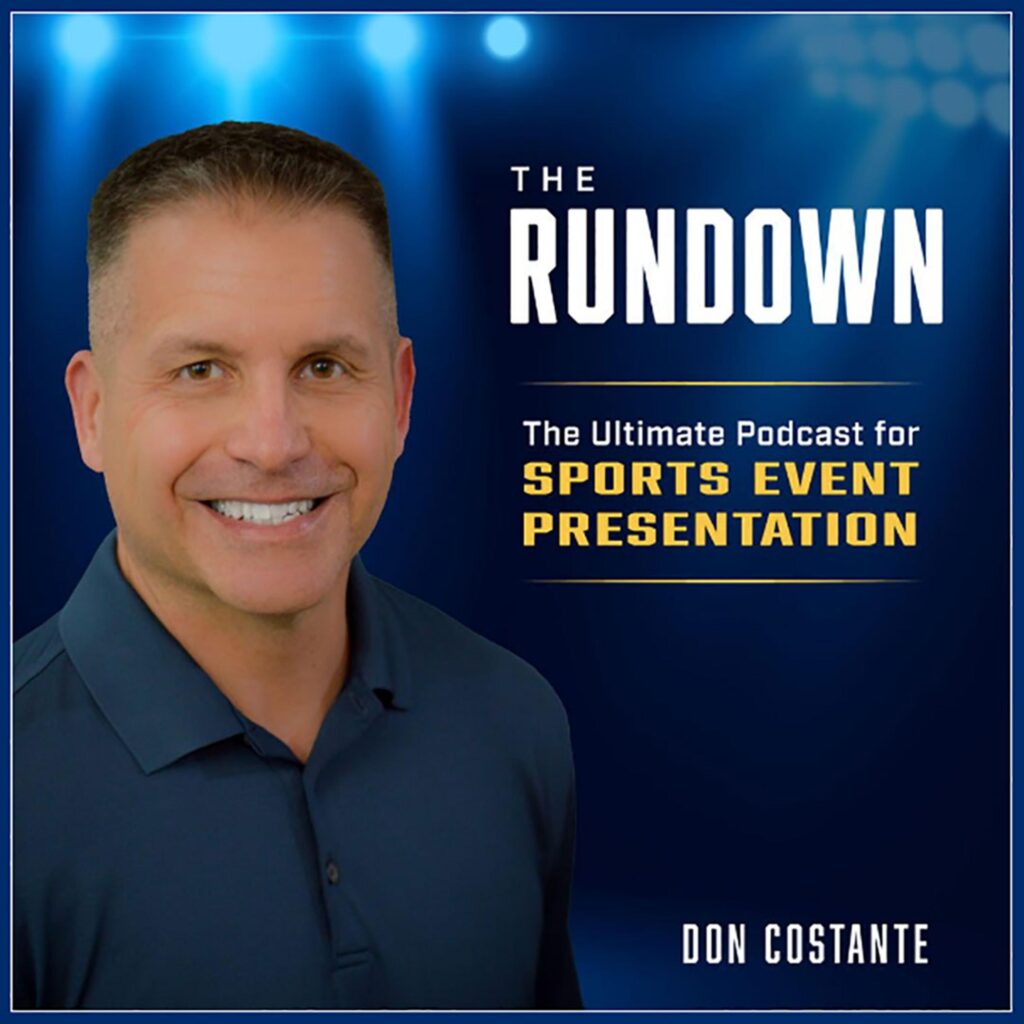
In this special episode of The Rundown, the table is turned as host Don Costante takes the hot seat to share the story behind his new book, Beyond the Scoreboard: The Ultimate Guide to Sports Event Presentation. Hear how three decades of experience turned into Sports Business Journal Publishing’s first book, and why it’s a game-changer in the sports industry.
Transcript
The transcript below has been lightly edited for readability and clarity. Click any starting timestamp to jump to that exact point in the YouTube video.
Podcast Introduction
[00:00] Don Costante:
Welcome to The Rundown Podcast, hosted by Don Costante, a nationally recognized event presentation expert with over 30 years of experience and author of Beyond the Scoreboard. This podcast takes you behind the scenes with industry leaders to unpack the insights, strategies, and creative tactics that drive unforgettable live experiences. Let’s get started.
Chris Miles Takes Over The Rundown
[00:26] Chris Miles:
On this episode of The Rundown Podcast, oh, the voice throw you off? Well, it’s none other than the very first guest of The Rundown Podcast, yours truly, Chris Miles. And man, do I have a special guest today as the co-host of The Rundown Podcast. We’re going to be interviewing the author of Beyond the Scoreboard, the ultimate guide to sports event presentation. Now, what qualifies this person to write a book? Well, over his career, he’s directed, produced, and managed more than 3,000 live sporting events, including three NBA Finals, two World Series, 12 NBA All-Star Jam sessions, and countless special events that have captivated millions of fans. Literally millions of fans. While with the San Antonio Spurs, he produced, and directed over 1,100 MLB games, including the 2014-2015 MLB postseasons, and led the production of the 2015 World Series City Celebration, which drew over 800,000 attendees. As president of his own sport and event management company, he’s worked with global brands such as Manchester City Football Club, Derby County Football Club, Milwaukee Brewers, University of Kansas Athletics, Connecticut Sun, Major League Baseball Special Events, University of Texas Athletics, and NASCAR Event Experience to deliver innovative, impactful event presentations. This extensive experience has given him to create unforgettable event experiences across the sports and entertainment industry.
[02:09] Chris Miles:
Ladies and gentlemen, it’s my pleasure to bring to you the author of Beyond the Scoreboard, the ultimate guide to sport event presentations, none other than Don Costante, the actual host of the Rundown Podcast. Don, welcome to your own show.
[02:25] Don Costante:
Thanks, Chris. That’s quite an introduction. I never would have thought I would be introduced on my own show like that.
[02:34] Chris Miles:
Well, I figured you didn’t think you’d be introduced that heavily, but I wanted to give you all your gusto, all the accolades you so well deserve.
[02:43] Don Costante:
Thanks, Chris.
[02:44] Chris Miles:
Of course. Listen, this is beyond exciting for me, not only because I’ve known you forever, but I am on you. I’m the only other host that’s ever been on this podcast, and it’s apropos, since I’m pretty much the host of Don Costante and Costante Group. So I’m excited to be on here. I’m looking forward to talking to you about the book. And listen, let’s just get into it right here.
[03:10] Don Costante:
Well, before you get into it, Chris, I got your first correction of the day is that you’re not the only host on this podcast. Ahmaud from Cleveland was on this podcast as well.
[03:19] Chris Miles:
Oh, no, Ahmaud wasn’t. Oh, Ahmaud wasn’t. Hang on here. Listen, first of all, I love Ahmaud. We had such great time in Cleveland.
[03:28] Don Costante:
We did.
[03:28] Chris Miles:
For the Major League Baseball All-Star weekend there. And what a true host of the city he was.
[03:35] Don Costante:
He was. So that was a good time.
[03:36] Chris Miles:
Oh, my goodness. Well, listen, obviously, we’ve known each other forever. We’ve had some incredible experiences, you know, even just reading about the 2015 World Series City Celebration just brings back so many memories, man, of being in front of that crowd during that time. But we’ll get to that in a second. It was just an exciting, exciting time for us. I got to do what you do to all your guests. I want to take you all the way back. I want to learn about Don Costante.
Getting to Know Don Costante
[04:04] Don Costante:
Oh, gosh. So who are you? Where are you from? Where are you born? Tell us. Okay. I was born in New York.
[04:10] Chris Miles:
Whoa, whoa, whoa, whoa. Seriously?
[04:12] Don Costante:
I don’t think I ever told you that. I was born in New York.
[04:16] Chris Miles:
I thought you were born in Vermont.
[04:17] Don Costante:
Yeah, I lived in Vermont. But I was born in New York. I grew up in Vermont. Ended up going to Western Kentucky, University in Bowling Green, Kentucky, where I got a degree in marketing. I left that. My dad helped me get my first job working at Vermont Apple Orchards in Westminster Station. Vermont. So out of school.
[04:36] Chris Miles:
Hold on. Wait, wait, wait, wait, wait, wait, wait. This is all news to me. All news to me. Vermont apples.
[04:43] Don Costante:
Yep. Vermont apples. Selling apples and cider.
[04:48] Don Costante:
That’s how I started my career. Apples and cider.
[04:50] Chris Miles:
Come on, bro. Seriously?
[04:52] Don Costante:
Yeah. No matter how much I love apples and cider, I knew that wasn’t going to be my passion. But I enjoyed the experience anyway.
[04:59] Chris Miles:
All right. So tell us about Vermont Apple. Tell me about Vermont Apple.
Vermont Apple Orchards and Michael Eisner
[05:03] Don Costante:
Well, again, what made that a unique opportunity is, yes, I was getting experience specifically in sales, but it was actually owned by somebody you’ll know. It was owned by Michael Eisner’s family from Walt Disney World.
[05:20] Chris Miles:
Disney Michael Eisner, bro.
[05:22] Don Costante:
Yeah. So his mom lived on the farm with their dog. Yep. With their dog, Pumpkin. And she would come in routinely. But what was really cool is Michael Eisner would make a visit, you know, every once in a while at the farm. And what was awesome about that, I’ll never forget the first experience. They told me he was coming in. I was getting really nervous because Michael Eisner, I mean, at the time he was one of the top five CEOs in the world. And so here he is, he’s coming in and they said, yeah, he wants to meet you. And I was getting a little bit nervous. And the advice they gave me was whatever you do, when you talk to Michael, look him in the eyes and do not look away. Do not look away because if you do, he’s going to get up and walk away. So here comes Michael. He walks in. He comes over to my desk. I’m nervous. He sits down, introduces himself. Now, this guy knew everything already about me. I mean, this is a top five CEO in the world. And he’s done homework on me. Little old Don, you know. So I’m sitting there. All I’m thinking about, Chris, is stare him in the eyes. You know, just look at him. And I don’t know if you’ve ever been in that situation when you start thinking about blanking. But I felt like I felt stupid because I felt like my eyes were watering. Like, am I blinking?
[06:39] Don Costante:
Am I staring them in the eyes? And of course, I had individuals walking by trying to divert my attention to get me to look away. But man, it was awesome. It was a great experience. And then.
[06:49] Chris Miles:
So wait, what? So let me ask you, what year was this, if you can recall?
[06:52] Don Costante:
Gosh, I graduated in 92. So it was probably just shortly after that, somewhere between 92 and 93.
Chris Miles’ Michael Eisner Story
[06:58] Chris Miles:
So let me tell you my crazy Michael Eisner story. I worked for Disney. I moved to Orlando in March of 90, worked for Disney for two years. And I met Michael Eisner. And what was crazy, we had name tags, obviously. And you used your first name. And everybody was to be called by their first name. And Michael was the same way. But people would, Mr. Eisner, Mr. Eisner, when he came around. And so this is 1990 for me, roughly around, I’d say May, May or June of 1990. And so I had to take him around Disney. I was working at the Disney MGM Studios at the time. And I took him around. And I was calling him Michael. And everybody was like, why are you calling Mr. Eisner Michael? Because that’s on his name tag. We’re a first name company. Nobody could believe it. But he appreciated me. He literally said, hey, I appreciate you calling me by my name. That’s my name, Michael. And he says, that’s how we are around this company. And that was really my only interaction with him. But that’s crazy that you and I both have a connection. I mean, the world is so small. That you and I would have a connection with Michael Eisner like that. That’s just insane to me.
[08:08] Don Costante:
That’s wild. The big joke with my wife is that she worked for Disney for many years as a character. But never met Michael Eisner. So I would look at her and say, you know what? You worked for Disney, but I met Michael. So I went.
[08:19] Chris Miles:
I am today years old. I am today years old learning this. Very cool. Very cool story. All right. Continue on. Continue on. So after Michael. So then where do you go after Michael? I mean, what do you do?
Breaking Into Sports
[08:29] Don Costante:
I went to NC State. I went there as an intern. I gave up a full-time job to get into sports. And I was an intern in the athletic department and enjoyed it. I was there for about a year and maybe a year and a half. I got moved up during that time to an assistant director of marketing. But sometimes I think the mindset is if you come in as an intern, people will always look at me like as the intern. So the only way to move up sometimes is to move out. And I moved out and went to the University of Memphis as director of corporate sales and marketing. And it was an interesting time in the industry because multimedia rights holders were just purchasing properties, but they hadn’t purchased Memphis. So it gave me that corporate sales experience in addition to marketing and game ops. And probably about a year and eight months after that, an opportunity came about with the San Antonio Spurs. And this one’s interesting, Chris, because, you know, I’d gotten calls about, you know, other sales opportunities with other professional teams. But this was the first that was specific about game operations and promotions. And so it was a crossroad for me. Do I stay with marketing and corporate sales or do I go more game ops storytelling?
University of Memphis and the San Antonio Spurs
[09:39] Chris Miles:
And so before then you had no prior experience to game operations.
[09:44] Don Costante:
Well, I mean, in college working at NC State and Memphis, I did game ops and I had an idea, but obviously now we’re talking about a whole new level in the professional rank. So I said, let’s do it. And so we moved to San Antonio and it was during the 1999 NBA playoffs. It was amazing. One day I’m sitting in Conference USA at a baseball game and the next day, pretty much I’m at the NBA Finals. So I was there with the Spurs for seven years. What was great about that is I was a part of not only the Spurs, but they ended up taking on two additional franchises as they moved from the Alamodome into the SBC Center. They took on Rampage, hockey and Silver Stars WNBA team. And so I had the opportunity to do all that in addition to the building events. So I stayed there for about seven years, ended up leaving, starting my own company with Kistani group. And not too long after that, an opportunity became available with the Kansas City Royals. And with that opportunity, they allowed me to continue to do my consulting work with Kistani group. And so you don’t get that opportunity too often. So I went as senior director of event presentation and production. And did that for about 14 seasons. And so it was maybe just after the pandemic that I ended up leaving the Royals and going full-time with Costante Group where I produce and direct and help organizations to elevate their
Costante Group and the Kansas City Royals
[11:11] Don Costante:
events.
[11:12] Chris Miles:
Brilliant. Brilliant. All right. So that leads us to the book. Clearly, I gave a plethora of experience that you have achieved over at least a three decade career so far. That totally gives you the credibility to write the book. And something that’s even more interesting, this is the first book being published by Sports Business Journal Publishing. So clearly, clearly they saw something of a need to really help accentuate what you’re trying to expose here with event presentation. So what is the actual why? What is the why behind the book?
Why Don Wrote Beyond the Scoreboard
[11:50] Don Costante:
Yeah. So, you know, this is something that’s been in the making for years. I actually started writing it many years ago before my daughter was born and I kind of just put it off to the side once she was born. And my wife’s like, you should finish this book that you started. It’s so needed. And she’s right. And so I spent the summer and completed it because in our industry, in the sports industry, everybody talks about the digital aspects or the production, social media, marketing, sponsorship, so on and so forth. And they do talk about the game-day experience is important, but there’s never been a book or a class that really educates people on how to do that. Right. In most cases, like in my case, growing up and coming through the industry, you know, when I was at NC State, I got there and I had to learn on the fly. I didn’t really know what’s this game operations. What am I doing? Player intros. Okay, well, I’m going to learn as I go. And I think that in a lot of cases, there’s a lot of organizations that do a great job, but there are just as many that are struggling because they have young professionals or professionals in positions that don’t really have an understanding for what event presentation really means and what it entails. They basically have inherited what was already in place.
[13:14] Don Costante:
And so they’re going forward with the status quo. And it takes a long time to move the needle in innovation and creativity in those kinds of environments because it takes years to realize, oh, I’m not doing this right. We should be doing this differently. But in a lot of cases, those people move up and move out. So I thought it would be great to have a book that levels the playing field. It provides a standard. It educates everybody as to what are the core principles of event presentation. What should we be thinking about? And that’s what it is, Chris. It’s not about saying this is the only way to do it. What I’m doing here is I’m providing a benchmark, a starting point, and a standard where if you do follow what I’m providing, which is a direct guide, it’s going to raise the bar. And it allows you, though, to customize everything specific to your organization to even elevate it that much further. So I’m providing a standard that has never been there before, a starting point.
Learning Through Experience and Mentorship
[14:13] Chris Miles:
So, Lily, I got to stop you. I got to stop you right there. And I’m sorry to interject. I really am. But here’s what I also want to say, because I can say this authentically from a personal standpoint and a professional standpoint. Having worked with you, I think our first deal was 2005 in Denver NBA All-Star Jam Session. And we worked together until 2014. New Orleans was my last. 2005 or 2003? 2003 was Atlanta. I wasn’t center court then. That was Scotty B, if you remember Scotty B. Yes. He and I did not go center court until 2004, which was L.A. And then you and I, our first engagement, I think, together was 2005 Denver. But what my point is…
[14:57] Don Costante:
No. What my point is…
[14:58] Chris Miles:
You’re wrong, Chris.
[14:59] Don Costante:
You’re wrong.
[15:00] Chris Miles:
No.
[15:00] Don Costante:
Yeah.
[15:01] Chris Miles:
When was it? When was it?
[15:01] Don Costante:
It was four in L.A. It was probably the most exciting jam session we’ve ever done with all the celebrities.
[15:08] Chris Miles:
Well, listen, I will 1,000% agree with that. That was the first one?
[15:12] Don Costante:
Yeah.
[15:12] Chris Miles:
Okay. Dude, that was so chaotic. So, fans, bear with us for a second. Here’s the listeners here. In 2004, the NBA All-Star went to Los Angeles. Kobe, Shaq, Prime. I mean, just think of the NBA in 2004. And the celebrities that wanted to be associated and connected. So, we had the skills challenge. We had celebrities galore. I mean, who were at their elite top level at that jam session. And that really, Don, if you want to know the truth, I think that’s what set us center court apart from everyone else.
[15:49] Don Costante:
No question.
[15:49] Chris Miles:
I will give you credit because the NBA gave you total leeway. That was when DJ Irie, the Miami Heat, and myself, we were clicking on all cylinders. It was just a phenomenal, phenomenal experience. So, I digress. So, let me go back to what I was going to say about you and the fact that you wanted to write this book to help people. What I want people to understand, firstly, is you were an open book beforehand. In fact, you would ensure that every event you did, you would have interns for you. You would ensure that they had access to you, all access to everything. And you wanted to give them the full-on experience of whatever the event was. So, I can appreciate more so this from a personal standpoint because I saw how you interacted with folks. And as a professional, how you wanted to ensure that people knew how it was done properly. So, the book, folks, is just an extension of who Don already was because every event we did, we had interns galore. And he ensured that they took on roles and responsibilities that he had. And so, this book is just an extension. And I can honestly say it is exactly who he is and has been to the core. So, I wanted to express that, that this book just didn’t happen. It was just something of who you are. It’s just an extension of what you already practice in your profession.
[17:17] Chris Miles:
So, I commend you for that.
[17:19] Don Costante:
Well, I appreciate that. Thank you.
[17:20] Chris Miles:
So, I appreciate you giving us the why and the recollection of where you were in 2004. It was awesome. So, now we know the why. Do you feel that this book can inspire anyone? Or who do you feel the audience is for?
Who Beyond the Scoreboard Is For
[17:35] Don Costante:
There’s actually four primary groups or target markets for this book. I think it’s important to educate young professionals coming up that are going to be the future leaders of our industry, students out there who are currently in sport management or just interested in working in sports and the professors who are teaching. And I think this is a great resource to give students the opportunity to get a really good understanding of what this industry is about and what this specific area of the industry is about. I mean, I’ve had many people, Chris, over the years come and job shadow me when I was with the Royals, the Spurs, and even doing other events. And, you know, I always get one of two reactions. It’s either, wow, I had no idea what goes on behind here. Or, you know, others will say, this is too much. I don’t want anything to do with this. But I think the important thing here is that the reaction just illustrates it’s not something that’s taught. And I think that a lot of people come in with the ideas. They see the glamorous side of it. Oh, you get to be at games and you get to produce and direct and do all these great things and be next to or work with the players. But they don’t understand all the logistics and the behind the scenes stuff that needs to take place to get there.
[18:48] Don Costante:
And I think this book is a great way to educate them. And it brings it all together. And it takes theory that they’re learning in school and it transforms it into practical execution. So it’s a guidebook that really outlines that, gives a clear picture for the students who are reading this. So they’re much better prepared and in a position to be put into roles coming out of college. Because they have a much better understanding. Now, the second group are the professionals that are currently in event presentation. Whether it’s the director, the coordinators, the interns. A great opportunity. Yes, a great opportunity to learn and to see what has been done or what strategies and tactics maybe I use that maybe they can adopt. Sure. There are a lot of organizations out there that do a great job. Okay. But there are just as many that are struggling. And so great opportunity to read this book to raise the bar of your current event presentation. It will showcase maybe some pain points that you’re currently having and how to get through those. Provide the solutions, right? And for those that are doing well, it’s going to give you some additional strategies and tactics, as I mentioned. But what’s so good about this book is it’s going to help level the playing field to help organizations out there to elevate their event presentations.
[20:05] Don Costante:
And then take what I’m providing and customize it so it’s their own spin. And I think that’s going to be very helpful for this community in the event presentation space. And then the third group are the leaders. The leaders who oversee the event presentation department. In most cases, I’m not saying all, but in most cases, the individuals who oversee the event presentation department have never worked in that department. They’re VPs of marketing or whatever, and they have an understanding, but they have never really walked the walk. And so this book, by having it, they get a full in-depth look as to the inner workings of what this department is made of, what they should be thinking about, and provides the terminology and the direction to help steer that department in a direction that is going to accomplish the goals and objectives of the organization. And I think that if nothing else, it helps to make those leaders better managers to help manage those individuals in those roles. And I think the last group, the fourth group that I wrote the book for, there are so many fans out there who love the behind the scenes type of stuff. And so here’s an opportunity where I pull the curtain back and allow people to see the behind the scenes, what goes on to put on a game-day. And so I think it’s interesting.
[21:23] Don Costante:
I always liked that. And so I wanted to be able to provide this book as a snapshot as to what really goes on because people have no idea, no idea what’s all involved to make that game come to life.
[21:35] Chris Miles:
Perfect. Come to life. What game, what event did you go to, whether it was a child or whatever sparked your imagination? Yeah. What game came to life for you? What event came to life for you that you were like, wow, this is different. Like for me, you know, I’m into racing, as you know. So the pageantry of the Indianapolis 500, as soon as they released the balloons, you know, that used to be the big thing of the releasing of the balloons before the start of the race. And then I think the Harlem Globetrotters, right? That was a game that just gave you something. It was just a lot of action and entertainment. What game or event sparked your interest to really want to do the best at it?
The Event That Shaped Don’s Philosophy
[22:21] Don Costante:
Yeah. I had already been working. I had worked at NC State. I was at the University of Memphis on vacation in Orlando with my wife. And I’ll tell you what, Chris, I truly believe things happen for a reason. But I was given two tickets to attend an Orlando Magic game. And again, I’m on vacation with my wife and she’s not necessarily the biggest sports fan. And this is a time when it was Shaquille O’Neal and Penny Hardaway. So you know how big these tickets were. And my wife was like, heck no, we’re not doing that on our vacation. And so I convinced her to go and she went and wasn’t very happy about it. But she was happy that, you know, I was enjoying it. But by the fourth quarter, guess what, Chris? She was standing and having a great time. She was yelling for the t-shirts that were being tossed by the interactive squad. She was dancing to the music. She had such a great time. But at the end of it, she looked at me and said, you need to get a job in the NBA. And that game, Chris, I give credit to Pat Williams and their staff at the time. They did a phenomenal job. I mean, I was coming from the world of college athletics. And so now I was seeing my first professional game and it blew us away.
[23:28] Chris Miles:
And what year? I’m pleased to give me. What year was this?
[23:30] Don Costante:
Oh, gosh. Let’s see. I told you I graduated in 92. Then I went to NC State. It’s probably in about 96, 97.
[23:41] Chris Miles:
Dude, that’s wild. Again, the intersection of you and I. I was in Orlando at that time, connected with the Orlando Magic heavily at that time. It just boggles my mind, our intersection. Awesome. So go ahead. Keep continuing. Continue, continue. So Beth is the one that said, you got to get a job in the NBA.
[24:00] Don Costante:
Yeah, and I did. And the funny thing is, so did she. So we both ended up working at the Spurs shortly thereafter. That’s probably the one event that shaped my philosophy moving forward.
[24:12] Chris Miles:
Interesting. Very cool. So you have gone to Gamble. You have worked in professional sports. You’ve worked in collegiate sports. Let’s run through the book briefly. But there’s 13 chapters here. I have a particular one. But there’s 13 chapters. Share quickly with the listeners the chapters. What’s important?
Inside the 13 Chapters of Beyond the Scoreboard
[24:31] Don Costante:
Yeah, I’ll just go through this really quick. And in chapter one, I’m defining what event presentation is and its challenges. I mean, a lot of people don’t even know what event presentation is all about. So I define it. In chapter two, I get into establishing your philosophy. It’s so important because it’s the root of all your decisions moving forward in your event presentation. In chapter three, I then take you into building that event atmosphere to use your funds to create the atmosphere that you’re looking for. And then in chapter four, I talk about managing your event presentation inventory, which is critical. And then chapter five, I talk about designing a strategic event rundown. This is the most critical document for communication purposes on your event days. And in chapter six, I talk about the communication aspects. Communication, communication, communication. So important. So I go into the documents and the types of meetings that you need to have to be successful. And then in chapter seven, I talk about the event director. I talk about what their mindset should be. I talk about their role. I talk about ways of gaining experience. And when you’re out there looking for somebody, what are the key traits that you’re looking for? So I go into all of that. In chapter eight, it’s about staff.
[25:45] Don Costante:
How do you build your game-day team? I get into recruiting and training and all of the particulars to help you develop the right staff for your events. In chapter nine, I get into the entertainment resources. I talk about the traditional entertainment resources that are available to most organizations. And I also, in this chapter, go over what I believe to be the five common mistakes made with entertainment resources. In chapter 10, I get into promotions. How do you get the most out of these? So I provide the standards and the criteria for successful promotions. And I go into great detail as to how to create the type of promotions that are engaging and effective. In chapter 11, I get into the team introductions. For me, and I know for my wife, one of the most powerful moments and one of the moments that we want to be in the seats for is player introduction. So I go into how to create an ideal player introduction. I actually give a formula for people to follow and to customize and make it their own. In chapter 12, I get into, you know, the digital production aspects of this. How to use your digital boards to create the most impact. And then the last chapter, in chapter 13, I talk about the power of music. Music is one of the most powerful resources that you can use to elevate any event presentation.
[27:03] Don Costante:
And it costs very little to do that. So those are the 13 chapters that I cover in my book.
[27:08] Chris Miles:
And honestly, I think chapter nine, there’s just a name in there on page 119. Chris Miles, my trusted longtime host, you know. So, yeah.
[27:19] Don Costante:
Did I put that in there?
[27:20] Chris Miles:
No, it’s in there. It’s in there. Page 119.
[27:23] Don Costante:
Yeah, it really is.
[27:24] Chris Miles:
Chapter nine. So, actually, thank you for that, by the way. Very, very nice of you to have done.
[27:28] Don Costante:
Yeah, you’re welcome.
[27:29] Chris Miles:
Yeah. So my question now is, where do you see sports presentation going in the future? Or at least in the next five years?
The Future of Sports Event Presentation
[27:40] Don Costante:
Well, I think more than anything else, technological advances is going to reshape how people experience coming to live events. You know, you have augmented reality. You have projection mapping that’s going on. A lot of these technological advances, though, are cost prohibitive.
[27:56] Chris Miles:
Right? Right.
[27:56] Don Costante:
It’s not realistic for a lot of organizations. But the one technology out there right now, it’s only exponentially getting better is AI, right? AI is going to, or it is, reshaping many aspects of event presentation. And what I mean by that, from content creation to real-time decision-making, it’s going to allow teams to personalize experiences more than ever. Curating music, promotions, and it’s going to allow them to create content based on fan behavior. But Chris, what’s important, though, while technology is going to enhance the overall toolbox for event presentation, it’s never going to replace human creativity or intuition and the ability to read a crowd. That magic, that still comes from people for now.
[28:40] Chris Miles:
No, I get it. Dude, what I love also is when you talk about this, seriously, the energy, the enthusiasm, the passion you have, I’m glad you were able to captivate that in a book because people really miss out. I mean, I’ve had the joy and the pleasure of working with you and us being friends for over 20 years crazily in this business. And so it’s been a joy to see your growth because I’ve seen your growth as a professional in this industry. And so I love the fact that you put this book together. So last question, I’m just going to make this the last question.
The Biggest Takeaway: Presentation Matters
[29:13] Don Costante:
Okay.
[29:13] Chris Miles:
What is the takeaway? If there is one takeaway you want a listener, someone in the business to take from this book, what is the one takeaway? You put your finger on it and say, boom, this is it. What’s the one takeaway you want of the book?
[29:28] Don Costante:
Two words, Chris. Presentation matters. Period.
[29:32] Chris Miles:
Oh, right. Listen, yeah.
[29:36] Don Costante:
No, great game atmospheres. Don’t just happen. Chris, they’re created. It takes planning, attention to details, storytelling and execution to create an unforgettable game-day experience. And I think that if there’s one thing I want people to walk away from this book, understanding is that presentation matters.
[29:56] Chris Miles:
There you go. That’s it. Don Costante. I hope you’ve enjoyed being a guest on your own show. So before we go, where do we get the book? Tell us everything.
Where to Find Beyond the Scoreboard
[30:07] Don Costante:
Yeah, man. Right now, Amazon, Barnes and Noble and any major retailers, you can get this book. But if you want more information, come to Costante Group dot com. C-O-S-T-A-N-T-E-G-R-O-U-P dot com.
[30:20] Chris Miles:
There it is. That is Don Costante of The Rundown Podcast, the host, the curator of The Rundown Podcast. His book, Beyond the Scoreboard, The Ultimate Guide to Sports Event Presentation. I’m your host, Chris Miles, signing off. Till next time.
Podcast Closing
[30:38] Don Costante:
That’s a wrap on this episode of The Rundown. Have a question or want to share your thoughts? We’d love to hear from you. Just email TheRundown@CostanteGroup.comEmail The Rundown. Also, be sure to subscribe, share the podcast and follow us on LinkedIn and Instagram. On behalf of Don Costante, thanks for listening. Until the next time, this is The Rundown Podcast.
Explore Seasons
Find us on your favorite platform
Listen to the latest episodes and stay updated!
Find us on your favorite platform
Listen to the latest episodes and stay updated!
More Episodes