Transitions are part of every sports career — joining a new organization, stepping into a different role, or adapting to a new culture. In this episode, Darius Smith, Senior Director of Game Presentation and Entertainment for the Washington Commanders, shares five strategies for approaching new opportunities with confidence, clarity, and creativity. Drawing from his experience with both the Commanders and the Minnesota Vikings, Darius offers practical insights for building momentum, earning trust, and making an immediate impact in a new environment.
Season 3 • Episode 4
Building Momentum: 5 Strategies for Transitioning into a New Role
Featuring Darius Smith
Transcript
The transcript below has been lightly edited for readability and clarity. Click any starting timestamp to jump to that exact point in the YouTube video.
Podcast Introduction
[00:00] Don Costante:
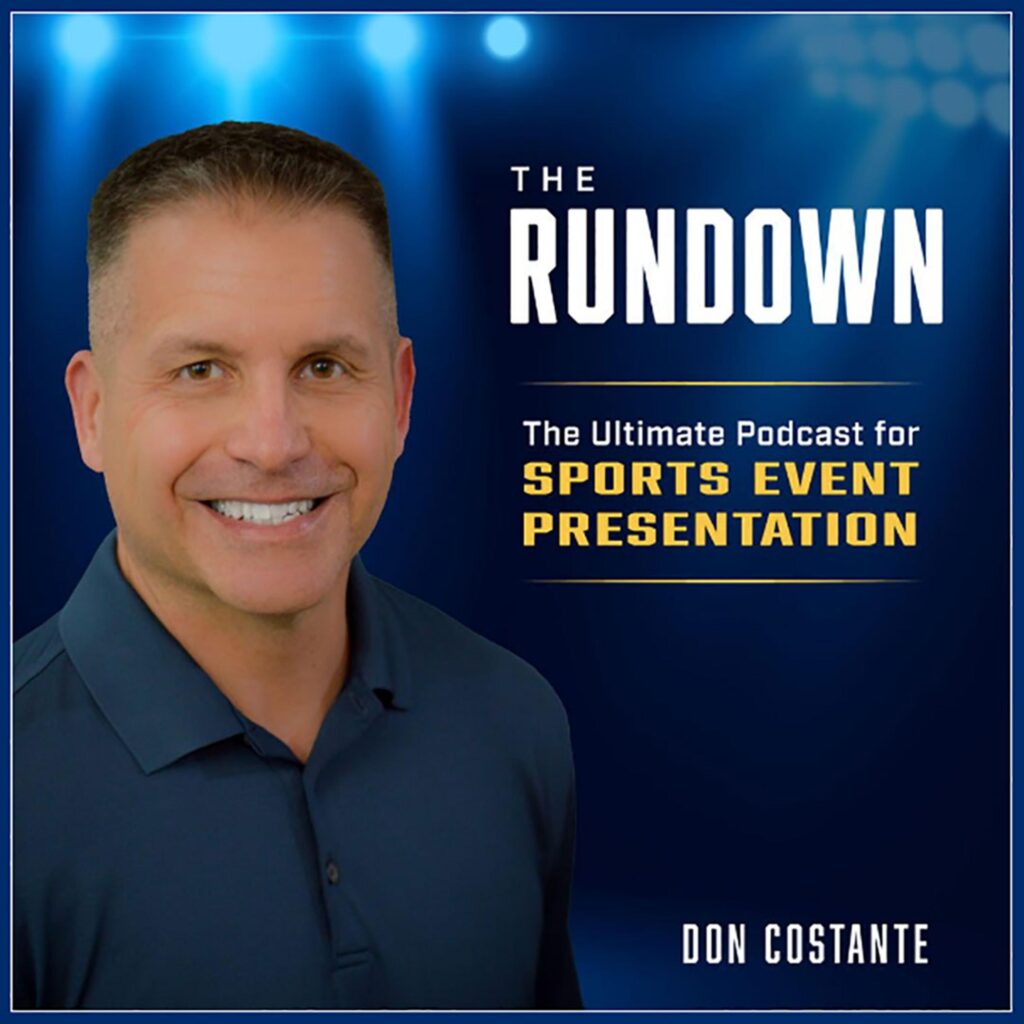
Welcome to the Rundown Podcast, hosted by Don Costante, a nationally recognized event presentation expert with over 30 years of experience and author of Beyond the Scoreboard. This podcast takes you behind the scenes with industry leaders to unpack the insights, strategies, and creative tactics that drive unforgettable live experiences. Let’s get started.
Building Momentum: Five Strategies for Transitioning Into a New Role
[00:27] Don Costante:
In sports, we all face professional transitions, moving from one organization to another. You know what I’m talking about, stepping into a new role or adapting to a new culture. These moments can be both exciting and challenging, and how we navigate them often shapes our long-term success. My guest today has experienced those transitions at multiple levels across collegiate and professional sports. Darius Smith, Senior Director of Game Presentation and Entertainment for the Washington Commanders, has built quite the reputation for creating some of the most engaging in-game experiences in the NFL. Before joining Washington, he brought his talent, leadership, and creative vision to the Minnesota Vikings, where he helped to elevate the fan experience to new heights inside U.S. Bank Stadium. And that brings us to today’s episode, Building Momentum, Five Strategies for Transitioning into a New Role. We’ve all been there. And today, Darius shares the strategies that helped him to successfully step into his new position with confidence, clarity, and creativity, all while building trust with his staff and making the key adjustments that drive early success. I’m ready to get started. Let’s meet Darius Smith. Hey, Darius, thanks for joining me on the rundown.
Meet Darius Smith
[01:51] Darius Smith:
Hey, Don. Thanks for having me. Excited to chat.
[01:54] Don Costante:
I don’t know how long it’s been. I think it was, gosh, 2013. You and I actually worked together. And seeing where you are now, I see that I didn’t mess you up too bad.
[02:07] Darius Smith:
No, not at all. Well, it’s funny how things work because even though we haven’t worked together in a long time, I feel your presence every game that I work just because I keep the strategies and the information close to my heart. So you are a very big part of where I am now. So I couldn’t thank you enough. And happy to dive in and share some of my learnings along the way.
Darius Smith’s Career Journey
[02:31] Don Costante:
Let’s start off with your career journey. You’ve worked with multiple organizations. So talk about your journey and how you ended up in your current role with the Washington Commanders.
[02:43] Darius Smith:
Absolutely. So I really got into it in college. I went to the University of Virginia. I joined their athletics, marketing and promotions department as a second year or a sophomore, as most colleges say, and really just kind of fell in love with the fan to fan interaction and how you can control an audience and knew that I really wanted to pursue this path full-time. As a lot of people know, it’s not as easy or as linear as some people may want. So you run into your trials and tribulations along the way, but was very fortunate to head out to Kansas City and join you with my first internship out of college in 2013. Full transparency. I knew absolutely nothing about Kansas City. I knew absolutely nothing about the Royals, but you painted a really good picture for me. And it just turned out we had a deep World Series run that year. So got a ton of experience, both on like a game-by-game point of view, but also just with the national broadcast side of things. After the internship, I was fortunate to continue to work with you for a couple of years and working some of the NBA All-Star events, the NAIA tournaments. And I really think that’s kind of the foundation of where I really started to put the pieces together for live production and entertainment. And so after those kind of opportunities with you, I was able to land my first full-time job as a coordinator of entertainment with the Minnesota Vikings.
[04:14] Darius Smith:
It was a great opportunity for me in the fact they were opening a brand new stadium, hosting a Super Bowl, hosting a Final Four. And they were really looking to take their game presentation to the next level. So I started there in 2016 and ended up working my way up to associate producer, senior manager of game presentation. And then that ultimately kind of transitioned into the role that I have now. So life happens. My wife and I, we had our first child and wanted to be closer to family. And I decided to kind of prioritize that. So ended up leaving the Vikings, which was a really tough decision. We were doing a lot of great things. We had one of the top shows in the NFL and ended up moving back to Virginia to just kind of start raising my family. The next year, the commanders reached out about a new position that they were opening as a senior director of game presentation as they kind of looked to usher in the next era of their programming. And they reached out to see if I was interested. It turned out to be a great fit. So I’ve been here for two years. This is my third season and we’re going strong over here.
[05:22] Don Costante:
That’s awesome. Now, I’m going to ask you a question. I don’t want you to give away anything that you’re going to be talking about with your strategies. But what were some of the key takeaways from your early experiences that shaped how you approach leadership and event presentation today? I know you mentioned the time spent working some of the events with me, with MBA and also with the NAIA. But maybe there were some others.
Early Lessons in Event Presentation and Leadership
[05:44] Darius Smith:
Yeah, I mean, I think in this industry, you become fortunate to really learn from great people across the board, whether they’re your bosses or mentors. So I’m the type of person that really wants to be a sponge and kind of take something from everybody that I cross paths with. Starting with you, I feel like when I talk about the foundation of game presentation, I learned a ton about just the timing, how you transition from one element to another, how you should execute, what your camera shot should look like, how you stack and program a show. Really, really the core philosophies that go into producing a live experience. How do kind of the video board elements mesh with the live elements? How do you use entertainment and situational momentum to kind of tell that story? So I had a lot of that just kind of in my back pocket and had gotten really good in my early days to where in Minnesota, that was actually not something that I needed to pull out a lot. It was really the creativity and the innovation side of the industry. When you have your core principles and you know how to execute a show like the back of your hand, then you can really start to leverage emotions and how you tell stories and how you engage an audience. And how does live entertainment and music fit in with this? How do you leverage celebrities, special effects, the theatrical side of the show?
[07:15] Darius Smith:
So it was really a combination of both worlds that really formulated kind of where I’m at now and how I can use the core principles of execution of a game with the innovation and the creative pageantry side to put together a cohesive show.
Developing a Leadership Philosophy
[07:33] Don Costante:
So that’s how it shaped your event presentation. Just briefly, how did it shape your approach to leadership?
[07:39] Darius Smith:
I think when you’re not in a leadership position, you tend to think about how you like to be managed. And I’m the type of person that I didn’t necessarily like the micromanaging side of things. I like to create within boundaries. I like to be able to kind of report up and then obviously we want to take feedback and be good at taking feedback. So a lot of those core principles are kind of like what led me to my leadership philosophy in terms of I want my creators to be able to create within their world. There’s not really a straight line path to what we do. There are a number of different ways that you can engage an audience. There’s a number of different ways that you can tell a story and every creative has a different vision. And so for me, I really want to be able to allow those on my team, similar to how I came up to work within their lanes, be creative, push the envelope, don’t get stagnant in what we’re doing. Have a new show every week because you never know how many fans are coming on a game-by-game basis. And then really have clearly defined goals and communicate that so that everybody knows what we’re working towards and how we’re going to get there. So I think that’s really kind of what I learned along the way is just being able to have space to create and then follow up, tweak, get better.
[09:02] Darius Smith:
Mistakes are going to happen. Learn from the mistakes, take calculated risks, and then continue to develop as you move throughout on a game-by-game basis.
Darius Smith’s Event Presentation Philosophy
[09:10] Don Costante:
Now you’ve had success at both collegiate and professional levels. So now let’s shift gears. Let’s talk more about that philosophy that you have about event presentation. How do you define a great event presentation and what are your non-negotiables in your approach?
[09:26] Darius Smith:
Yeah, I’m big on the emotion of game-day and a lot of that comes through storytelling. And I think of it as a movie or as a book and the fact that you’re going to have your climax moments and you’re going to want to have a build to those climactic moments. And when those moments happen, you want to knock it out of the park. Then you need to give the fans a chance to breathe a little bit and catch their breath before we move into the next climactic moment. So for me, from a philosophical perspective, it really comes down to how can you leverage what you’re doing to tell a cohesive story from top to bottom. A lot of that will show up in pregame, especially around the pregame show, which I’ll talk about a little bit later. But that’s also in the context of the game itself. You want fans to be able to respond emotionally in a number of different ways. You want them to be excited. You want them to feel angry. And you can use that when you announce the visiting team. You want them to feel emotional. And you can do that by storytelling, whether it’s a really impactful military moment or a cancer survivor moment. You want that feeling. You really want to tap into the human nature side of people because at the end of the day, we’re all humans. We’re here to watch a sporting event, but we also care to be entertained.
[10:47] Darius Smith:
And so that’s really how I look to program kind of some of the shows that we do. And we’ve done a really good job, not only here with the commanders, but with the Vikings as well, of just weaving these different emotions through the game-day experience. And then you also just have to be really cognizant of your audience because, you know, you’re going to have your diehard fans who are there to live and breathe by the play on the field. But this is also a social destination. So you have a lot of families and more passive fans that want the social side of things. And so that’s really where the entertainment, the music, the programming comes into play. And that’s really how you can deepen the fandom for that individual, because they may come to a game just from a social point of view, but they have such a good time that now I want to come back and I want to bring my friends. Oh, I’m going to bring my kids. Now my kids become fans.
[11:43] Don Costante:
So that’s right.
[11:44] Darius Smith:
Really, that’s how you deepen the fandom through what we do is by creating these memorable kind of experiences that certainly amplify the game and the sport that we’re putting on. But they have that entertainment side that is just going to appease to a wide variety of people. I tell people all the time, it’s like, you know, we’re not competing with TV. We know how comfortable it is to sit on your couch and the drinks are cheaper and you’re not in the elements. We’re competing with the other entertainment destinations that are out there. So how would you rather choose your time? Would you rather go to a movie, a different sporting event, go to the theater, go catch a live show? Or would you rather come be entertained at a football game? And then naturally, we want to have such a good experience that they want to watch it in the building and they don’t want to watch it on their couch.
[12:34] Don Costante:
Yeah.
[12:35] Darius Smith:
Because, you know, that is always in the back of our mind.
[12:38] Don Costante:
I love that. That’s the foundation right there, Darius. What you just explained is exactly what sets the stage for success when stepping into a new role. And it also brings us to today’s focus. And that is your five key strategies for building momentum when transitioning into a new role. With that being said, Darius, what’s your first strategy?
Five Strategies for Building Momentum in a New Role
Strategy One: Use Preconceived Biases as Motivation, Not a Crutch
[12:59] Darius Smith:
My first strategy is to use preconceived biases as a motivator and not as a crutch. And what I mean by that is working in the NFL, you have an understanding of what other teams do. Working in sports in general, you have a general understanding of what other teams do from an entertainment and a game presentation perspective. And coming into the role here, I think I was very cognizant of the show that was in place and kind of some of the barriers that were set up here for the team before me. And so you really have to use that as motivation and not make excuses for yourself. And I think that starts at the interview process. I think as you’re going through the interview process, you have to realize that, you know, you want to make sure that this is a good fit for you as much as it is for the team or the company that’s looking to bring you on.
[14:02] Don Costante:
Absolutely.
[14:03] Darius Smith:
So you really want to make sure that you represent yourself well, you’re prepared and you’re able to speak to your experiences and why your experiences move the needle and how they can be transferable. But you also need to be curious and ask the questions so that, one, you have a little bit of knowledge if you do inevitably get the position. But two, you don’t want to go in and not be fully informed. I’m big on making informed decisions that translates to how we program our show, that translates to our strategies, but that also translates to just identifying what fits and what works for you in a career sense. So I think for me, I had a lot of, I guess, ideas as to what I was walking into. Some examples, you know, it’s an older stadium. It’s a stadium that is looked at as, you know, not one of the premier destinations in the NFL. And I just come from a brand new building with all the nice shiny toys that made it easy to program when you’re able to kind of have all of the best technology at your fingerprints. But I didn’t want to use the fact that we had an older stadium as a crutch. I wanted to be able to say, well, this is our stadium. We’re going to figure out ways to make it work. And at the end of the day, you can still entertain. You can still tell stories. You can still evoke emotions regardless of where you’re at.
[15:38] Darius Smith:
So the stadium was really one piece that, you know, you have to think about how you’re going to program to it. But you can’t use that as an excuse. Same with some of the foundational principles. So the way that the show was programmed, you know, it was a heavily sponsored show. There were a lot of notions about the branding just going through a name change a couple of years ago. You know, these are all things that you take into consideration that a lot of people may shy away from. But I looked at it as an opportunity. I knew that Josh Harris and the ownership group was on the horizon. And with that, I knew that there would be new expectations with the new owner or new team president, new leadership. There are going to be new standards across the board. And those are the type of standards that I wanted to live by. You know, I wanted to make sure that I could be a value add to this situation. And I’m going to put my energy into it because I’m passionate and I care about it. I can take some of my learnings across the way and we can figure out a way to kind of change the landscape and the perception of the commanders and of the stadium. And so that was a big thing for me is and especially as I would communicate to others is like, you know, sometimes you’re not going to have the best situation in the world, but you can make the most of that situation.
[17:05] Darius Smith:
And as long as you stick with what you know, you come in with a positive attitude, you learn as much as you can. You’re nimble, you can react on the fly, you can take in the situations, you can ask questions, you can leverage the relationships that you’ve made along the way to kind of get opinions on things. Those are all tools that you can have to maybe take a challenging situation and make it as an opportunity. So that’s really probably the first strategy that I wanted to call out.
[17:36] Don Costante:
I love that such a powerful way to start right there. So let’s go right into the next one, Darius. What’s your second strategy for transitioning into a new role?
Strategy Two: Evaluate the Current Landscape
[17:45] Darius Smith:
Yeah, so really, this is all chronological. And I think, you know, this is still top of mind to me, as I mentioned, this is still my second year with the team. So it is relatively fresh. And I think being able to kind of explain my thought process as I went through the interview process into the onboarding into my first 90 days and then ultimately where we sit now. I think these strategies will align with that nicely. So my second strategy, once you accept the job and you decide that this is the right fit at the right time, you start to get integrated with the team and things like that. You really, as a leader, have to evaluate the current landscape that you’re in. And so this is where the preconceived notions and the ideas that you hear about, they become a reality. And what you see on the surface may not actually be what’s actually happening. It could be better. It could be worse. And so you really need to early on think through and identify where you can start to make an impact while also learning and figuring out your best path forward.
[18:59] Don Costante:
Sorry to interrupt you right there, but what are you looking for right away when you’re evaluating the landscape?
[19:04] Darius Smith:
Absolutely. So it’s different for everyone. I started in July. So as you know, the NFL season, you’re starting to play preseason games in August.
[19:13] Don Costante:
Yeah.
[19:14] Darius Smith:
The regular season will kick off in September. So for me, I didn’t have a ton of time to come in and make a huge impact right away. Because one, I wanted to be able to learn and observe. But two, there was already a lot of work that was in motion. I mean, there was a lot of stuff that had already kind of taken flight that were moving. So you don’t want to get in the way and kind of derail processes. You want to be able to observe. So for me, it’s really trying to figure out the core principles of my responsibilities. So I wanted to learn the stadium. I knew from the outside what the stadium was, but I had never actually been here before. And it’s very different than what I had in Minnesota. And that’s, you know, outside of the age. But we have a grass field versus a turf in Minnesota. The lighting was different. In Minnesota, we could turn the lights on and off due to the LEDs that we had. Here, we still had the older lights that take 30 minutes to heat up.
Understanding the Stadium and Infrastructure
[20:15] Don Costante:
Right.
[20:16] Darius Smith:
It’s an outdoor stadium versus an indoor stadium. So you start to think through, what am I working with on just a physical infrastructure side?
[20:25] Don Costante:
Okay.
Evaluating Technology, Programming, and Entertainment Teams
[20:26] Darius Smith:
Then you start to think through the technical side. So I also oversee the production of the game as well as the entertainment. So what equipment do we have? What are the vendors that we’re using? What’s the state of the control room? What’s the state of the equipment? So that’s another big piece of the puzzle, just so you can familiarize yourself with what you have to work with. Then you kind of dive into the programming side. So what programming is already in place? What are we obligated to do for partners? What are the traditional moments? What are the things that, you know, we do every single game? What entertainment was already booked? So those are things that as you really start to evaluate the landscape, I’d say those are probably the big three. The fourth one for me was the entertainment team side of things. So, which was also very different from Minnesota. So we have the Command Force Dance Team, which is a integrated, almost hip hop mixed with the classical team where it’s very different than a traditional NFL cheerleading team.
[21:33] Don Costante:
Yeah, I love that.
[21:34] Darius Smith:
So that was new for me. Yeah. And very talented, by the way. So it was a lot of fun to get to learn about them and their skill sets and how we can weave them into the experience, which I’ll talk about a little bit later. We also had a marching band. So we are one of two NFL teams with a marching band. So learning how to use a marching band in an NFL capacity was very different for me. We had a drum line in Minnesota, but having a full 60-person marching band is not one of those norms that you’re accustomed to.
[22:06] Don Costante:
Yeah.
[22:07] Darius Smith:
And then how do you integrate them into the game? Yeah. So you have them. And now when do we use them? How do we integrate them into pregame? When does the band play? And then also just kind of the hospitality side of things. Like I want to push the envelope on entertainment. I want to push the envelope. Well, do we have a green room? Where do they sit? Those are the boring logistical side that I think all of us in this industry have in the back of our mind of, oh, we have all these ideas, but how do we actually execute it?
[22:35] Don Costante:
Yeah.
[22:36] Darius Smith:
And how do we actually make it work? So those are really the key landscape points that I wanted to identify.
[22:43] Don Costante:
Oh, I love it.
[22:44] Darius Smith:
And then the next big one is my next strategy that we’ll get into in just a second.
Strategy Three: Learn Your Team and Key Stakeholders
[22:48] Don Costante:
That’s awesome. So once you have a clear understanding of the environment, I guess the next step is all about people, the relationships that make the organization move. So that brings us to your third strategy. Darius, go ahead and tell us what that is.
[23:03] Darius Smith:
Absolutely, Don. So you mentioned it’s all about the people. And I think as a leader coming in and joining a new team right before the season, you really need to learn your team and the key stakeholders that you have both within the internal side of the business organization as a whole, but then also the external side. So for me, and like I said, every situation is different for me specifically, there were a number of new hires that were brought on to the game presentation and entertainment team prior to me joining. So there are some situations where you’re able to come in and then hire your team and kind of go from there. That wasn’t the case here. Full transparency. Full transparency. I think that was the best situation possible. We’ve got such a phenomenal team here. Oh, that’s great. The commanders on our game present entertainment side. A lot of which were hired prior to me starting and they’ve taken the baton and they’re sprinting towards the finish line. So for me, I wanted to earn trust because you always put yourself in the position of when a new boss or a new manager gets hired. When you’re on the coordinator side of things and there’s always kind of that level of ambiguity and anxiety as to like, who is this person going to be? What are they going to try to do? What’s their personality? Where are they coming from? And so you really need to establish trust. I think that’s someplace that you really need to start. And then you also…
[24:42] Don Costante:
Before you leave that though, how do you establish that trust?
Establishing Trust With a New Team
[24:45] Darius Smith:
You’re not going to come in as a know-it-all. I mean, you’re not going to come in as someone who’s here to save the day. I wasn’t going to put my superhero cape on and fly in and say, everything that’s been done is wrong. This is how we’re going to do it. It’s going to be my way or the highway. That’s just not how I like to operate. And so for me, it was being able to establish one-on-ones with everybody, learn about them as people, learn about their skill sets, learn what they want to be doing. Not that that’s something that we’re going to be able to implement right away. But hey, like in the next five, 10 years, where do you want to be? And how can I help you get there?
[25:24] Don Costante:
Did you meet one-on-one with people or did you do it as a collective group with your team?
[25:27] Darius Smith:
I met one-on-one with everyone on my team.
[25:30] Don Costante:
That’s awesome.
Understanding Skills, Passion, and Team Potential
[25:31] Darius Smith:
Especially the first couple of weeks I started, I made it a priority to kind of sit down, explain my background, explain kind of what I look to do, but then also learn about their past, their history, their skill set. And then we came together as a full team and really started dialing in a little bit more of the vision side of things and how we’re going to measure success in year one versus year three versus year five. And so for me, the team was the biggest piece because I need to understand who I can lean on for certain things. I did have a relatively young team in terms of NFL experience. So that was something that I needed to be cognizant of was like, I have to do my job as a leader teaching what I know. We can’t come in with assumptions of this is how the NFL works. This is how a timeout works. This is how pregame works. You really have to teach because if you’ve never been a part of it before, I can’t assume that you’re just going to come in and know and hit the ground running. So that was a big piece. Skill set wise, like, hey, I’ve got, you know, a video producer on staff. Like, hey, you produce videos. Like, what style of videos? Is it long-form? Is it short-form? Is it more feature-based? Is it more hype-based? So understanding exactly what their skill set is. And then really, you kind of take it to the next level and you figure out the passion level.
[27:05] Darius Smith:
And I think that’s something that we can’t teach. I feel very confident in being able to teach game presentation, teach how to program a show, teach how to feel a live audience in the moment. You can’t teach passion. You can’t teach hunger. You can’t teach that grit. So I wanted to see, you know, who on the team was going to be willing to roll up their sleeves and grind with me because it wasn’t going to be easy over the next couple of years. And so it’s also being able to understand what you have and how you can pull the most out of people. And so that was really the first step was kind of the internal team, my direct reports that made up the game present entertainment side. And then, as you know, you got to execute the game. And so we bring in 40, 50, 60 people on a given game-day that has got to take your run of show and your vision that you’ve been working on for weeks on end, learn it in a couple hours and then execute it on a national stage. So that’s our game-day crew, our production crew. I wanted to make sure that I talked with the key stakeholders there. So our director, some of the key associate producers, some of the key stage managers, some of the key camera ops, just to, one, you know, explain what I was looking to do, kind of the vision of the show moving forward, not only this season, but in future seasons.
Building Relationships With the Game-Day Crew
[28:38] Darius Smith:
But I also wanted to, as we talk about information sharing, I wanted to be able to gather information. What were some barriers that you guys had before, whether it’s from an equipment perspective, communication perspective, a logistic perspective? Like, what are things that I can do to make your jobs easier, to make the team’s job easier? Because once again, you’ve got somebody new that’s coming in that never worked with you before. And you just have to sit back and assume that they’re going to have your best interest in mind. So I really wanted to earn their trust early on and then just deepen that trust, deepen that relationship year over year so that, you know, at this point now, they’re part of the team. They’re part of the family. Our successes as the commanders are their successes as freelancers. So that was another big piece that I needed to make sure that I built rapport with right off the bat. And then the last one was just kind of the ancillary departments in the organization that have a hand in the show. As you know, Game Prez is really a thread between every aspect of the business, whether it’s marketing, partnerships, alumni relations, community relations. We’re working with everyone. We are one of the few departments that works with everyone on the business side. But then, you know, we’re also working with folks on the football side from a replay competitive advantage kind of situational point of view.
Collaborating Across the Organization
[30:17] Darius Smith:
So I wanted to make sure that I got to learn kind of about these departments and how the relationship had been in the past, how I could achieve their goals while also achieving our goals, learn about some of the processes that were in place in building the show, figure out maybe gaps in communication or figure out ways that I can communicate better with them on our internal goals and our internal processes that I’m going to look to develop. So there were a lot of people, especially in kind of the first two to three weeks that I wanted to talk with, kind of convey what I was looking to do, but also mostly be a listener and hear what had been done in the past, what was working, what hadn’t been working. What would you like to see more of? Because that way, like I mentioned, you can form a better opinion and you’re not necessarily going into the season blind.
[31:20] Don Costante:
No, I love that. You’ve got some background and then once you actually sit through a game, you’re going to learn a ton more. That’s fantastic. I think the underlining strategy here is communicate. And I love that you took the time with your team, the staff, the other departments, because I was going to ask you, how did you go about aligning the other departments that might have different goals and expectations? But you explained that you went in and you listened. What are your goals? You asked the right questions and not coming in and just assuming and just moving forward without involving them in a collaborative effort. So I think that’s fantastic. So once you’ve established your relationships and they’re all built, you’ve done a great job doing that, it’s time, I guess, to establish direction and structure. And that leads to your fourth strategy to building momentum in a new role.
Strategy Four: Establish Short-, Medium-, and Long-Term Goals
[32:10] Darius Smith:
Absolutely. So now that we’ve transitioned into the season, it’s time to really assess what we’re doing and where we’re going to go. And that can be daunting at times. And if you sit there and you try to think of everything all at once, it is very overpowering. And it feels like you’re never going to be able to break out of it. And so for me, I really wanted to break things down into short term, what can be done this season to make an impact? Medium term, what can be done in the next two to three years to get us going in the right direction? And then long term, what can we do the next two to three to five years to fully establish and cement ourselves as a premier destination from a game presentation and entertainment point of view in the NFL? So that really helped me kind of compartmentalize things and not get overwhelmed with solving every issue in one year, because that’s just not realistic. There’s a lot of things that you can solve and you can make an impact on. And then there’s a lot of things that it’s going to take time and you almost have to show what you can do and what can happen to get that trust and to get that opportunity to be able to make some of those long term investments.
[33:39] Don Costante:
And getting some early wins probably earns that trust quicker. So can you share maybe an example or two of short term wins that you aim for early on when you first got there?
Finding Early Wins
[33:50] Darius Smith:
Yeah. So I think a lot of that is the show was was mostly set. There wasn’t a lot of wiggle room that I could add within the show. The sponsor obligations were already in motion. There were a lot of things that were already kind of baked in that I really couldn’t navigate in my first couple of weeks. The two opportunities that I saw as immediate impacts were the pregame show. So that was something that in Minnesota we took a passion to. We were able to develop this awesome 15 minute showtime sequence to kind of navigate fans on this journey, ultimately leading to a huge player introduction moment and then also to a big kickoff moment. So that was something that had become a best practice in the NFL had become one of those things that other teams were starting to try to emulate. And that was something that I thought we could at least maybe scratch the surface on this year. So we weren’t going to have this grand show like we were able to build out in Minnesota, but we can lay a foundation. We can utilize our entertainment teams to build momentum. We can create storytelling moments around the visiting team introduction. We can have a good, powerful player introduction video. We can create moments on the entertainment front. So good national anthem performers utilizing legends or celebrity before kickoff.
Building the Pregame Show
[35:15] Darius Smith:
So that was kind of the first area that I really wanted to focus on because I thought that could be a great way to just show like the excitement leading to kickoff. And then the next one was just leaning into situational moments in the game. So having custom hype videos as we kind of usher in this new era. So having some really dynamic videos to run during timeouts for the home opener specifically, just knowing that this was going to be our ownership group’s first game. So we leaned into the welcome home phrase and we had a lot of content throughout the game that was, you know, celebrating this new era of Washington football. So those were probably a couple of the big areas that I wanted to hit on first. And then that allows me time to then assess kind of our in-game inventory from a sponsorship perspective. How do our graphics look? How is our music? How are things like that that are kind of already set in tone? So that gave me a little bit of wiggle room to be able to like put together a little bit of a strategy and plan once the season ended.
Creating Situational Moments
[36:30] Don Costante:
I love that. Just curious, your long-term objectives. What was it the first year you joined the club?
Year-One Objectives
[36:37] Darius Smith:
I think it was to execute games at a level that was the standard. So there was a big compliance side to that. So make sure that we play within the rules. We don’t get fined by the NFL. We don’t make our team and leadership look bad on the sense that I can control. Find moments that you can bring out new pieces of entertainment. So halftime shows, bring in a variety of different things, lean into the NFL themes of like crucial catch and salute to service to tell stories, find ways to bring in more notable artists and things to be able to kind of lean in on some of those ceremonial moments. So for the year one, it was really just trying to find maybe one to two things each game that you could do that fans have never seen before. And that could be something as simple as Frisbee dogs. We had never done a Frisbee dog halftime show before, which is low-hanging fruit to some people. But to our fans, like that was a big deal. So it’s really just trying to think through ways that you can put your pie-in-the-sky ideas off to the side, execute at a high level, learn each game, stay within the rule book, and then just have fun and be confident and communicate why this is going to change, why this area is going to be a focal point moving forward. So that’s really my first year goals were just to tread water, make an impact where you can, learn.
[38:22] Darius Smith:
And then once that season ends, let’s start putting some things in motion to get better.
[38:26] Don Costante:
That’s great. And once the plan is in place and your team is aligned, next is how do you bring it to life every day? Darius, what’s the fifth and final strategy you want to share with our listeners?
Strategy Five: Lead With Creativity and Passion
[38:38] Darius Smith:
Yeah, I think at the end of the day, whether you are a new employee coming in as an intern or a part-time associate, or whether you’re coming in as a director, vice president, a C-level, I think you just have to lead with creativity and passion. I think you really need to trust your instincts. You have to have fun. We’re in the business of entertaining, and we can’t lose sight that fans are choosing to spend their money, their time, their energy with you all. And what you’re able to give them needs to be additive to their experience. It doesn’t need to be a distraction. So if you’re not passionate, if you’re not creative, if you’re not putting your best foot forward, that is going to trickle out to your show, and that’s going to trickle out to your audience. And so I’ve been very fortunate to have great mentors and thought partners across the way, from yourself, Don, to my bosses in Minnesota, Greg Bostrom, Brian Harper. Those guys really helped set the foundation of can-do attitude. And nothing is off-limits. If you have a big idea, figure out how to make it work. It may not always work, but you may stumble upon something great. And then also just want to give a big shout-out to one of my key thought partners that I talk to every day, Arthur Koo with the Vikings. When you go someplace new and you’ve been so accustomed to working with a team for so long, you really feed off of their energy and that drives you.
Mentors, Thought Partners, and Creative Community
[40:24] Darius Smith:
And when you remove yourself, sometimes it’s hard to find that added push externally. And so being able to lean on people and have them pump you up and have them offer ideas and have them offer creative solutions to things. Like, we’re all a community. I mean, I talk with folks across the league in my role weekly, just from other teams and things like that, about what they’re doing and what are things that they’re doing to push the envelope. Because we all want to do the best that we can. We’re all extremely talented. We all have different circumstances that we’re going through, whether it’s a stadium, whether it’s financial support, whether it’s staffing support. But we all do the best that we can. And this community has really allowed for me to continue to grind and want to be the best that I can be, which in turn, I hope, trickles down to my team, which trickles up to leadership, which trickles up to ownership. Because those are the things that if I can get excited, if we can put on a really good show, I want to be a positive entity for our business, for our stakeholders. I want to make sure that we’re providing a great experience for our season ticket members, for our premium guests, for our partners. Because at the end of the day, like, they’re choosing to invest in us. And I can’t do anything on the football field.
[41:55] Darius Smith:
I can’t control the outcome of a game. But what I can control is how you feel when you come to a game. And that’s what I want to make sure that others know is that if you’re able to be passionate in what you do, not put yourself in a box, not let other people tell you, well, this is what has been done before. Push the boundaries, take calculated risks, innovate, create. And really, the sky is the limit. That’s really what I think is probably most important as we kind of transition into new roles wherever you may be.
Controlling the Fan Experience
[42:29] Don Costante:
That’s fantastic. You know, it’s such a crazy industry, the sports industry in general. How do you maintain that level of passion in such a fast-paced, demanding industry?
Maintaining Passion and Finding Inspiration
[42:38] Darius Smith:
You just have to think outside the box. And I think…
[42:41] Don Costante:
Is that what ticks the box for you, is thinking outside the box?
[42:44] Darius Smith:
That and also being able to execute. I think that’s the thing that separates a lot of people. It’s easy to come up with an off-the-wall idea. But if you don’t execute it correctly, and if you don’t get the buy-in and the support, it’s going to fail. And there goes that level of trust that we talk about.
[43:04] Don Costante:
Right.
[43:04] Darius Smith:
So for me, I look at so many outside sources for inspiration. Like, you look at award shows.
[43:11] Don Costante:
Oh, sure.
[43:12] Darius Smith:
And the NFL does a great job with how they program Super Bowls and their tentpole events. What emerging technology can you use? How can you leverage special effects and lighting and music all to create this sort of dynamic experience? So that’s really where I gather my inspiration is just trying to see what’s top of mind in the industry, see what you can do and what’s possible within the confines of your stadium, and then figure out how to make it work. Ask the right people for support. Get the right people excited. And then deliver and build on that.
[43:49] Don Costante:
What a perfect way to close out your five strategies with passion and creativity. I mean, those are really the heartbeat of this industry, if not almost all industries. At this point, you’re not done yet. I want to end this episode with you sharing your final thoughts.
Final Thoughts From Darius Smith
[44:04] Darius Smith:
First of all, Don, thank you so much for providing this platform for people to learn about our industry. It’s not necessarily something that you learn about in school. There’s not a major that you can study about this. It really is about falling into it, falling in love, grinding to get where you can be. So I really just thank you for providing a forum for people to share their experiences. And hopefully it empowers the next generation. And I think that’s the biggest thing for me right now. At this stage of my career, I’ve been fortunate enough to do so many great events, whether it’s a Super Bowl, a Final Four, the NBA All-Stars, NFL playoffs. The thing that drives me most right now is giving back to others and being able to share my path along the way. And there are countless amounts of people out there that are willing to do the same thing and share their journey and help out where they can. So for me, anybody that’s listening, whether you are a vet in this space, but just looking to have thought partners along the way, or if you’re new and trying to get into this industry, I think explore as much as you can. Use the resources that you have. We didn’t have LinkedIn when I was coming out of college, but use that platform to be able to connect with like-minded people. Reach out via email to just be inquisitive about their journey and what they’re doing, because there are a lot of people that are willing to help and provide guidance.
[45:38] Darius Smith:
So that’s kind of what I want to leave people with is that it’s a very challenging environment that we work in. It’s a very fun, rewarding environment. And if you’re interested, like find the people that can really sit alongside you and help you get to where you need to be. And then once you’re in that position, really be strong with your principles and your strategy. Build out a plan that clearly illustrates your goals and what you want to do. Communicate that to anyone and everyone that will listen. Communicate it in a way that is data-driven and not anecdotal. Make sure that you’re backing it up with facts and best practices. And then deliver and execute and then celebrate your wins and then continue to ideate, continue to innovate, and the sky’s the limit.
[46:29] Don Costante:
That’s fantastic. And a selfish little plug there. You could also buy my new book, Beyond the Scoreboard.
Beyond the Scoreboard
[46:37] Don Costante:
There’s never been a book out there, but there is now, actually. So, Darius, thank you for sharing your time and your insight. The five strategies you shared are such valuable takeaways for anybody stepping into a new role, not just in sports, but also in any profession. So, I appreciate your openness and the thought that you put into helping others successfully navigate transition. We all go through it. So, well done, Darius.
Don Costante’s Closing Thoughts
[47:02] Darius Smith:
Thanks, Don. Happy to be a guest. And thank you for the forum.
Podcast Closing
[47:07] Don Costante:
That’s a wrap on this episode of The Rundown. Have a question or want to share your thoughts? We’d love to hear from you. Just email TheRundown@CostanteGroup.comEmail The Rundown. Also, be sure to subscribe, share the podcast, and follow us on LinkedIn and Instagram. On behalf of Don Costante, thanks for listening. Until the next time, this is The Rundown Podcast.
Explore Seasons
Find us on your favorite platform
Listen to the latest episodes and stay updated!
Find us on your favorite platform
Listen to the latest episodes and stay updated!
More Episodes