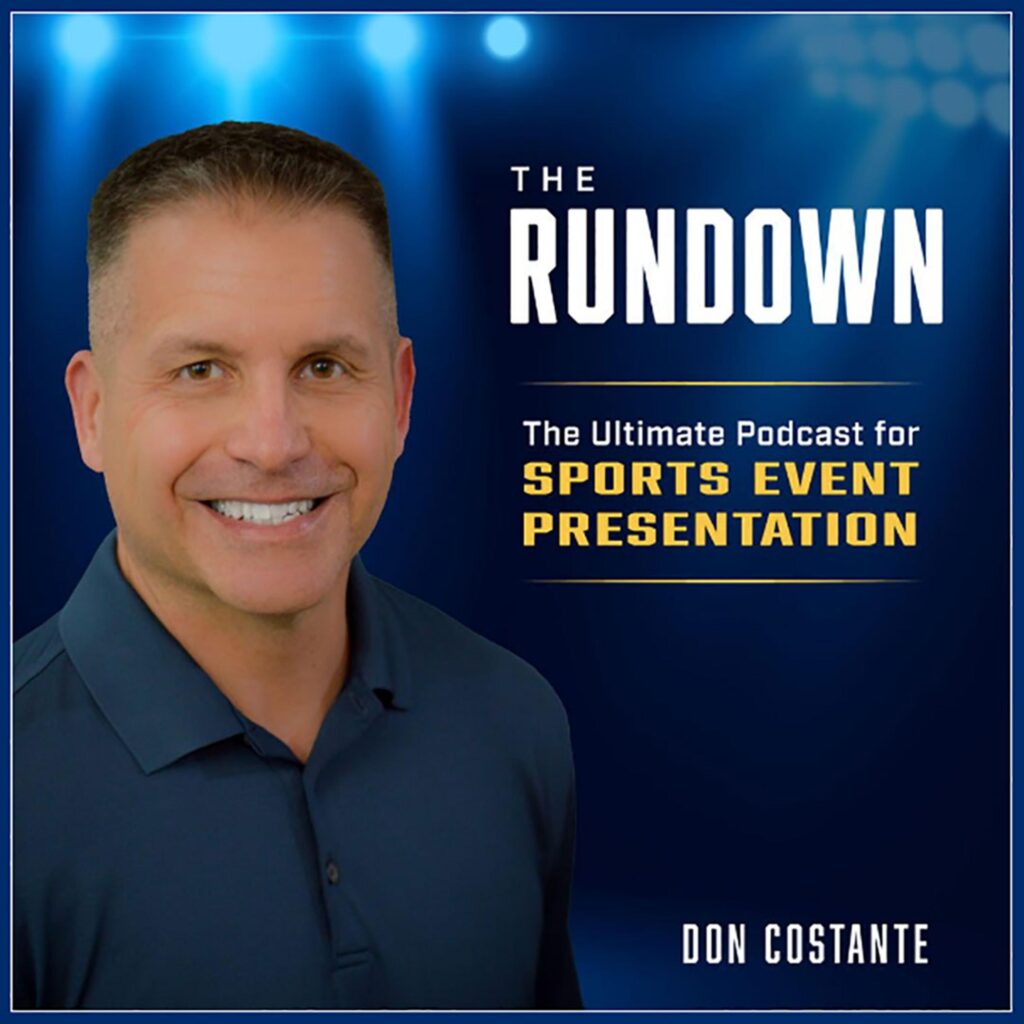
In this episode, Don sits down with Don Scott, Vice President of Entertainment and Marketing for Clemson Athletic Ventures, to explore the strategy behind one of college athletics’ premier gameday experiences. Don explains why “traditions are awesome, but traditional thinking is not,” shares Clemson’s approach to communication, creativity, and evaluating new ideas, and reveals the framework that guides every gameday decision. He also shares the biggest mistake athletic departments make, the most overlooked element of the fan experience, and practical lessons that can help elevate Event Presentation at any level.
Transcript
The transcript below has been lightly edited for readability and clarity. Click any starting timestamp to jump to that exact point in the YouTube video.
Podcast Introduction
[00:00] Don Costante:
Welcome to the Rundown Podcast, hosted by Don Costante, a nationally recognized event presentation expert with over 30 years of experience and author of Beyond the Scoreboard. This podcast takes you behind the scenes with industry leaders to unpack the insights, strategies, and creative tactics that drive unforgettable live experiences. Let’s get started.
Event Presentation in Collegiate Athletics
[00:27] Don Costante:
Event presentation is one of the most visible and influential touchpoints in collegiate athletics. It’s where atmosphere, tradition, and entertainment come together to shape how fans experience a program and how sponsors, student-athletes, and recruits connect with it. Behind every successful game-day environment are the people, processes, and strategies that bring those moments to life. My guest today is Don Scott, Vice President of Entertainment and Marketing for Clemson Athletic Ventures. With more than two decades of experience in collegiate athletics, including leadership positions at Notre Dame, Elon, Sanford, and UAB, Don has built a reputation for elevating fan experience, marketing, and engagement strategies. At Clemson, he leads the department’s efforts to enhance the game-day experience across all sports. In this episode, we discuss Don’s career journey, his philosophy on event presentation, how Clemson approaches staffing, communication, and the creative process, and the lessons he’s learned throughout his career that athletic departments can apply to elevate their own event presentation efforts. I’m ready to discuss, I’m ready to discuss, and I’m ready to discuss, and I’m ready to discuss this. With event presentation and your strategy, let’s start first with your journey.
Meet Don Scott
Don Scott’s Career Journey
[02:18] Don Costante:
So take us through your career journey that ultimately led you to your current role as Vice President of Entertainment and Marketing at Clemson Athletic Ventures.
[02:28] Don Scott:
Yeah, you know, as a kid, obviously I was playing every sport. I was an only child, so I got outside all I could, team sports, tennis, golf, you name it. If you played it, I wanted to do it, and grew up in that golden era of ESPN in the 80s. So, I mean, I wanted to be a professional athlete. And like 99% of us realized, hey, that wasn’t going to happen. So how do I channel that passion into doing something like this? I didn’t really know about event presentation, but I knew about sports information, getting all the media guides when I was little and growing up. So I knew that there was a path forward in that. And after I graduated college, I was able to go to New York City and work in media sales, which kind of bridges the gap right there. I was with an offshoot of ESPN and Fox Sports, doing that on the sponsorship side, and then moved to Birmingham, Alabama. And that was really my first taste of getting into the actual event presentation world. Still on the sponsorship side, but working hand-in-hand with the marketing team and event presentation. As you know, and we’ll talk about this in the college world, marketing is sort of that catch-all umbrella for both consumer marketing and event presentation. So I was working with that team at UAB very closely and really wanted to get onto that side, to the administration side.
From Media Sales to Event Presentation
Samford, Pinehurst, and Elon
[03:49] Don Scott:
And so I was able to go across the mountain in Birmingham to Samford University and was running their entertainment, their marketing, their ticketing team. And then went back home and kind of got out and went back to my New York City days, moved back home to North Carolina and worked for an ad agency that did everything for Pinehurst. So really into the golf world. And then my hometown team, the Elon University Phoenix, called me opening up a brand new $50 million communication center, basketball and volleyball arena. And needed someone to sort of shepherd that through from a ticket sales and an event presentation side. So I was able to go back home and that was an amazing opportunity there. And then, you know, when you’re 30 seconds from your mom and dad, you’re 30 minutes from your in-laws, you’re two young boys, they’re loving it. Life’s pretty good. So I wasn’t really looking to move. Then I got a call from a friend of a friend at Notre Dame and she was looking for someone as Notre Dame sort of split consumer marketing and fan experience to head up the fan experience team. And you got to chase that ground ball, you know, run that ground ball out. It’s Notre Dame.
Notre Dame and the Move to Clemson
[04:56] Don Costante:
Oh, yeah.
[04:57] Don Scott:
I was fortunate enough to be in that position. What I forgot to say was that I also got my master’s degree in athletic leadership at Clemson. And so Clemson was always in the back of our minds as it’s in the Carolinas, it’s home. And so after two years at Notre Dame, the job at Clemson opened up and we really wanted to get back home. And so applied for it, threw my hat in the ring and was fortunate enough once again to get that job. And we’re finishing up our second year here at Clemson. And it’s funny enough, after renting my wife and I and our boys were actually buying a house next week. So by the time everyone hears this, we will be about five or six days in our new house at Clemson. So that’s sort of my career journey.
The Experience That Shaped Don Scott’s Philosophy
[05:36] Don Costante:
Well, that’s fantastic. Now, looking back, was there one experience or opportunity that really had the greatest impact on you on how you think about event presentation today?
[05:46] Don Scott:
You know, I think when it goes back to everything that I’ve done in my career, whether it’s been media, event presentation or the golf world, all three of them, they center around experiences that people remember. So if you just put yourself in that mindset of creating those experiences that people remember, then everything that surrounds it is going to work. Whether it’s the lights going out, the music, the traditions, the anticipation, and those moments that can make 80,000 people feel connected at the same time. That’s going to make it work. So, but probably that first time where I said, oh yeah, like this is it. I was at UAB and I was in the sports sponsorship side. In men’s basketball, we played number one Memphis when John Calipari had it rocking and rolling. Derrick Rose was a freshman.
The UAB vs. Memphis Game That Changed Everything
[06:34] Don Costante:
Oh yeah.
[06:34] Don Scott:
And the place was packed out. I mean, it was standing room only. The fire marshal got involved. Not in a bad way, but just like, hey, we got to stop letting them in. We had 8,000 gold t-shirts on every seat. It’s the first time UAB came out in gold uniforms.
[06:51] Don Costante:
Nice.
[06:52] Don Scott:
10 or 15 years. National television. Game went down to the wire. It was loud. It was, I mean, it was the loudest I had ever heard of building. And I grew up, you know, going to games on Tobacco Road. Unfortunately, we didn’t win. Derrick Rose, or actually Chris Douglas-Roberts, he made a shot at the buzzer. But that was where I was like, yeah, this is for me. I got to get out of the sponsorship world and I want to get into the event presentation.
[07:17] Don Costante:
Oh, wow.
[07:17] Don Scott:
But I think it always goes back to like, I always remember that even in a loss. So if you create those experiences that people remember, you’re going to go places in our career and in our profession. So that’s certainly one of my key tenets and that thing that I remember.
[07:32] Don Costante:
Fantastic. Now, Don, what is your personal event presentation philosophy? And I say personal because I know I’ve been in roles where I’ve had leadership direct a certain philosophy that necessarily wasn’t my take or how I would do it, but I had to implement it. So I’m asking for your personal take on event presentation. What’s your philosophy?
Don Scott’s Event Presentation Philosophy
The Three E’s: Entertain, Engage, and Emote
[07:53] Don Scott:
Yeah, so I go back to hit threes. And what I say about that, entertain, engage, and emote. So if you can entertain the crowd, if you can engage with the crowd, and if you can stir emotion with the crowd, you’ve made it. That’s the philosophy is creating those emotional moments, those engaging moments, and those entertaining moments.
[08:15] Don Costante:
Love that.
[08:16] Don Scott:
Because anybody can play a video or launch a t-shirt.
[08:18] Don Costante:
Yep.
[08:18] Don Scott:
But what fans remember is how you made them feel. So when you can enhance the game, when you can celebrate your brand, and you can create those moments that people talk about afterwards, everyone’s going to keep coming back. Your coaches are going to be happy, your administrators, your student-athletes, and then your team. So that would be my personal presentation philosophy.
[08:39] Don Costante:
I love that. Now, when you left Notre Dame and you arrived at Clemson, what opportunities did you see to further enhance the fan experience, atmosphere, and the overall game presentation?
Enhancing the Clemson Fan Experience
[08:51] Don Scott:
Yeah, I was lucky because, you know, I mentioned I went to graduate school at Clemson. And growing up in the ACC world, I knew Clemson.
[08:58] Don Costante:
Yeah.
[08:58] Don Scott:
So I knew about a lot of the traditions. Certainly not all of them because I wasn’t boots on ground. But I’m smart enough to know, like, hey, we probably should always run down the hill of football. We’ve been doing it since the day we opened our football stadium. So it’s really, you know, I noticed that we had these just amazing, incredible assets from our traditions to our student-athletes to our coaches. I mean, Coach Sweeney.
[09:22] Don Costante:
Oh, yeah.
[09:23] Don Scott:
You know, two national championships, all the college football playoffs, our fan base, our venues, the atmosphere. We didn’t need to create anything. It was really, it’s how do we amplify the tradition in a modern era and still make them traditional and uniquely Clemson? And I think one of the things I always go back to as well is like, hey, traditions are awesome, but traditional thinking is not. So how do we amplify those traditions? Spend a lot of time observing. I’ve got a great staff here. I’m really lucky. You want to watch fans how they enter the stadium, how do they take different seating areas, talk to people, because it’s hard. Like what a student wants is probably different than what a donor wants, probably different than maybe what a staff member wants. But at the end of the day, we’re all Clemson. And when you cut us open, we all bleed orange and purple. So it was really going back to, you know, how do we amplify these traditions or how do we create new ones in sports that maybe don’t have them? Our gymnastics program is just coming off year three. Lacrosse, year four. Softball, year six. These are very young sports that we are very good at.
Amplifying Tradition Without Traditional Thinking
Building Traditions in Clemson’s Newer Sports
[10:25] Don Costante:
Right.
[10:25] Don Scott:
College super regionals, the NCAA tournament, ACC champions, and gymnastics. All three sports came right out of the gate. The only tradition they had was, you know, that Tiger, Paul, and orange and purple. So it was being able to help create those as well. And then how do we take our Clemson traditions and bring them into those programs? So being able to help with that’s been pretty neat as well.
Rethinking the Collegiate Organizational Model
[10:47] Don Costante:
So I want to shift gears now and talk about the collegiate organizational model and what I mean by that in college athletics. Event presentation is traditionally under the director of marketing. You mentioned that a little bit ago. This person’s responsible for sponsorship activation, ticket sale initiatives, fan engagement, among other external functions. Meanwhile, when you look at the professional sports models, they’ve built a dedicated event presentation department with specialized personnel who are focused solely on the fan experience. My question, Don, is do you think collegiate athletics needs to rethink its current model?
Why College Athletics Needs Specialized Event Presentation Teams
[11:24] Don Scott:
So the short answer is yes. The long answer is we’ve already started. And certainly, you know, I mentioned Notre Dame. We’re doing it here at Clemson. I know others have done it. I know Auburn’s doing it.
[11:35] Don Costante:
Auburn as well.
[11:37] Don Scott:
But you’re right. You got to think about it this way too, Don. Not only is it splitting it up, but we have more than one sport. We’re not the NBA where you just have 41 homies. We’ve got 21 other sports. And those student-athletes, those coaches, they put in the same amount of effort that our football team does. So they’ve earned the right. They deserve the same from us in the event presentation world, in the consumer marketing world. And just with the way we’re staffed just from a person level and having marketing being that umbrella, it was working, but it could have been much more effective and efficient. And so that’s what we’ve done here at Clemson. We brought in, you know, with Clemson Ventures and Michael Drake, our CEO. We brought in a chief marketing officer who’s two months under his belt to really help us refine that. He comes from the consumer packaged world and working at Facebook and Instagram for Meta. So he’s really in charge of our fan lifetime cycle, getting new fans, getting them into the cycle. And then he and I are working together on that consumer marketing side of, hey, not only a ticket strategy, but just fans. Because we need new fans coming in. Certainly we want to get them as young as possible. So they build that affinity up. We’d love them to come be students here at Clemson.
The Clemson Ventures Model
[12:51] Don Scott:
But if not, we’d love for them to watch our games. That’s a huge new revenue component for us. The way that the ACC has restructured their television deal is that some of the money is based off of viewership. So even if you live in Wyoming and you’re not able to come to, say, a lacrosse game, a football game, a men’s basketball game, you still can turn on ESPN, ABC, the ACC network, watch our games. And then that’s helping us. And so we know that. Now the inverse of that, it’s incumbent on us on the entertainment side that we’ve split it. And I tell my team on that side, I just want you thinking butts in seats and the experience. So get people to use their tickets and then show them the best time so that no matter what happens on the court or on the field, they can’t wait to come back. And they’re leaving saying, man, I wonder what Clemson will do next.
Butts in Seats and the Experience
[13:42] Don Costante:
Yeah.
[13:42] Don Scott:
So we’re thinking in that event presentation world, going back to those three E’s. I want to entertain. I want to engage. And I want to create emotion.
[13:49] Don Costante:
I love that. And I love that at Clemson, you have Clemson Ventures that has specialized personnel to handle specific areas. And that’s so important because you mentioned it just right there. Your three E’s, entertain, engage, and create emotion. Well, you can’t do that if you don’t have the bandwidth. Yeah. Specifically when you have 21 sports like you do at Clemson, by having one person responsible for everything, marketing, digital production, social media, game operations, sponsorship, the overall event presentation, you put limits on what an organization’s ability is to deliver.
Why Bandwidth Matters
[14:27] Don Scott:
Yeah.
[14:27] Don Costante:
Because there’s just not the bandwidth to do it. So I’ll give you an example. I have a client in collegiate athletics, a major university that brought me in to evaluate their event presentation. And they had one individual designated to the role for marketing, digital production, creating the graphics, the animations, the staffing assignments, the game operations, the script writing, the promotion development, the ideation, the sponsor fulfillment, the CRM for marketing, the advertising. Among other external responsibilities. One individual. They’re looking for somebody to bring in to help an assistant director, but really one individual. And what happens is this person is so overwhelmed, so overworked. They’re talented. Sure, they have the ability to do every area, but they’re limited in their bandwidth of being able to do more and to elevate each of those areas because they’re looking to just maintain status quo.
The Problem With One Person Doing Everything
[15:30] Don Scott:
Yeah.
[15:30] Don Costante:
When I talked to the individual and I said, what makes for a good game-day? He basically just said, as long as I can get through all the elements without a mistake, I consider that a good day. And yes, you want to have no mistakes, but the mindset is we can’t do more. We can’t innovate. We can’t go above and beyond to create that experience. It’s more about let’s just maintain status quo.
[15:54] Don Scott:
Oh yeah. Let’s hope nothing falls through the cracks. And as long as that happens, it’s been a great day. That’s a tough way to go about it. It really is. You know, I thought one of the things I found interesting about your book is that I’ve always been somewhat envious of the pros. Just because I was talking to the Bulls and their staff, they’re like, Billy doesn’t know who the hell I am. You know, coach Donovan. But then reading your book, it can still be team driven.
[16:18] Don Costante:
Yeah.
[16:18] Don Scott:
Young lady that used to work at Clemson. She’s with the Washington Wizards now on the NBA on the event presentation side. She’s like, oh my God, every intro video we got to send to the team. No, he’s in it too much. He’s not in it enough. And it’s like, wow, I didn’t realize that.
[16:33] Don Costante:
It’s such a challenge for sure. So Don, you mentioned that you don’t follow the traditional organizational model. So can you walk us through your structure, the key roles that are involved and how those responsibilities are divided across the team?
Inside Clemson Ventures’ Organizational Structure
[16:47] Don Scott:
Yeah. So just all under Clemson Ventures, we’ve got certainly our partnership sales team.
[16:52] Don Costante:
Yep.
[16:53] Don Scott:
And they’re in-house and they do an amazing job. Clemson Ventures really is set up more of a professional model because we’ve got our broadcasting team. And they help us both from the minier and the digital side in the pro sports model, more of the regional sports network. But then also our in-venue shows, our Paul Vision shows. I work hand-in-hand with them and they are phenomenal. By Rick Bagby, who’s a SVG Hall of Famer and longtime Clemson employee. And he and his team are just amazing and really bring to life our ideas when we need to put it up on the video board. You know, I mentioned that consumer marketing and digital and social team. And there’s three guys there that have done an amazing job. Got just these specialists in our data team, our ticket strategy team, and then my team with the fan experience. So we’ve got three graduate assistants and then two full-time people and we split up. Our 21 sports, certainly football, everyone’s working because it truly takes a village to put a football game on. But we’ve got those specialists that are focused on game presentation, creative content, digital engagement, our analytics. But we work towards a shared objective. They have their defined responsibilities. And our success comes from that alignment rather than ownership and territorialism.
Communication and Alignment
[18:11] Don Costante:
Let’s shift gears into communication and alignment. One thing people often underestimate is just how much communication and coordination it takes to produce a successful game-day experience. So, Don, walk us through Clemson’s planning process and how the various groups involved stay aligned throughout the season.
[18:32] Don Scott:
Communication matters.
[18:34] Don Costante:
Absolutely.
Planning Begins Months Before the Season
[18:35] Don Scott:
Our process starts months before the season begins. I’ll just take football for an example. You know, you’ve got your spring game in March, but the schedule comes out in January. So we’re always thinking, hey, what do we think our themes are going to be for the year? You’ve got homecoming. You’ve got senior day. Are you going to do a stripe out? When are we going to put military appreciation day on the calendar? Because that is a tradition at Clemson, other than the three military academies, that is unlike any other, to borrow our friends from the Masters. We do it better than anyone else. I mean, it starts in January. And then really after the spring game, it cranks up because now everyone’s able to focus on the upcoming football season. And then Memorial Day, your kick times come out. So now you’ve got your first three weeks. So if you’ve got a night game, that looks different from a pyro or an LED wristband or a drone show. We’re not like the NFL where we know our games are going to kick one, four, or Thursday or Sunday or Monday nights. So we’ve got to make these plans, but we’ve got to be able to pivot quickly, knowing that we only get our kick times 12 to six days out. So you’ve got to make the plans early so that you’re able to pivot and adapt depending on how the season goes, what’s going on.
[19:51] Don Scott:
But we established the goals, the themes, the priorities, those major moments. I mean, like I said, we start late January when the schedule comes out.
The Game Matrix and Event Inventory
[19:59] Don Costante:
Sorry to interrupt you, Don, but is there a special document that kind of details that inventory? And is there a gatekeeper for that?
[20:06] Don Scott:
There is. We’ve got about five of them. So the biggest one I would say is our game matrix. And I’m actually looking at it right now for football. So we’ve got it laid out. Columns are our seven home games. And then the rows go date, kicker. And I’ll tell you what the kicker is in a minute. Time, theme, TV, presenting sponsor, color guard, any special pregame activities, flyover, honorary captains, the eye dotter. We have someone come and dot the eye and script tigers in our band dots. Anything special we’re doing for the students, pyro. Which band performance? Our band does four performances a year. So each performance is done twice, once to the north, once to the south. And then our special military appreciation day. What’s going on at halftime? Do we have our hall of fame game? Homecoming, dark valley, senior day. Those are all different. Is there anything that our president’s office wants us to do special? Our IPTA donor of the game, which is our booster organization and our philanthropic arm. And then hero of the game that we have. And then I will layer those in. Kicker is always sort of those surprise and delight moments. Are we doing a drone show? Are we doing special amplified pyro? Are we going to do an LED wristband show? Any of those things. So we’ve got them all laid out so that we’re not stacked.
Creating Surprise-and-Delight Moments
[21:26] Don Scott:
We’re not on top of each other.
Managing Sellable Assets and the Game Rundown
[21:27] Don Costante:
Love that.
[21:27] Don Scott:
And then we work with our partnership team on all of our sellable assets. So what they’re able to do from a video board perspective, on field, if there’s any smiling waves, special things that we’ve got to do in that aspect. And then actually have the game rundown where, as you know, you’re looking at all of our timeouts and how are we scheduling those? And then what’s their cadence? So we always have a hero moment in the timeout. We try to stay away from PA announcements, but we will have some video board features that have to have a PA announcement. But just a true PA announcement, we recognize that it’s white noise. And so those are really our three big documents. You know, gatekeeper sounds so bad, but certainly I’m in charge of those when it comes to football. Now, when it comes to men’s soccer and women’s soccer, it’s the people that are running point for us on those as well.
Shared Documents and Transparency
[22:20] Don Costante:
Now, are these documents living on a shared network as a read-only?
[22:23] Don Scott:
We do.
[22:24] Don Costante:
Yeah.
[22:24] Don Scott:
Yeah, we do. We’ve got them in our shared drive because, you know, transparency and communication are the key for us to have the great experiences that we have.
[22:35] Don Costante:
Absolutely.
[22:35] Don Scott:
So they’re on our shared drive and then people can come in and look at that. And then we get into our weekly cadence of meetings. You’ve got your operational meetings and then you have your game meetings.
Clemson Football’s Weekly Meeting Cadence
[22:45] Don Costante:
Just curious, when you talk about football, let’s take football for the example. When are you meeting for that operational meeting?
[22:51] Don Scott:
So I’ll walk you through our weekly cadence when it comes to football.
[22:55] Don Costante:
Okay, great.
[22:56] Don Scott:
So Mondays is just a huge meeting day.
[22:59] Don Costante:
Yep.
[22:59] Don Scott:
We’re looking back and then we’re looking forward. So we’ll have our sales team meetings, we’ll have our revenue strategy and insights team meetings, our operations meetings, where it’s not even just football. I mean, we’re going over the whole week because you’re going to have volleyball. You’re going to have men’s and women’s soccer.
[23:15] Don Costante:
Oh, absolutely.
[23:16] Don Scott:
If you have field hockey, you know, those are the things that colleges are always putting on throughout the course of the year, not just football. We talked about not just that one sport that you’re living in in the professional world. Then on Tuesdays, I’ll write the script. And then Wednesday morning, we have a massive operations meeting. I mean, it goes everything from parking to concessions to broadcast to awesome fan experience. There’ll probably be 200 people at that meeting. And then we’ll go into our video board production meeting with our producer, our director, our technical director, and our head of cameras. We’ll go into our show, cheer, dance, and band as well. We’ll go over the script. We’ll go over the run a show. And then from a strategy standpoint, Wednesday at lunch, I’m pretty much done from strategy. And now everyone’s taking it over and going into execution mode Wednesday afternoon and Thursday during the day. And then I’ll get together with a couple people Thursday night. If it is a night game, we certainly have to do this meeting during the night because we’re going through our lights and any sort of pyro tests that we need to be due. But we’ll go ahead and get our video board elements up there, see what’s working, see if that timing fits. If it doesn’t, if we need to move something from, say, third quarter, second timeout to second quarter, first timeout.
From Script Writing to Execution
Testing the Show Before Game Day
[24:36] Don Scott:
Just because in the flow of the game, we think it’s going to work better. And really because in the second half, you know, that’s winning time, especially the fourth quarter. We try to get all of our major, major sponsored elements out of the way so that we can do what we need to do in the fourth quarter to help the crowd get involved. And just maybe, just maybe that gets the team ready to rock and roll and is that 12th man for us to win.
Protecting the Fourth Quarter
[25:00] Don Costante:
I love that. That just is an example why you do such a great job. That sort of meticulous planning and thought out process goes a long way to the finished product, as you know. Thank you for sharing that. Let’s talk about the creative process for a moment. Many departments are constantly looking for new ideas, but the challenge is turning ideas into execution. So what does Clemson’s creative process look like and how do concepts ultimately make it into the game-day experience?
Clemson’s Creative Process
[25:30] Don Scott:
So I got a great friend of mine. He’s at the University of Alabama now. We were together at Elon. His name is Mike Ward. He always, it was on the whiteboard in his office. Best idea wins. If I think like the ideas can only come from me, we are going to fail. So I don’t care where they come from.
Best Idea Wins
[25:49] Don Costante:
Absolutely. Yeah.
[25:50] Don Scott:
Our group chat of our team is so much fun. Eight to five, we’re getting work done in there. But I mean, six o’clock to midnight, we’re watching other games. We’re watching social media. Hey, did you see this? Oh, man, how cool would this be? And then we get into our brainstorm meetings. That best idea wins. But we’ve got to evaluate the ideas through these three lenses. Does it work within our brand? So can we make this uniquely Clemson? Does it improve the fan experience? And can we execute it at a high level?
Three Lenses for Evaluating Ideas
[26:24] Don Costante:
Love that.
[26:24] Don Scott:
If the answer is yes to all three, we’re going to do it. And look, it might not work. But we’re going to do it because we’ve got a culture of creativity where at Clemson, that it’s okay if we fail. We’re going to try things. They’re not all going to work. We’re going to use the learnings to make it better. And then we go on. And hey, if it doesn’t work at football, we might see it at men’s soccer.
Creating a Culture Where It Is Okay to Fail
[26:47] Don Costante:
Sure.
[26:47] Don Scott:
Or that’s going to work at softball. Or what if we just tweaked it a little bit and then it really works? I think the important thing is ideas can come from anywhere. The challenge really isn’t generating ideas. It’s how do they support the larger objective?
[27:02] Don Costante:
Absolutely. So when you’re getting into the creative mode, who’s involved in that process, though? Is it just the experience team? I know ideas come from anybody. But when you’re actually going through your brainstorming session, who’s involved in that and who’s leading that conversation?
Who Participates in the Creative Process?
[27:16] Don Scott:
Yeah. So certainly on the entertainment side, that’s our team. We’ve got a weekly Wednesday. We meet twice a week as a team.
Weekly Operations and Brainstorming Meetings
[27:24] Don Costante:
Okay.
[27:24] Don Scott:
We meet Monday morning, just truly operations. So I can look at Sammy and be like, hey, Sammy, what’s going on with volleyball this week? Where do you feel confident? Where do you not feel confident? How can we help each other fill in the gaps? So everyone knows what’s going on. And then Wednesday, we have just a brainstorming of like, hey, I saw this. You know, we want to do that. Of course, it doesn’t just have to be Wednesday. We’ll add it to the agenda because it’s a running doc. And like I said, you’ve also got to do your day job. I mean, we’ve got to do the games for, you know, our 21 sports.
Collaboration Across Creative, Broadcast, and Content Teams
[27:57] Don Costante:
Yeah.
[27:57] Don Scott:
But the idea is we’ve got an amazing creative team as well, both from a brand side, a graphic side, and then a video side. They’ve got to support our teams, you know, from recruiting and from the day-to-day team aspect. And then also how they work with us from a creative standpoint and a sales side. I mentioned our broadcasting team. Obviously, they’re in our control room with our graphics and our replay decks and our switchers. They are helping out. They do an amazing job. And then our custom content team, which is really right now focused on a lot of name, image, and likeness and sponsored material.
[28:31] Don Costante:
Sure.
[28:32] Don Scott:
But they also help us out as well.
[28:33] Don Costante:
Yeah.
[28:34] Don Scott:
Everyone really comes together. I think it always goes back to that culture of best idea wins. It doesn’t matter where it comes from.
[28:40] Don Costante:
I agree.
[28:40] Don Scott:
If it’s going to make Clemson better, we’re going to find a way to get it in our show.
[28:45] Don Costante:
I love that. When you think about Clemson’s approach to event presentation and fan experience, what’s one practice or process that you believe has had the greatest impact on the game-day experience?
Making Everyone Feel Part of the Show
[28:57] Don Scott:
Man, that’s a great question. I would say if you make everyone feel like they’re part of the show, then you’re going to be able to walk out that day and be like, yeah, that was a win. And when I say everyone should feel part of the show, I mean internally.
[29:12] Don Costante:
Yeah.
Aligning Every Element Around One Narrative
[29:12] Don Scott:
So like sort of a will and spoke model of the mascot, the band, the cheerleaders, the dance team, video boards, music, lighting, our traditions. Like they don’t compete with one another. They’re all in sync. They support the same narrative that goes back in, you know, into the middle of the wheel. And because the fan doesn’t see the separate departments, Don, they know that. When you’re show calling for the spurs, they don’t know who’s calling out the coyote.
[29:34] Don Costante:
Right.
[29:34] Don Scott:
They just see it as the spurs.
[29:37] Don Costante:
Right.
[29:37] Don Scott:
Now it’s a challenge to find that right balance. But when you’re able to bring everyone involved internally and externally, that’s where you win.
[29:43] Don Costante:
Your process is bringing everybody into a partnership, being synced together to create an experience that elevates the game-day experience is what you’re saying.
[29:52] Don Scott:
Yeah. The best example is pregame because you lived it with the coyotes, or excuse me, with the spurs. But I mean, go back to, go back to pregame, go back to team introductions. When everything comes together, you’re built towards that single emotional crescendo of the intro video, special effects, lighting, crowd prompts, how you introduce the mascot, then how you introduce the team going to tip off. That is the best example of everyone comes together, the internal and the external, you build towards that single emotional moment and you go from there.
Pregame as the Emotional Crescendo
Designing for Multiple Audiences
[30:29] Don Costante:
One of the unique challenges in college athletics is that you’re creating an experience for students, alumni, donors, you mentioned, recruits, families, casual fans, all at the same time. So how do you design an experience that resonates with all of those groups without trying to be everything to everyone?
Students, Alumni, Families, Recruits, and Donors
[30:49] Don Scott:
Yeah, another great question. I kind of look at it. You can’t build an experience for everyone at every moment. And I guess what I mean by that is, you know, students want energy. The alumni want tradition. Families want accessibility. Recruits want to envision themselves playing there. Donors want to feel valued. But at the end of the day, everyone is Clemson. If you build an experience where everyone has moments that are meaningful to them, that’s how you design for the multiple audiences. So there’s a lot of times where, you know, you can’t serve every audience simultaneously. But you get those moments in the game where, okay, hey, this is for our alums. I mean, remember a world before cell phones when it was still newspapers led. This is for our students where music and phones lead. And this is for our recruits, which is kind of the same, but it’s a little different. You want to envision them being here. So is it a moment in pregame where I’ve worked with our football creative team just this year? You know, we’ve got something like 55 players in the NFL since Coach Sweeney took over.
[31:53] Don Costante:
Wow.
[31:53] Don Scott:
So we’re highlighting them on the video board.
[31:55] Don Costante:
Yeah.
[31:55] Don Scott:
So that our recruits can say like, oh, yeah, I’m going to be the next Trevor Lawrence and be an All-American at Clemson and then go on and play for the Jacksonville Jaguars. Then our fans and our donors also feel that when they’re like, yes, like I remember that game. And now I can’t wait to see who the next Trevor Lawrence is going to be. So that’s sort of how you design for multiple audiences. But Don, I always go back to like everyone’s still Clemson when you’re with the Royals. I mean, yeah, you’ve got your corporate, you’ve got your groups, you’ve got your season ticket holders. But at the end of the day, everyone’s a Royals fan.
Everyone Is Still Clemson
[32:30] Don Costante:
Yeah.
[32:30] Don Scott:
Everyone wants it for Kansas City. So I think if you can always put it in that lens of everyone’s Clemson, you’ll be able to make it work.
Innovation Versus Tradition
[32:38] Don Costante:
Let’s talk innovation versus tradition. Fans often say they want innovation, but they also want things to stay the same. How do you navigate that tension between preserving what fans love and evolving to meet the changing expectations out there?
Tradition Is the Foundation, Innovation Is the Enhancement
[32:54] Don Scott:
Yeah. Tradition is the foundation and innovation is the enhancement. No one’s asking us to replace our traditions, nor do we want to. They define our brand. So it’s our responsibility to make those traditions more impactful. And like I said, the best innovations amplify tradition rather than compete with it.
[33:11] Don Costante:
Yeah.
[33:11] Don Scott:
If we just would have gone and put 50 smoke mine towers on the field, that wouldn’t have worked.
[33:16] Don Costante:
No.
[33:16] Don Scott:
But when you put four or two, when you change the colors, that works.
[33:21] Don Costante:
Yeah.
Balancing Data, Feedback, Observation, and Instinct
[33:22] Don Scott:
And data matters. Fan feedback matters. Observation. But the experience matters too. And so I try to make decisions where they all four can align. So like kind of instincts as well. And when you do that, you’re usually headed in the right direction.
[33:37] Don Costante:
Is there one area that you put more weight to your decision making, meaning to the data, the observations, the feedback or the instinct?
Enhancing Traditions With Technology
[33:45] Don Scott:
Yeah, I think it kind of goes back to a lot of our videos. Our fans love our introduction video, our stadium video, and our third and fourth quarter video. It’s long been a tradition that our just recently retired head strength and conditioning coach basically narrates a story about how you win championships.
[34:06] Don Costante:
Nice.
[34:06] Don Scott:
And that smooth hands don’t win championships. They don’t put rings on smooth hands. And our fans now, it’s a call and response. I mean, they are narrating the video back to them. And so how do we make that video better as well? Because if our fans know it, but then we can put those surprise and delight moments of innovation of, hey, is there any pyro we can put on the field? Is there an additional sequence that we can do off of the roof? How are we manipulating and programming our LED lights? Are we adding moving heads? Are we sequencing our quads from a light show as well? And I think that’s how you get into that balance.
The Strategic Value of Event Presentation
[34:48] Don Costante:
Okay. Let’s talk about the strategic value of event presentation. As college athletics continues to evolve, how do you see event presentation contributing to the broader goals such as revenue generation, recruiting, donor engagements, sponsorship value, and overall brand perception?
Event Presentation as a Revenue and Recruiting Tool
[35:04] Don Scott:
Yeah, I’m lucky where I’ve been over both roles and know the importance of revenue generation, whether it’s in a vacuum or now in the current landscape of college athletics. So I recognize most people look at it as just a loss leader, but I look at it as it’s become one of the most important strategic tools that we have. It impacts ticket sales because people return to experiences they enjoy. It impacts recruiting prospects or evaluating our atmosphere. Donors want to invest in successful programs. Sponsorship wants brands that are associated with memorable experiences. And so our event, our game, it shapes those perceptions. It influences how people feel about our institution, our athletic program, our brand, and everything. So that’s the strategic value of event presentation. Ticket sales and experiences, it drives revenue. From that standpoint, our sales team is better equipped with our brand and with our analytics. And our football team in that aspect are all of our 21 teams. Their recruits are enjoying it. So they’re getting the players that they believe is going to make an impact and continue the tradition of winning championships that we have at Clemson. We call ACC another Clemson championship for our conference. There’s the strategic value of event presentation is that we’re able to feed into all of these revenue generation pods now and help them.
[36:33] Don Costante:
Oh, yeah. A quick story that illustrates the value of event presentation. And you mentioned recruits. College athletics is an extremely competitive atmosphere when you talk about trying to recruit. And one particular school in Texas brought me in. Not that they weren’t selling out, but they weren’t creating the atmosphere. And when you talk about bringing a recruit into an arena and they’re competing in the same conference as a Kansas, the Jayhawks and their type of atmosphere. And you have one that is stagnant. The likelihood of getting that recruit to want to play there diminishes. So the importance of creating that atmosphere that entices the recruits to want to play there. It just is so important. So hearing you talk about the strategic value. Fantastic. Love that. Yeah.
How Atmosphere Impacts Recruiting
Learning From Kansas and Rock Chalk, Jayhawk
[37:14] Don Scott:
And I mean, I know you’ve done some work with Kansas and I’ll give them kudos as well. A very tradition rich program when you get into the field house and James Naismith court. But what they’ve done with Rock Chalk, Jayhawk and their introduction of how they’ve amplified their experience and made it unbelievably immersive. It’s key and it’s critical.
Three Changes for a Struggling Athletic Department
[37:35] Don Costante:
Let’s move on to another question. If you were consulting now, Don, with a mid-major athletic department tomorrow whose event presentation was struggling across the board and you could only recommend three changes, what would those three recommendations be?
[37:50] Don Scott:
Yeah. The first thing I do, you know, do a music audit is your playlist up to date.
Recommendation One: Audit Your Music
[37:55] Don Costante:
Yeah.
[37:56] Don Scott:
There’s free programs out there. So you don’t have to have show flow when it comes to scripting software or a seven point audio or even hiring a DJ. But do a music audit and look at where you are because that can feed all sorts of emotion. Look at your team entrance and you don’t have to have all the bells and whistles and the special effects. But that is such a important part. We talked about how it’s the crescendo of what the student athlete, mom and dad, fans, students of what they’ve gotten to and what they’re coming to in that game and getting ready to experience. So that and then look at your last two timeouts. Football, it’s the fourth quarter. If it’s a basketball game, if it’s men’s, it’s the eight and the four. If it’s a women’s game, the fourth quarter. If it’s baseball, those last two innings or any diamond sport, those last two innings, six, seven or eight, nine. Try to get those as clear as possible so that no matter what direction the game’s going, you can help impact it.
Recommendation Two: Improve the Team Entrance
Recommendation Three: Protect the Final Timeouts
[38:57] Don Costante:
Love that. I heard people talk about music and team intro, of course, for the climactic moment. But great advice by looking at those last two timeouts and creating the type of energy or excitement that overall drives that experience. Leaving it open and having that conversation, of course, internally with partnership and giving them the understanding why you need that time available in your inventory to play to the crowd. So I definitely think that’s great advice. All right. So, Don, as you look ahead, what excites you most about the future of event presentation and the fan experience in collegiate athletics?
The Future of Collegiate Event Presentation
The Golden Age of Fan Experience
[39:32] Don Scott:
I feel like we’re in the golden age. And I’m fortunate enough to be at the power form where we have the resources, but the competition is massive. For us, we expect to be in the college football playoff. That’s just who we are at Clemson. So I think administration and our fans and our student-athletes and our coaches, they expect and they also deserve these unbelievable immersive environments. They put a lot of blood, sweat, and tears. Whether you’re spending money to come to the game or everything a student-athlete and a coach does, money through Friday to get ready for the weekend. They deserve these just amazing immersive experiences. And so it’s incumbent on us to create them. We’re the memory makers. And with how technology has changed, both from special effects to second screen experiences, we’re really able to create a personalized moment. As tough as it is, we talked about it, for 80,000 people at a football game, 10,000 at a basketball game, 6,000 at a baseball game, 4,000 at soccer for us. I think we’re in the golden age right now. So it’s an exciting time to be in the event presentation world.
Technology Don Scott Is Most Excited About
[40:39] Don Costante:
Is there a particular form of technology that you’re most excited about in terms of creating this experience?
[40:45] Don Scott:
Yeah, certainly. Now that LED lighting has become widespread and DMX and programmable lighting, so we’re able to create these amazing light shows. But then also what one of our great vendors, Q Audio, has been able to do is that everyone becomes an active participant in a light show with their phone instead of a passive participant. And then once again, that goes back to you’re creating something. Someone says like, hey, I was part of the show. And that’s something that they’re never going to forget either. I really think it comes down for me. I love the lighting. I think pyrotechnics. But, you know, they’ve always been around forever. But I think it’s becoming more commonplace and more accepted to get a little bit more liberal with, hey, where can we put them on the field? What can they look like? What can they do? Are we doing different things between minds, comments, GERBs, the sequencing, all those special effects? Those are really the two big things, the lighting technology and special effects.
LED Lighting, Phones, and Special Effects
[41:44] Don Costante:
Okay. So, Don, before we wrap up, let’s finish with a few rapid fire questions. I’m looking for quick answers here. First thing that comes to your mind. How does that sound?
Rapid-Fire Questions
[41:53] Don Scott:
Let’s go.
[41:54] Don Costante:
All right.
[41:54] Don Scott:
Let’s do it.
[41:55] Don Costante:
Here’s your first question. What’s the most common event presentation mistake you see athletic departments making today?
The Most Common Event Presentation Mistake
[42:02] Don Scott:
Um, not having a goal and not being aligned across all your departments.
[42:08] Don Costante:
Okay.
[42:08] Don Scott:
The fan experience, the entertainment team can’t do it themselves. You need communications, you need broadcasting, you need content. So, just not being aligned and not having that goal of what you want event presentation to be.
The Most Overlooked Part of the Fan Experience
[42:22] Don Costante:
What one element of a game-day experience is often overlooked but has a huge impact on atmosphere?
How Fans Enter the Stadium
[42:29] Don Scott:
I think the entrance and not what you’re thinking about or probably our listeners are thinking about. Not the team entrance. It’s how the fan enters the game. So, it’s a little less game presentation but more fan experience. If you think about it, like the first time you go see the Eiffel Tower. Like, you see it from far away and it gets closer and closer and you’re looking up and it’s this amazing experience. And then you get in line and you get up there and it pays off and you’ve got that amazing view of Paris and of France up at the top. We do it like our fans are looking down at their phone. They don’t know which gate to go into. Hopefully had a good parking experience but maybe they didn’t. They’re cramped in line. They’re hot. So, I think we need to look at like how do we make that fan entrance better? Because they’ve been waiting all week and then we’ve got them like looking down at their phones and trying to find out where they are. Whereas we want them looking up at the stadium.
[43:22] Don Costante:
Yeah.
[43:22] Don Scott:
Like there it is again. Whether it’s your first time or your 200th time. Like this is home and we want that anticipation that you’re about to have to be at the highest level off the charts. And I just don’t think we think about it. And I’m guilty of it as well.
[43:35] Don Costante:
I agree with you.
[43:36] Don Scott:
So, I think that’s something like we all overlook.
The Hardest Part to Get Right Consistently
[43:39] Don Costante:
What’s the hardest part of event presentation to get right consistently?
Keeping Sponsored Elements Unpredictable
[43:44] Don Scott:
That’s a really good question. I would say consistently is probably your sponsored elements. And what I mean by that is a lot of times people are going to say, all right, hey, at this point in the game, I know that it’s going to be the so-and-so of the game sponsored by ABC Company. I never want our fans to be able to say that to one another. So, we are always looking at, hey, you might have to do it for all 18 home men’s basketball games. But I never want to see it just layered in at the 12-minute timeout of the first half. Move it around the game. And it’s hard to do because, like I said, you want to really front load everything. But I always want our fans to be on their toes. I don’t want them to be like, well, it’s this timeout. We know what’s happening. I always want them to go in and be like, hey, I wonder what’s going to happen in this timeout.
Who Don Scott Would Like to Observe
[44:35] Don Costante:
If you could spend one game-day observing the event presentation for any college or professional team in the country, who would it be?
[44:43] Don Scott:
That’s a great question. I’ve been very fortunate just in my career to make great relationships with who I think is really good. Being at Elon in North Carolina, the Carolina Hurricanes were right there. At Notre Dame, Michelle at the Chicago Bulls, I think does the job better than anybody. So, I’ve been able to really be embedded with them. We’ve been fortunate here at Clemson to have three Savannah Bananas events. Two where they actually played Clemson baseball and once where we hosted them in our football stadium. So, really to work with Jesse Cole and his team, Zach and Jesse H on the video board side. Concerts. I mean, Morgan Wallen is coming in two weeks. And the special effects that they’re doing, it’s got my mind racing on how we take and adapt it.
[45:26] Don Costante:
Sure.
[45:26] Don Scott:
So, I’ve been fortunate in that. I think the one game that I haven’t been able to get to, and we’ve spoken with them on an ACC conference call. And I know they win the NFL Voice of the Fan almost like every other year. But I’d really love to go see a game for the Minnesota Vikings.
Event Presentation Is Less About You and More About the Fans
[45:44] Don Costante:
Last question. Complete this sentence. Game event presentation is less about blank and more about blank.
[45:51] Don Scott:
Great event presentation is less about you and more about the fans.
[45:57] Don Costante:
Love that. Well, great. Wow. This has just been a great conversation, Don. Thanks for taking the time to share your insights and give our listeners a behind-the-scenes look at just how Clemson approaches event presentation and the fan experience. So, Don, thanks for joining me on The Rundown.
Final Thoughts With Don Scott
[46:13] Don Scott:
Don, it’s been a pleasure. I appreciate it.
Podcast Closing
[46:17] Don Costante:
That’s a wrap on this episode of The Rundown. Have a question or want to share your thoughts? We’d love to hear from you. Just email TheRundown@CostanteGroup.comEmail The Rundown. Also, be sure to subscribe, share the podcast, and follow us on LinkedIn and Instagram. On behalf of Don Costante, thanks for listening. Until the next time, this is The Rundown Podcast.
Explore Seasons
Find us on your favorite platform
Listen to the latest episodes and stay updated!
Find us on your favorite platform
Listen to the latest episodes and stay updated!
More Episodes