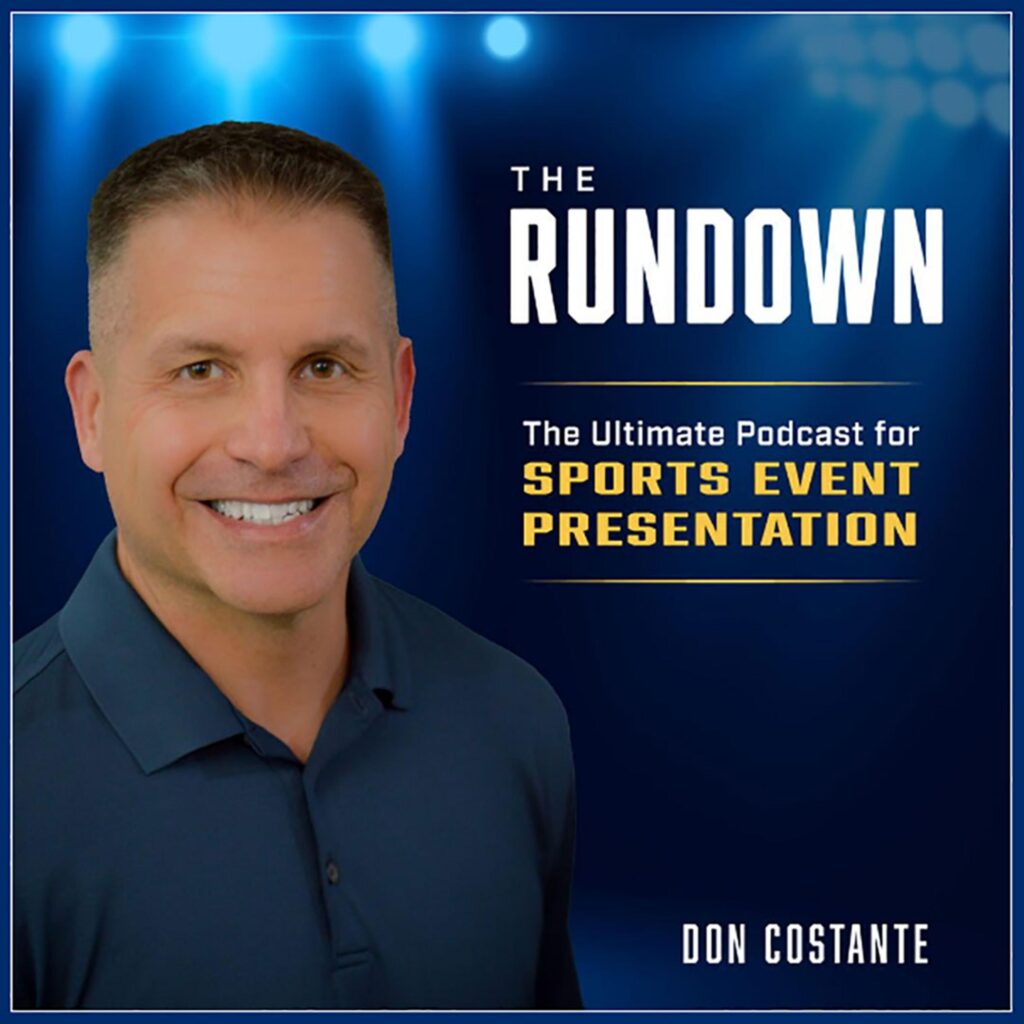
A great host shapes how an audience feels, reacts, and remembers a live event. In this episode, Lauren Thompson shares her playbook from more than 20 years in television and live event hosting with NBC Sports and Golf Channel. We cover her career journey, hosting philosophy, the three most important skills to be effective, how to deliver content authentically, her preparation process, and the most common mistakes hosts make and how to avoid them. If you want to become a host, improve as one, or manage hosts, this conversation is for you.
Transcript
The transcript below has been lightly edited for readability and clarity. Click any starting timestamp to jump to that exact point in the YouTube video.
Podcast Introduction
[00:00] Don Costante:
Welcome to the Rundown Podcast, hosted by Don Costante, a nationally recognized event presentation expert with over 30 years of experience and author of Beyond the Scoreboard. This podcast takes you behind the scenes with industry leaders to unpack the insights, strategies, and creative tactics that drive unforgettable live experiences. Let’s get started.
The Impact of a Great Host
[00:27] Don Costante:
A great host shapes how an audience feels, reacts, and remembers a live event. They guide the experience in real time, connecting every moment with clarity, energy, and purpose. What looks effortless is driven by preparation, timing, and the ability to read and respond in the moment. In many ways, no role has a greater impact on the success of an event than the host. My guest today understands that at the highest level. Lauren Thompson has spent more than 20 years in television and live event hosting, working with NBC Sports and Golf Channel on shows like Morning Drive, Top 10, and GolfNow, while also hosting major events across the industry. In this episode, we walk through Lauren’s career journey and the philosophy that guides her work. She shares the three most important skills needed to be effective as a host, how to deliver content authentically, what her preparation process looks like, and the most common mistakes hosts make and how to avoid them. She also offers valuable insight to those who oversee hosts. If you want to become a host, improve as a host, or manage hosts, this is a conversation you won’t want to miss. I’m ready to get started. Let’s meet Lauren Thompson. Hi, Lauren. Welcome to The Rundown.
Meet Lauren Thompson
[01:53] Lauren Thompson:
Thank you for having me. I’m so excited to be joining you.
[01:56] Don Costante:
You know, full transparency to everybody that’s listening. Lauren and I know each other. I’ve worked with Lauren for eight years now, believe it or not.
[02:04] Lauren Thompson:
Yes, sir. Amazing. Yes, sir. Eight amazing years, I would say.
[02:08] Don Costante:
But I will tell you this, that this is the first time I’m nervous talking to you, Lauren.
[02:14] Lauren Thompson:
Stop. Do not tell me that. Listen, we have seen each other in scenarios that could have been way more nerve-wracking. This is not one of those scenarios, Darren. We’re good now. We’re just talking.
[02:24] Don Costante:
I am talking to Lauren Thompson. So she has talked to some of the biggest names in sports. And here I am interviewing you. It’s a little intimidating. I got to tell you.
[02:34] Lauren Thompson:
Listen, I’m usually the one doing the interviewing. So if I know what you feel like, I can promise you I’ve been in that exact scenario. I’ve messed up so many times. And, you know, we’re just two friends catching up. So this is great. But I’m kicking back and I get to be the interview subject this time. So sorry, Don. I’m enjoying every bit of this. This is awesome.
Lauren Thompson’s Career Journey
[02:53] Don Costante:
Well, let’s start right from the top. Lauren, you’ve spent 20 years in television and live events hosting. So walk me through your career path from how you got started to where you are today.
[03:05] Lauren Thompson:
Well, I can tell you that my first goal was never, ever to be in TV.
[03:10] Don Costante:
Wow.
[03:10] Lauren Thompson:
I wanted to be a nurse, actually.
[03:12] Don Costante:
Really?
[03:12] Lauren Thompson:
In fact, when I was younger, and this started probably middle school, early high school, I was a diehard science nerd. Just loved it. The shows I watched were not anywhere near the shows that all my friends were watching. I was watching everything on TLC, medical, incredible, labor and delivery. I mean, anything that dealt with being a nurse, taking care of, in particular, like babies and delivery. I was just fascinated by the whole process.
[03:37] Don Costante:
I never knew that. Wow.
[03:39] Lauren Thompson:
Yeah. So the whole goal growing up was to go to UCF. I went on scholarship. I was a really good student. I was a nursing major. And honestly, just while I was putting myself through school, decided that instead of being a hostess and waiting tables, which was one of the first jobs I had in college, that doing local convention work and print work, car commercials. I heard how much money these people were making. And I’m like, you know what? Instead of taking out a bunch of student loans, I’m going to join up with an agency and I’m going to do a little bit of this. You know, I’m pretty comfortable talking to the public. I enjoy public speaking. I enjoy just the adrenaline of production. But it was never the goal to do that, you know, when I, you know, quote unquote, got a real job.
From Nursing School to Hosting
[04:25] Don Costante:
Sure.
[04:25] Lauren Thompson:
So to put myself through nursing school, that’s what I was doing for the most part.
[04:30] Don Costante:
Wow.
[04:30] Lauren Thompson:
But then honestly, I had a big change of heart. I had a professor that I probably let get under my skin a little too much at school and decided to change my major to marketing. And still at that time, I thought, you know, I can’t be doing this TV stuff forever. I need to get a career. I need to do something a little more, you know, cemented and solid. So my family would say, you know, and a lot of people would say that TV is just kind of a part-time thing. So in the meantime, kept doing the commercials, infomercials, a lot of car commercials. Got a audition to be an interviewer for a wrestling company on Total Nonstop Action was the show on Spike TV. And I remember thinking, okay, well, you know, eventually I want to get into like medical supply sales or do sales of some type. But decided to do the wrestling thing just for a little bit, mainly because I had a girlfriend who was kind of doing the same thing. I’m like, well, this will be fun. We’ll be able to hang out together, hang out with these cute guys and all this stuff and then check out the wrestling industry. And I did that for about a year. And at that time was like, okay, you know, eventually I need to button things up a little bit and get to the heart of what my career goal is in the first place. And that’s when Golf Channel called.
Wrestling, Golf Channel, and Morning Drive
[05:39] Lauren Thompson:
And I remember hearing they were right down the road. They were in Orlando, Florida. I played golf very, very casually, like terrible softball step through in my swing. I was not good. But, you know, it turns out most people who talk the game of golf and don’t actually play it for a living, none of us are that good. So I started taking lessons secretly, but I joined up with Golf Channel to do a countdown show called Top Ten. Loved it. They gave me a chance to host a travel show, which kind of had always been like a hidden dream of mine. I used to watch all these travel shows and I’m like, you know, that could be kind of fun. You know, let’s go try that out. Did that for about two years. And then they had a show called Morning Drive. They decided to expand the team that was on Morning Drive. We were going from five days a week to seven days a week and they needed more people and joined up with them. Did that show for about 10 years. So that was 10 years of having a 3 a.m. alarm.
[06:30] Don Costante:
Oh, wow.
[06:31] Lauren Thompson:
Which was insane. Whole lot of coffee, just copious amounts of the stuff, but loved it. Honestly, I just had such a great crew that I was working with and we’re still friends to this day. Enjoyed every second of it. And also became a really good napper in the process. I can take a nap anywhere. I’m completely good at falling asleep for anywhere from 15 minutes to two hours if you give me the opportunity. But yeah, that’s what kind of got me into the whole sports realm and just loved every second of it. Got to interview a ton of fun players and learn about the game. I’ve luckily become a much better player of the game myself in the process.
[07:06] Don Costante:
Awesome.
[07:07] Lauren Thompson:
I’m about a 16 handicap right now.
[07:10] Don Costante:
Wow.
[07:10] Lauren Thompson:
But you know, we’re working on it.
[07:11] Don Costante:
That’s awesome.
[07:12] Lauren Thompson:
We’re always trying to get better. Aren’t we, Don?
[07:13] Don Costante:
Not me, unfortunately.
[07:16] Lauren Thompson:
One day I’m taking you out on the golf course. It’s going to happen. One day.
[07:19] Don Costante:
That’d be fantastic. But I’m loving this. I’m learning stuff I had never known about you. So this is fantastic.
[07:25] Lauren Thompson:
It was a roundabout way to get to work with you eventually in the end, Don.
[07:29] Don Costante:
Oh, boy.
[07:29] Lauren Thompson:
It did happen. And yeah, a lot of stories to tell for sure.
A Live Event Moment That Could Have Been a Disaster
[07:32] Don Costante:
So let me ask you, was there ever a moment when you were on stage or on camera that really stands out to you? One where you thought, this is why I love what I do.
[07:41] Lauren Thompson:
Oh, my gosh. You know, there was a moment that could have been a disaster. And honestly, I feel like that is when live TV shows what it’s made of. I think that’s when live events show what they’re made of. When things do not go according to plan, because we can plan out the day and how things are going to unfold all we want. But I feel like the magic is when things take a little slide and then you’ve got to get creative. And there was a PGA Junior League World Championship event. It’s out at Disney. Huge event where just junior golfers from all over the place come. They’re playing. They’re competing. They’re giving awards out. Really cool to be a part of it. So this is during my morning show days. So I’m doing the morning show. And that day I was asked by our executive producer at Golf Channel, PGA Junior League needs someone to host these. You know, let’s say it was like a Thursday. After the show, go out there. It’ll be like an hour. It’ll be really fun. Laid back. You’re just helping pass out awards. So we go out there to the Disney property, which is doing this. We’ve got a room of about 500 people. You know, the kids, their parents. I’m told by the person, you know, in charge of the event, you know, you’re going to go up there. You’re going to talk about 10, 15 minutes about what you do.
The PGA Junior League World Championship
[08:52] Lauren Thompson:
Then you are going to bring up a very special cast of characters onto the stage. And, you know, at Disney, they’re talking Mickey and Minnie and Donald and the whole crew.
[09:01] Don Costante:
Of course.
[09:01] Lauren Thompson:
So they’re going to be coming out. So I go out there. We’ve got all these kids in the room, all these parents. They’ve traveled from all over the country. And I’ve got someone in the back, the person who tells me if I need to wrap things up. They’re saying they need five more minutes. And I’m like, well, I’ve already said everything I was going to say. You know, I don’t really know what I’m going to do right now. So I just decided at that moment, we’ve got all these kids hanging out. I’m just going to pull my microphone out from its stand and I’m going to walk out into the crowd and I’m going to talk to these kids a little bit. So that was when things, maybe people could tell that this wasn’t exactly going to plan, but I kept, you know, telling them, you know, we’ve got some really special people that are about to join us on stage. But for now, let’s get to know some of our competitors. And I’m walking around the room and you’ve got the kids who like do not want to talk to you. You know, you can just tell. They’re just like, not me, not me.
Improvising With the Audience
[09:48] Don Costante:
Right.
[09:48] Lauren Thompson:
And then you’ve got this whole table of, oh gosh, they were probably eight to nine year old boys and they’re pointing at their friend. You know, they’ve all got their hands in the air. They’re pointing over this one particular kid.
[09:59] Don Costante:
Yeah.
[09:59] Lauren Thompson:
Like, all right. So walk over this kid. I’m like, you know, your friends really think that you should answer some questions. So tell me about yourself. And I’ll never forget this kid. His name was Spencer Benton. He starts telling me that he’s here to compete, but he’s also here to find a girlfriend and starts telling me how he likes long walks on the beach and all these things. And I am just thinking his friends are like, they’re all red in the face, but he’s not. He’s as confident as he could possibly be. So, you know, I’m thoroughly enjoying this moment with this kid. Ended up asking him a few more questions. Then of course I get the cue that it’s time for Mickey and the gang to come out. So I had to end my conversation with Spencer. I’m probably 38 at this time. And this kid is full blown hitting on me and it’s super inappropriate. But yeah, we were just being laid back with it, going with the flow. So Mickey and Minnie come out. Everything’s fine. I get a letter at Golf Channel the next week and it’s from Spencer. And he’s telling me, you know, I really enjoyed our conversation. You let me know if you change your mind.
A Memorable Connection With Spencer Benton
[10:58] Don Costante:
Oh gosh.
[10:59] Lauren Thompson:
I’ve since found out you’re married and you know that you’re not interested. So Spencer Benton continues to send me a Christmas card every single year.
[11:07] Don Costante:
Wow.
[11:07] Lauren Thompson:
For years. I mean, probably 10, 11 years he sent me a card. And we’re now friends on Instagram and he’s now like a collegiate golfer and he’s doing great things and he’s incredible. But he still jokes around all the time. He’s like, you just let me know if you change your mind. I’m a phone call.
[11:20] Don Costante:
What a great story.
[11:22] Lauren Thompson:
That’s a moment that sticks out in my head about a live event that went wrong, but then also went so right and humorously, you know, it was just a great way to, you know, just have fun in the situation.
[11:34] Don Costante:
What do you do?
[11:35] Lauren Thompson:
You got to roll with it.
[11:36] Don Costante:
Absolutely. That right there was a moment for you that you said, this is why I love what I’m doing.
Why Lauren Loves Live Events
[11:41] Lauren Thompson:
Well, I loved it for a lot of reasons. I loved it because I became more confident and, you know, just sometimes you got to make a decision and you’ve got a room full of people. You’ve got a room full of kids and you’ve got a room full of kids who love the game of golf. And honestly, that is kind of at the heart of all of it for me when it comes to just being involved in the game. I love the pros. Don’t get me wrong. They are impressive. They are fun to interview. It’s really cool to see them hoist trophies, but nothing’s better than seeing kids take up a game that they love, playing it with their friends, putting their phones away and, you know, just enjoying the sun. I think now more than ever, golf is so important to juniors. And I’ve got an eight-year-old boy and a 12-year-old boy. And, you know, it means something different nowadays to me than it used to. And it’s for all of the above reasons. And I love the pros, but I love the juniors in the game for sure.
Lauren Thompson’s Hosting Philosophy
[12:32] Don Costante:
I love hearing that. So I want to get to the root of your philosophy. What is your philosophy for being a host?
[12:39] Lauren Thompson:
Oh, my philosophy. I would say it is to make it fun. I don’t think anyone wants to be in a stuffy room. And so I think to loosen things up is always good. I really like to be able to work a room a little bit and get to know some people before I go on stage because that, I think it can be a great back pocket moment where if someone tells you a story or just kind of something funny along the way and you’re up there and you’re talking, but you can point it out. You can have that person stand up. You know, people kind of enjoy that sort of recognition, I think, for the most part. But overall, I think my philosophy is to keep things warm and welcoming and to get the crowd to think you’re talking to them and that they could come up to you and they could hang out with you. They could have a beer with you at any given moment, talk sports with you. And they feel like they know you as a person when they leave that day.
The Role of the Host
[13:26] Don Costante:
So how do you think your role as a host? Are you there to entertain, to guide the program, to serve the audience or something else?
[13:34] Lauren Thompson:
Well, I think it’s a mix of everything. I think you’re mainly there to set the tone. So definitely know your crowd, the organization that you’re there for and the people that are sitting in the crowd. Know what they want out of this. I think it’s important to establish who you are to the people who may not know you. I mean, I’ve definitely hosted events for insurance companies and they’re like, wait, who’s this girl? And, you know, where’d she come from? All sorts of vendors I’ve hosted things for. So I think it’s important to, you know, without feeling like you’re tooting your own horn or yelling out all the things that make you who you are. Just give them a little reminder of who you are. You know what you do. Some cool experiences you’ve had and then get on with it. But a lot of times it just depends on the company. A lot of times they just want me to do a brief introduction, get someone else out there and get them talking. Other times it’s more of like a fireside chat, we call it, where you’re bringing out a few people and you’re conducting a conversation. In those moments, I think it’s very, very important to make sure that all of your interview subjects, especially if they’re from different industries, to get them all on the same page. We had an event with Annika Sorenstam, who, you know, in golf is huge.
Creating a Conversation on Stage
[14:40] Lauren Thompson:
She’s a World Golf Hall of Famer. She’s a history maker. And I mean, we’re bringing up everyone on the same stage. We’re bringing up Kathy Ireland.
[14:47] Don Costante:
Wow.
[14:47] Lauren Thompson:
Swimsuit model extraordinaire.
[14:49] Don Costante:
Yes.
[14:50] Lauren Thompson:
But also quite a businesswoman. Like she’s like top 30 in the Forbes list. She’s insane. Incredible.
[14:56] Don Costante:
Incredible. Yeah.
[14:57] Lauren Thompson:
Then Caitlin Clark. And this is during her rookie year. So this is a couple of years ago. And then we’re bringing up Annika. So we had, you know, Kathy Ireland talking about creating like who you want to be known for and setting your reputation and what messages do you want to get out there to a crowd. But then we’ve got Caitlin just starting her career. And then we’ve got Annika who’s celebrated at everything she’s done. You know, what do all these people have in common? And we’re also bringing up the main sponsor of the event, which was Gainbridge. So they’re big in women’s sports. So we got them to talk about multiple things to the crowd that day. But I think in moments like this, you’ve really got to carve out your questions so that they have something in common so they can all talk because you don’t want it to be just you throwing out one question, then one person answers. You answer another question. You want it to be a conversation.
[15:42] Don Costante:
Absolutely.
[15:42] Lauren Thompson:
You want it to flow. And honestly, you want the audience to feel like they’re involved in it too. So I think there’s important moments where you do take a moment, look out at the crowd, kind of wrap things up. What you’re hearing and what you hear the message as and get them to kind of nod along, make sure they’re still with you so that everyone’s still present in the room.
[16:01] Don Costante:
Incredible talent to be able to do something like that. I’ve seen.
[16:04] Lauren Thompson:
It doesn’t always go as planned.
[16:05] Don Costante:
Well, I’ve seen you do it time and time again. And I’m always amazed how you bring it all together. It’s just incredible. So there are people listening now, Lauren, that are so interested in getting into hosting. If somebody wants to become a host, whether it’s in sports or in the live event industry, where should they begin, in your opinion?
How to Get Started as a Host
[16:27] Lauren Thompson:
Oh, my goodness. All right. So I just had this conversation with someone not that long ago who was getting into it.
[16:31] Don Costante:
Okay.
[16:32] Lauren Thompson:
And, you know, there’s my like basic answer, which is, okay, well, you know, typically if you’re starting from scratch, it really does depend on where they’re coming from. Because this particular girl I was talking to was in college. She wanted to be a sports broadcaster. So I was like, okay, well, what are you doing right now to kind of hone your skills? And she’s like, well, I can’t do anything. I’m in college. I’m like, sure you can’t. There’s sporting events at your college, right? You know, you could go out there. You could hire a friend to hold the phone for you. I mean, iPhones are pretty good these days. You can record some pretty good high quality material on there and do some interviews for your school. And she started thinking, this is crazy. Who would I talk to? I’m like, go talk to the head of athletics. See if you can start doing some interviews and try to sharpen your teeth that way. But if someone’s already out there and maybe they’ve dabbled in it a little bit, they know a little bit about the industry. I would say to say yes to everything. You’re not going to get these high-paying jobs right off the bat. And you’re certainly not going to be hired for the high-paying jobs unless you’ve already done other jobs. You need a resume. You need experience under your belt.
Say Yes to Opportunities and Build Experience
[17:34] Lauren Thompson:
So I would say even if something is absolutely free, you’re not getting paid anything for it, say yes to it. Because some of those experiences are the ones where you will learn the most. It’s not exactly what you want. Of course, all of us want a paycheck for work that we’re doing. But you’ve got to become a professional and do the work before you get that title. So I would say just to do as much work as you possibly can. These days with social media, you can really get the word out quite easily about what you want to do. So I think you can spread the message through social media. You could spread the message through friends. And then once you do have a few things under your belt that have been recorded, make a demo reel and literally send it to anyone. Send it to news channels. Send it to Golf Channel, NBC Sports. I mean, there’s a million ways you could go about doing this because you never know when they’re looking for someone, someone fresh to start with. Someone who might be an intern. I mean, you could intern with these companies and very easily kind of get the ball rolling that way too, because you just need to get in as many doors as possible. Have as many conversations as possible. And you never know when that right moment might catch up with you.
Creating a Demo Reel and Opening Doors
[18:36] Don Costante:
Oh, absolutely. I loved how you told her in college, get involved with your athletic department.
Start With Your College Athletic Department
[18:41] Lauren Thompson:
Yeah.
[18:42] Don Costante:
We talk to kids all the time. Students say, I would love to get experience. That’s your university. Get involved.
[18:47] Lauren Thompson:
Yeah.
[18:47] Don Costante:
And they don’t even realize that they should go to the athletic department. It’s like, no, go, go shadow the producer or the stage managers or the host. You’ll gain such great experience. And so I love that you told her that.
[18:59] Lauren Thompson:
Oh, yeah. And you can learn something from anyone.
Learning From Every Experience
[19:02] Don Costante:
Oh, yeah.
[19:03] Lauren Thompson:
I mean, this guy I did car commercials with back in the day. I mean, he was brutal. He was so, oh, he was awful. And these were long scripts. And honestly, we’re friends now. But we had some moments where there was almost like a shouting match at one point. And it was so tricky and uncomfortable. And I think he was, you know, going through some challenges of his own back in the day. And I was relatively green also, but he didn’t believe in a teleprompter. And we’re memorizing two-minute car commercials that have, you know, APR rates and down payments. And I’m like, this is impossible to memorize this and get it in one-take without any editing. However, let me tell you, I learned so much from that guy about head movements in car commercials. I mean, how you shouldn’t be shaking your head no. Even if you’re saying something good, you’re non-verbally telling the audience no. So he would get us on little head movements. He’s like, you just shook your head no at me. Why would I want to buy a car from this dealership? And things you’d never think about. But I learned an immense amount from him. And I’ll take every bit of the knowledge I can from experiences, good and bad, because you need that to become who you want to be.
[20:08] Don Costante:
I love that. So this next question, I’m really interested in what you’re going to say, because like I said, I’ve seen you perform. So this is going to be interesting. From your experience, what are the three most important skills somebody needs to have in order to be an effective host, whether that’s on television or on stage at a live event?
Three Essential Skills for an Effective Host
[20:27] Lauren Thompson:
Oh, goodness. Number one, I think you need to be genuine because your crowd, whether they’re in a room or watching you on TV from home, they’re smarter than you think. So they’re going to see right through you if they think you’re being fake, if you’re being cold. If you don’t enjoy what you’re doing, it is so obvious to a viewer. So I think you need to be genuine and actually love what you’re doing. I also think you need to know what you’re talking about because they’ll see right through that too. So that would be the number two point. Just really try to immerse yourself in your topic. I’ll be the first to admit, I was not a through and through golf expert when Golf Channel hired me. But I could tell right off the bat that I had a lot to learn. And I decided to and from home, just going to work, I’m going to listen to PGA Tour radio on SiriusXM. I’m going to listen to it. I’m going to live and breathe this stuff. I’m going to go home. I’m going to watch golf on TV. I’m going to take golf lessons so I actually know what I’m talking about, you know, a little bit more than just my homemade swing that I started with when I joined the network. And I’m going to talk to the people who are at the network. I’m going to ask them what they did. What’s their story? And you really need to just immerse yourself in the content.
Skill One: Be Genuine
Skill Two: Know Your Material
[21:37] Lauren Thompson:
So, you know, number one, be genuine. Number two, know your material. And number three, always keep learning because you are never too professional, too sharp to learn a few new things. And so I think you always need to be chasing things you can improve. It can be very uncomfortable watching your material back. A lot of times I used to hate doing this, but our producers at Golf Channel would make us do it. They would key us in on sayings that we said over and over again. Lauren, you repeat this one saying over and over and over again.
Skill Three: Always Keep Learning
Reviewing Your Own Work and Eliminating Crutch Habits
[22:09] Don Costante:
So smart.
[22:09] Lauren Thompson:
So today on live TV during our two-hour show, if you say this saying, you owe me a dollar or $10 or whatever.
[22:17] Don Costante:
Right.
[22:17] Lauren Thompson:
I think it was just a dollar at the time that the producer’s like, you owe me a dollar every time you say that.
[22:22] Don Costante:
Oh, I love that.
[22:22] Lauren Thompson:
And I’m pretty sure the saying was, well, time will tell or we shall see. He’s like, you say this over and over again. So, you know, you got to kind of watch yourself over. Be careful about the things that you, like your crutch phrases, go-to things that you do. Maybe you sway back and forth when you talk. Like you need to watch yourself to know if you even do these things in the first place.
[22:43] Don Costante:
Crossing legs as you’re standing there. Oh, yeah.
[22:46] Lauren Thompson:
All of it.
[22:46] Don Costante:
I wish I had that advice. I would have loved to charge my host in the past for things that they repetitively do.
[22:52] Lauren Thompson:
There you go. It’s one way to save some money.
[22:54] Don Costante:
Yeah, no question. So you mentioned preparation early on in this conversation. So I want to go there for a second. So before stepping out onto a stage or going live on camera, what does your preparation process typically look like?
Lauren’s Preparation Process
[23:06] Lauren Thompson:
Most of the time, and this starts, you know, as we know, weeks before the event, where you’re just in touch with the company. Who’s producing it? Who’s going to be your main point of contact? What is the main message? How much time are you going to have? What’s the crowd coming from? Where are they going to after they’re in the room with you? What’s your role? So these are all conversations that happen well in advance of the event. About a week before the event, I just make sure I’ve got the most up-to-date information because things likely change with live events. I start laying out outfits. We’ve got to make sure that in this industry that you’re not presenting wearing the color of one of their competitors. Say if it’s sponsored by a certain company that you’re not wearing their competitor’s main color. Some people don’t care. Other people are like, no, no, no. Actually, we really need you to wear this and this. So start laying out the outfits. And of course, you want to wear things that make you feel comfortable, make you feel confident. Outfits you feel good in will go a long way for live events especially. Then you want to start kind of preparing the things you’re going to say. I think it’s always good just to kind of read things out loud, walk around in a room while you’re doing it.
Preparing Wardrobe and Material
[24:14] Lauren Thompson:
Make sure you like the feel and the sound of it because if things are worded strangely or you’ve got questions about the material, you want to get that across to the production company or whoever your contact is as soon as possible. And then day-of, get there early. Early, early, early. Because no one wants to deal with someone who is running late, ran into traffic, had whatever issue that morning. In an event, especially if it’s a one-day event, you’ve got one chance, one thing they’ve hired you for and you cannot be late for it. So I always say get there incredibly early so that you’re comfortable. Worst case scenario, you’re going to hang out in a side room and you’ll be able to rehearse more of your stuff. If you’re a girl guy, whatever, touching up makeup, making sure you’re good to go, talking with the clients a little bit more, getting a coffee. There’s a million things you can do. But if you are on site and ready to go, that is 99% of the battle. You can’t do a good job if you’re not there and they’re going to remember if you’re late.
Get There Early
What to Learn When You Arrive On Site
[25:10] Don Costante:
So speaking about getting there early, what are those things that you want to see right away and understand when you arrive on site so that you can perform your role effectively?
The Importance of Rehearsal
[25:20] Lauren Thompson:
Well, it’s nice to have a rehearsal aside from just right before the live event. So if the company you’re working for has the freedom of having a day before rehearsal, that is huge. Especially if it’s a big event, seeing the stage, seeing how you’re going to be positioned, knowing what kind of microphone you’re going to be using if you’re going to be mic’d up. But with a love, we call it, or if you’re holding a microphone, that gives you a chance to kind of play out the interviews that you’re doing. Is that person going to have a microphone or am I going to have to move my microphone back and forth? Are we passing a microphone around? All of this, it’s nothing that you want to be surprised with during the live event or someone starts talking. We’re like, oh, gosh, they don’t have a microphone. So to rehearse things like that go a very, very long way. If they’re recording it, you want to know where you’re supposed to be standing, where you’re supposed to end. How do you want me to close this out? You’d be so surprised how many clients. They tell me everything I need to do. But then I’m like, so where are they going next? And they’re like, oh, well, you know, let me talk to so-and-so. They would know that. But it would be very awkward to close out something that goes so well. And you tell everyone, well, it was great talking to you.
[26:25] Lauren Thompson:
Enjoy the rest of your day. And they have no idea where to go. They don’t know what’s coming. They don’t know if there’s a reception or if they’re done. It’s nice to be able to walk through all the scenarios so you know exactly what the traffic flow is like that day.
[26:37] Don Costante:
Wow. You know, one of the things that you do exceptionally well, and I shouldn’t say one thing, you do a ton of things well.
Making Scripted Material Feel Natural
[26:44] Lauren Thompson:
Aw, thanks.
[26:45] Don Costante:
But the way you deliver the scripted material, whether it’s in a teleprompter or on note cards, and you do it in a way that feels completely natural. I’ve talked to you about this. In fact, after this year’s GCSAA event down in Orlando, it never feels like you’re reading. I don’t know how you do it. I mean, I want to know, how do you go about developing that skill?
[27:05] Lauren Thompson:
Oh, okay. All right. So the teleprompter is very different in a studio setting than it is in a live event. Live events, you usually have multiple prompters if you’re lucky. So it can make you look like you are looking around the room when you have multiple prompters you’re reading from. I do think it’s extremely important to read through every bit of the material on a teleprompter because there can be typos, there can be misspellings, names you’ve got to say. And you really, really don’t want to mess up the names of people who might actually be in the room and certainly the people you’re introducing. So you want to run through all of that. I think it’s very important, and this might be kind of tricky to convey to listeners, but to be able to read enough far ahead in the prompter, you know, and this is just like a few words, to where you can look away briefly and then come back to where you were. So if you can read ahead enough to know the rest of that particular sentence that you’re on, to where you can look away, quickly make eye contact with someone, and then go right back to the prompter, that goes a million miles in teleprompter world.
How to Work With a Teleprompter
Preparing for Teleprompter Problems
[28:09] Don Costante:
Wow. And honestly, even just to take a brief pause, if you need a second to find where you were, because trust me, I’ve been there before when I’m like, oh, wait, where did I? That’s fine. And just to have little things you can say, know what you’re talking about enough to where you can slide in your own original thoughts, brief original thoughts here and there. Let’s say the teleprompter gets stuck. I mean, it happens. Let’s say that it just goes completely blank. That’s when you want it. And I know you know this, Don, I love and kind of must have a printout.
[28:39] Lauren Thompson:
I love what we’re saying in front of me because if the prompter does go down, I need to be able to say something. So, you know, it’s not the worst thing ever to have to look down, find your spot real quick and to finish it off using the script in front of you. Like that’s happened before. We’re all human. I think that’s okay. But in that, with that script in your hand, you want to underline the main points, highlight things here and there so that it’s not just a bunch of jumbled words when you’re in the heat of the moment. It’s nice to be able to look down and find key thoughts to where you can catch up. You can catch up to where you are, which is good. But with teleprompters in studio, you know, kind of the same thing. To be able to look away briefly, to look down, you’re trying to emphasize a moment or something that you’re saying is in the teleprompter. It’s okay to look away real quick and then to go back. To move your head a little bit, you know, just a little bit of head movement, nothing crazy looking and don’t think about it too much because then you just look nuts. But, you know, just something natural head movement with how you would be talking to a person anyway will make you look like you’re not reading.
[29:42] Don Costante:
Wow. Like I said, you do it extraordinarily well.
[29:45] Lauren Thompson:
Thank you.
[29:45] Don Costante:
You walk into rehearsal. Obviously, you’re prepared because we’ll go through it for the first time and it’s like a one-take with you and you’re good. You’re done, which is amazing.
[29:56] Lauren Thompson:
Well, the helpful thing is that instance in particular was with the golf industry. So I’m like, oh, I talk golf all the time. So I knew the material well enough to where no surprises were coming up. It’s language I’m used to. It’s nothing too crazy. So I was lucky in that aspect.
Reading the Audience
[30:12] Don Costante:
So earlier you talked a little bit about stage presence or having a presence. So when you step out onto a stage, how do you quickly read the audience and understand what they need from you in that moment?
[30:24] Lauren Thompson:
Honestly, I feel like most of the time the audience is on your side and they want you to do well. And you have to believe that when you step out there. Most of the time at an event, people are happy to be there. They’re not upset about sitting in a room. They’ve oftentimes just had a nice lunch. They’re at an event. They’re staying at a hotel. Even if it’s a work event, whatever portion I’m working on, they’re not actively working. They are sitting in a chair and they’re usually pretty happy to be there. So just knowing that the crowd is happy to be in the room with you is a nice thing. Knowing that going into it. A lot of times they’re with work friends outside of work. So they’re enjoying the moment just being away from the office and on a work trip. But I think you’ve got to step into it being excited, being genuine, knowing they want you to do well and that they’re happy to be there also. And I feel like if you just tell yourself that, that gives you kind of all the good vibes in the room that you need to know.
Movement, Positioning, and Body Language
[31:19] Don Costante:
So Lauren, you talked a little bit about this early on in the interview, but what role does movement, positioning and body language play in helping a host connect with a large audience?
[31:32] Lauren Thompson:
I mean, you just don’t want to be mechanical. The worst possible thing that you can do is go out there and stand in one spot and not move your hands and not move your head at all and just read.
[31:42] Don Costante:
Yeah.
[31:43] Lauren Thompson:
Then everything’s weird. You know, it’s not how anyone does anything. It doesn’t look natural. Oh, no. Like I think just a little bit of natural movement back and forth on the stage. Nothing that’s too systematic because if you’re doing it too much, that gets weird also.
[31:57] Don Costante:
Yes.
[31:57] Lauren Thompson:
But honestly, I think it’s important. You know, it’s funny in golf. We always tell people if you want to improve your swing, you know, watch the swing of someone. If you like their swing, watch their swing. What do you like about their swing? So in public speaking, I feel like it’s the same thing. Watch someone. That you like how they do things. You like how just the feel that they put out there to a room and maybe mimic it a little bit. I don’t think it’s the worst thing to fake it till you make it.
[32:22] Don Costante:
Sure.
[32:23] Lauren Thompson:
I like watching this person because they make you feel at home. They’re warm. They’re funny when the moment’s right. You feel like you could be friends with them. How do they do that? Well, they walk a little bit back and forth. They make eye contact with different people in the room and they just seem to enjoy what they do. So I think that’s nice for people to go out there and to have something to work off of based on how someone else conducts their self in public speaking.
Technology and the Modern Host
[32:46] Don Costante:
That’s good advice. Let’s talk technology for just a moment. So technology continues to change how live events and broadcasts are being produced. From your perspective, Lauren, how is technology influencing the role of a host and what should professionals in this field be paying attention to?
[33:04] Lauren Thompson:
You know, it depends very largely on your event. You need to be comfortable with teleprompters for sure. I mean, that’s just, you don’t have to. And in fact, I do weirdly admire people who just never want to work on a teleprompter, but usually they’re the expert in their field. If they’re that person, good for them. Like they can talk, you know, ad nauseum about whatever it is. And they are the expert of what they’re talking about. But if you are hired for something, you need to be able to be comfortable with a teleprompter, comfortable with an IFB, which is the earpiece in your ear, which keeps you kind of in touch with the control room or whoever’s running the event. Because a lot of times things change and they’re going to be in your ear while you’re talking about something else. And they’re going to take, hey, next step, you were supposed to be introducing this person. We’re actually going to go to Mary Smith, who’s the CEO of the company. So introduce Mary next. And you’re going to hear this in your ear, but you need to still be talking to the audience that’s not hearing what’s going on in your ear. So I think it’s very important to get comfortable with an IFB, with a teleprompter. If you want to be able to do all the things, every event is not going to have all these things for sure. But to be able to have that in your wheelhouse and know how to use it comfortably is going to be big.
Working With an IFB
[34:19] Lauren Thompson:
I mean, a lot of times in calling golf, you’ll have a monitor just within view that will show what you look like to the people at home watching, but then it will also cut to footage that you’re supporting. So a lot of times I would be like, oh, you know, welcome back to Morning Drive. I’m Lauren Thompson. Let’s take a look at what’s going on at the Players Championship. And we would look at, and the monitor would show me the leaderboard. So this is the stuff I’d be talking over. Then right there in your ear, you’ve got your producer saying, okay, we’re cutting to the graphics on club heads. And how our leader has blown away the field. So you know what’s coming up. So you can direct them to put the next support bit into the monitor. So let’s take a look at how fast he’s swinging that club because it’s impressive on the leaderboard. But you know, let’s look at the stats. And then they’re showing you the stats. Then in that way, you can kind of call your own shots. But it is a lot of technology. It’s a lot going on. Things of course can go wrong. I’ve had something that we call all call in my ear, which is every single noise.
[35:18] Don Costante:
Not good. Not good.
[35:19] Lauren Thompson:
From the control room. And I’m hearing the camera operators and their calls. And then usually at that moment, my little thing to do so the producer knows that there’s a problem is to pull out my IFB. I’ll just pull that thing right out of my ear.
[35:32] Don Costante:
Yeah.
[35:33] Lauren Thompson:
And then give it a few minutes, put it right back in while I’m talking. And then usually you’ll hear from the control room. Sorry, Lauren. It’s like, it’s okay. Just, you know, I was hearing everybody. So I don’t know. Crazy things happen. It’s nuts.
[35:46] Don Costante:
Yeah.
[35:47] Lauren Thompson:
Getting comfortable with the technology is huge. Getting comfortable as a person talking is far more important. Yeah. So I think just honing your craft, getting the experience in there, not saying no to any experience whatsoever. It’s just a way to get your foot in the door, which is all you really need in the first place is just that first step.
Listening to a Producer While Delivering Content
[36:06] Don Costante:
So I do have a question going back to IFB for a moment, because obviously you’re delivering content and you have somebody talking in your ear and you’re having to comprehend what they’re saying, but you’re also having to communicate the content you’re delivering. How do you do that?
[36:23] Lauren Thompson:
Well, most producers know, you know, just real short phrases, right? They’re going to tell you, they’re not going to say a lot in your ear because they know that you’re also still actively working. So usually they’ll just say like, we have an issue cut to break, Lauren cut to break. And you’ll just hear that the whole time. And you’re like, okay, I guess we need to go to break. They’re having some sort of issue. Who knows what it is. I’ll find out during the break, but just cut to break or toss it to Charlie. Okay. Like they want me to shut up and they want me to get to the next person who’s going to be talking. So they’ll just say a quick phrase, toss it to Charlie or toss it to Gary, or actually we’re going to wrap up this segment, send it. I don’t know. Usually they know that it’s a short phrase and they’re going to tell you something real quick and they’re going to repeat it a few times. Cause I mean, sometimes say like your IFB slips out of your ear just a little bit to where you’re not hearing it so well, but you can tell they’re trying to talk to you. You can hear a little bit. So you’ve got a moment to kind of push that IFB a little further in your ear, speaking from experience. And then, you know, hopefully they’re still repeating that. That same thing until you do it. So yeah, you just kind of do your best in those scenarios. Usually you can tell that something is going on because someone’s trying to talk to you. So hopefully you’re able to kind of pivot quickly in that situation.
[37:35] Don Costante:
As a host, you give like a little nod on camera, giving an indication that you heard what they said.
[37:41] Lauren Thompson:
Yes. Yes. A few times they’re like, just nod if you can hear me.
[37:45] Don Costante:
Yeah.
[37:46] Lauren Thompson:
You will nod. I had one producer say, just lift your hand up if you heard me, which was super weird for him to say. But I was like, so honestly, I used it in what I was saying and I made it look like I was just kind of in a real Italian way, emphasizing what I was saying. And I’m like lifting my hand up, but I’m like, what was that? So we had a laugh about that later on. He’s like, I don’t know. I didn’t know if you knew what I was saying. So what do you do? It’s live. It’s fun. I had a girl who was a veteran on Golf Channel a long time ago. Tell me once when she saw me just sweating over something before the show. I’m looking up things. I’m trying to write scripts. I’m, you know, just freaking out. And she goes, Lauren, we’re talking golf. We’re not curing cancer. And I’m like, you know what? So true. You’re so right. Like, you’re right. We’re talking golf. And so honestly, that saying that day changed everything for me. So I’m like, you know what? This is fun. If the viewers are sitting there and tuning in and watching sports, they’re enjoying themselves too. If things go wrong, it proves you’re live. It’s okay. We’ve had the weirdest things happen live on TV. And it’s funny. I watch the Today Show every now and then. They mess up here and there. And it proves that they are live on TV.
Embracing the Imperfections of Live Television
[38:55] Don Costante:
They’re human, right?
[38:56] Lauren Thompson:
Yeah. So I feel like that’s a good thing. And I feel like the audience, you know, if they’re like me, they weirdly like those moments. They appreciate them.
Common Mistakes Hosts Make
[39:02] Don Costante:
Lauren, you’ve seen a lot of presenters and hosts over the years. So what are some of the most common mistakes people make when they’re on stage or in front of a camera?
[39:12] Lauren Thompson:
Oh, goodness. In front of the camera is a funny one when they don’t know they’re on camera. So I’ve seen people. I’ve seen them just sometimes the camera operator gets the wrong call or the producer. Sometimes it is not your fault. Genuinely. Yeah. I mean, it’s just the producer in the control room made the wrong call to the wrong camera and you didn’t know you were supposed to be on TV. But you know, what are you going to do?
[39:34] Don Costante:
I’m sure you are.
[39:35] Lauren Thompson:
You have to be a little careful if you are anywhere in a studio where they could be coming to you. Just, you know, be as ready as you possibly can. Oh my gosh. I’ve seen people just rattle off completely wrong information and they’ve got to go back and apologize for it, which is fine. You hear it all the time in sports broadcasts where they’re like, excuse me, I misspoke. Just correct the mistake as quickly as you can and then move on. And that’s fine. That’s enough for the audience. I think that’s okay for people too. Try not to cuss. People don’t appreciate that. You know, you definitely have to watch your language. Live TV, certainly, which is family material. Watch your mouth. So that’s important. I haven’t seen that happen in anything that I’ve done. Certainly not on purpose. But sometimes someone’s microphone is pulled up and they weren’t even part of that segment. And they like go to the restroom. Oh. Or flush a toilet or whatever. And you’ll hear it. You’re like, oh shoot, their microphone wasn’t supposed to be on. But you know, just be very careful. If there is a microphone on you at any point, just know technically they could be picking it up, whether it’s your fault or not. So just be really careful what you’re saying, who you’re talking to and when you’re talking. Because you never know if it could be picked up.
Adjusting When Live Events Go Wrong
[40:45] Don Costante:
Yeah. So live events, you mentioned it earlier. They rarely go exactly as planned. So can you share a moment that didn’t go as expected and you had to adjust in real time to keep the program moving?
[40:58] Lauren Thompson:
Oh gosh. While you’re live, I mean, goodness, we had some real emergencies during our Morning Drive days. Certain times we had a guest completely pass out, just a loud thud on the floor. We had to send it over to someone in the next studio that was going to be doing like a simulator bit and we just tossed it over. And of course, you know, in that scenario and in any scenario, and of course your viewers should understand that safety is first and you’re going to take care of that guest and more than likely just toss it to break so you can make sure they’re all right. Yeah. We’ve had people just completely freeze up. I had a segment with a kid, live TV. They were totally fine until that camera was rolling on them and then they were terrified. And we decided last minute that we were just going to sit down. And I remember, I mean, luckily I had pants on that day. I remember thinking about it. And we just decided to sit down on the floor and the camera operators, we ended up going to our Steadicam, which is like a camera that a guy is wearing because the other cameras were propped up and it wasn’t easy for them to get a floor shot. So I was like, would you like to sit down? Because I was scared they were going to pass out. So we sat down and I tried to put my notes down. I tried to just act like a friend and try to get them to forget they were on TV. Of course, afterwards, they were very nervous and they were upset that it happened.
[42:14] Lauren Thompson:
But we got through the segment and they ended up doing just fine. But it was their first time on live TV. They thought they were going to react one way and then they didn’t.
[42:21] Don Costante:
Wow.
[42:22] Lauren Thompson:
You know, you just have certain moments like that where things will happen. It’s not just with kids. I mean, you’ll get CEOs of companies on and their hands are shaking.
[42:30] Don Costante:
Wow.
[42:30] Lauren Thompson:
They’re terrified. You can tell. So I think it’s always nice to be able to bring them back with something that maybe wasn’t scripted and this doesn’t work with everyone.
[42:38] Don Costante:
Right.
[42:38] Lauren Thompson:
But I remember a very nervous CEO that we had on for a segment once. Just, I don’t know what it was, but they just were nervous once the camera started going. And I asked them, well, you get out on the golf course with your kids, right? I’m like, you love it? They’re like, a day on the course with my child? Are you kidding? And just getting people to talk about things they enjoy talking about will help take up the nerves. And you can’t do that all the time. Live TV is very limited. You know, you’re on the clock, but it just depends on the scenario.
Advice for Event Directors
[43:05] Don Costante:
But that’s your experience. I mean, you understand that you need to connect with them somehow and get them to talk a little bit and make them a little bit more relaxed. Advice for event directors out there. From your perspective as a host, what should the communication and working relationship look like between the host and the host? And the event producer in order for a live program to be successful?
Communication Between the Host and Event Producer
[43:25] Lauren Thompson:
I think communication itself is super important. You’ll get certain companies that you don’t even really talk to until it’s like the day before. I’ve had events like that where they’re like, oh, you’ll meet the producer 30 minutes before. Just get there 30 minutes before. And sometimes the event is simple and you don’t need big run throughs. But I also think just for the person running the event, especially if it’s your first time working with a host, to have some phone conversations before, to send them any material or any rundowns, any ways that you want the show to shake out the entire time, to show them all of that and to over communicate.
[44:02] Don Costante:
Right. And then just make sure they’re comfortable, make sure they’ve got water, make sure they ate something before they go out there. It depends on their relationship a lot and the experience of the host and the experience of the producer or the event coordinator. But I think just touching base beforehand and making sure that the host is okay will tell you everything you need to know before the event. You’ll know if they’re comfortable or not. You have told me stories of just walking into an event and not having any communication. So event directors out there, be sure, communicate early. Over communicate, as Lauren talked about. So that brings us to our final question today. For those listening who either want to become a host or want to improve their skills on stage, what advice would you leave them with?
Final Advice for Aspiring Hosts
[44:45] Lauren Thompson:
I would tell them to get out there and do what you can with what you have where you are, which I’ve heard that advice just with helping communities and charity work. But honestly, with hosting, it’s the same exact thing. So wherever you are that day, you’re sitting on TV, you’re watching a sports broadcaster and you’re thinking, that’s pretty fun. That looks like something I want to do. What can I start right now with doing? And sometimes that’s classes. There’s very formal education ways to go about it. Sometimes that is literally like the girl I was talking to in college who just wanted to get started and I told her to go speak with the athletic department, see if they’ve got a camera crew. Do they want to start covering events? Even just for social media, content creation is so easy to do with just even a tripod and a ring light and your phone. And you can just start putting out content. Say someone’s watching and they’re like, I want to be involved in golf. So get on your phone. Start a social media. Start a social media account. Establish who you want to be and just talk golf and say you’re going to have a Monday segment where you talk about what happened over the weekend. And it can be two minutes or 10 minutes. But that’s the way to establish a following. And these days, especially, that’s a way to establish a reputation to where you can potentially get noticed by other networks.
Don Costante’s Closing Thoughts
[46:01] Don Costante:
Such great advice. So this has been outstanding. I want to thank you, Lauren, for taking the time to share your experience and your insights. I’ve been with you for eight years and I’ve learned so much just from you talking today. So I know it’s going to help a lot of people out there who have dreams of becoming a professional host. So thanks again, Lauren, for joining me today on The Rundown. You’re the best.
[46:21] Lauren Thompson:
Thank you for having me on. I appreciate it. Until next time.
Podcast Closing
[46:25] Don Costante:
That’s a wrap on this episode of The Rundown. Have a question or want to share your thoughts? We’d love to hear from you. Just email TheRundown@CostanteGroup.comEmail The Rundown. Also, be sure to subscribe, share the podcast, and follow us on LinkedIn and Instagram. On behalf of Don Costante, thanks for listening. Until the next time, this is The Rundown Podcast.
Explore Seasons
Find us on your favorite platform
Listen to the latest episodes and stay updated!
Find us on your favorite platform
Listen to the latest episodes and stay updated!
More Episodes