Great in-game music doesn’t happen by accident. In this episode, Joe Green, DJ and Music Director for the NHL’s Vegas Golden Knights and the WNBA’s Las Vegas Aces, shares his career journey and provides an inside look at the strategy, preparation, and technology behind creating an exceptional in-game music experience. We also discuss playlist development, the role of music in sports, what separates a good sports DJ from a great one, and his advice for the next generation of Music Directors.
Transcript
The transcript below has been lightly edited for readability and clarity. Click any starting timestamp to jump to that exact point in the YouTube video.
Podcast Introduction
[00:00] Don Costante:
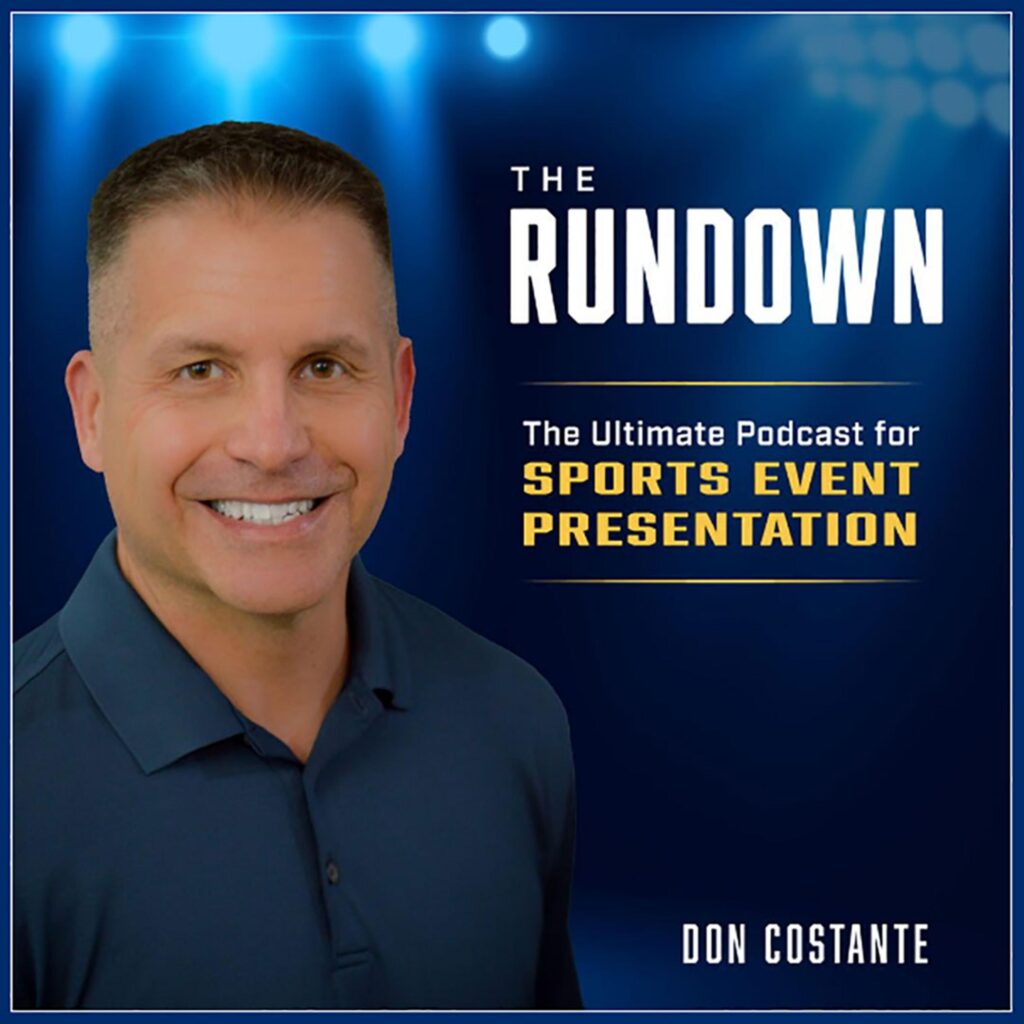
Welcome to the Rundown Podcast, hosted by Don Costante, a nationally recognized event presentation expert with over 30 years of experience and author of Beyond the Scoreboard. This podcast takes you behind the scenes with industry leaders to unpack the insights, strategies, and creative tactics that drive unforgettable live experiences. Let’s get started.
The Power of Music in Sports Event Presentation
[00:27] Don Costante:
Some of the most memorable moments at a sporting event aren’t defined solely by what happens on the playing surface. They’re created through sights, sounds, and atmosphere that bring an entire venue to life. Music is one of the most powerful tools in sports event presentation. When used intentionally, the right song at the right time can build anticipation, create energy, elevate emotion, and turn an ordinary moment into one fans remember long after the game is over. My guest today is Joe Green. Joe serves as DJ and music director for Foley Entertainment Group, where he oversees the in-game music experience for the NHL’s Vegas Golden Knights, the AHL’s Henderson Silver Knights, and the WNBA’s Las Vegas Aces. Throughout his career, he’s also provided music for some of the biggest events in sports, including Formula One, the NHL All-Star Game, the NFL Pro Bowl Games, NCAA March Madness, and the WNBA All-Star Game, while also consulting with organizations such as Oklahoma Athletics and the Charlotte Hornets. In this episode, Joe shares his career journey, his philosophy on the role music plays in sports event presentation, and how he prepares for every event. We also talk about how he builds playlists, organizes his music library, the technology and software he relies on, what separates a good sports DJ from one that’s great, and his advice for the next generation of music directors.
Meet Joe Green
[02:02] Don Costante:
I’m ready to get started. Let’s meet Joe Green. Hi, Joe. Welcome to The Rundown.
[02:09] Joe Green:
Hey, thank you for having me.
Joe Green’s Career Journey
[02:10] Don Costante:
Now, Joe, you have had an incredible career. Let’s start right at the beginning. Tell us about your career journey and how you found your way into sports and eventually into your current role with Foley Entertainment Group.
[02:24] Joe Green:
My career started kind of like right out of high school, where I had an interest in being a music producer. I looked up to a lot of hip hop producers who started out as DJs like Dr. Dre and Pharrell and Just Blaze. And their foundation was DJing. So I figured I’d pick that up, which took me through a lot of college events. I started at UNLV, events around town. And then I moved up into nightclubs and lounges and then later radio and all of these nightlife things and radio also. And then finally, we announced that we’re going to have a team. So I took a chance. And after about a year of trying to get on, I finally did, which brought me into the Golden Knights. And then later on, the Raiders, Aces, F1 and all these events. But the way I started was pretty much out of high school with an interest in music production and then DJing being the foundation of that.
Knowing Sports Was the Career He Wanted
[03:12] Don Costante:
Was there a moment when you realized that this was the career that you wanted?
[03:17] Joe Green:
Yeah. I mean, I grew up in Vegas. I’m born and raised here and we didn’t have any sports teams. So looking around, I either have to pick the Cowboys or the Stars or the Blackhawks and Bulls. And so once I found out that we were going to have a team, I knew that I wanted to be a part of that and I wanted to bring what I could being born here into these organizations. And so that’s when I knew I was like, I have to be a part of this in some aspect. And ideally, that would be music.
Joe Green’s Role With Foley Entertainment Group
[03:42] Don Costante:
Wow. And tell people in terms of your current role now with Foley Entertainment Group, what is that?
[03:48] Joe Green:
With Foley Entertainment Group, I’m their music director as well as in-game DJ. So I oversee all of our teams, which is the Vegas Golden Knights, the Henderson Silver Knights, the Vegas Nighthawks IFL team. And we used to have an NBA G League team, the G League Ignite, which doesn’t exist anymore. But I oversee all those teams and I can’t be everywhere. So that’s hiring DJs and training them up so they can take on some as well.
[04:12] Don Costante:
Yeah. Now you’ve worked on everything from Stanley Cup to Formula One, WrestleMania, March Madness, and even the Pro Bowl. So looking back, what’s one lesson you learned early in your career that still influences how you approach your events today?
Preparation and Organization
[04:28] Joe Green:
Preparation and organization, which spans across all of these sports and in DJing in general, just being well organized and prepared. Sports, it’s an unpredictable environment. You don’t know which way the game is going to go. So preparing for any and everything and being overprepared is one thing that I think everyone should really take into account for. There’s been DJs I know who’ve done it longer than me who come and see my organization and they’re like, oh, wow, I wish I could have that type of organization just to be prepared. So that’s definitely a major element.
[04:57] Don Costante:
I love that. Now, as prepared as you can be, mistakes are going to happen. Was there an early mistake maybe that became one of your biggest learning experiences?
Learning From Early Mistakes
[05:06] Joe Green:
Yeah. Playing for hockey specifically, you can’t play when the puck is in play. And so you may think that you hear a whistle and start playing music and you cannot do that. So that’s one mistake that haunted me for a while. And it happened a couple of times, especially early on in my career. And so I make sure to keep an eye on the clock. That’s one. It’s not a big one, but it can be if it’s a continued mistake. It could put your job in jeopardy or get the team fined.
Joe Green’s Music Philosophy
[05:32] Don Costante:
Before we get too far into our conversation today, what’s your philosophy on the role of music in creating a memorable experience for the fans?
[05:42] Joe Green:
Make sure you’re really in tune with the versatility of the crowd, making sure that you’re sending out within the environment and the culture of the sport. So, for example, hockey is a lot more rock and roll driven, but that could span generations. So making sure that you’re hitting everything that you can while still playing to the game. So I want the guy who’s 80 to have fun, but I also want to make sure we’re playing offense and defense. I want the guy who’s 20 to have fun. You know, we still got to play to the game. So that’s definitely philosophy, versatility.
[06:11] Don Costante:
Versatility. Love that. So you talked a little bit earlier about preparation. So let’s walk through your preparation process. From the time you find out that you’re going to be working on an event until the moment the doors open, what does that process look like for you? And who are you collaborating with along the way? And what information do you need from the event or game director, the talent or the production team to put you in the best position to be successful?
Preparing for a Live Event
[06:39] Joe Green:
Man, okay.
[06:41] Don Costante:
Loaded, right? Yeah.
[06:43] Joe Green:
I want to make sure I touch on all these. Preparation wise, today’s Friday. So if we have a game on Sunday, but there’s no game today, Friday, I’ll spend today getting ready for the game Sunday and Tuesday. And so that could be changing things up, making sure everything still sounds fresh, getting our performance tracks together. So I’m tracking down and getting in touch with our producers and directors to see if there’s a halftime performance. I need those tracks. If there’s a pregame performance, I need those tracks. Do I need to edit these down? What games are we playing? So I need the run of show from them. Yeah. I’m very particular about being prepared ahead of time. I don’t want to get the run of show at the game and then prepare. I want to be prepared and get it in paper form at the game. So getting those things from our higher ups or producers or directors or whoever, and making sure that I’m crossing T’s and dotting I’s. That way I’m in a great spot by the time Tuesday comes. I’m like, I’m ready for the game. I was ready two days ago. So if there’s any surprises, I’m already ready for that.
Why Joe Prefers a Paper Run of Show
[07:39] Don Costante:
I know there’s a lot of teams out there using show flow, having to go through a monitor. You had made a specific comment about receiving the run of show in paper form. Is there a specific reason?
[07:49] Joe Green:
Absolutely. In hockey and basketball and football, a lot of the times I’m using two laptops. So one could be, for example, basketball, offense, defense, and the other is the show. So I don’t want to have to pull up extra stuff. I’d rather just have it in paper. I’m reaching for it. I’m already on the page that I need instead of closing out of my program and then pulling up the show flow on the same laptop. And then something could happen and I’m opening up these apps again versus just having everything already there.
[08:16] Don Costante:
Gotcha.
[08:16] Joe Green:
If that makes sense. More accessible. No, absolutely.
[08:18] Don Costante:
And as you get that run of show and you talked about communication collaboration with the game director, how about talent? Are you meeting with the host talking about maybe some of the activations that they’re going to be doing and maybe they need specific music? Do you have those type of conversations leading up as well?
[08:34] Joe Green:
No. Collaboration wise, there’s not really a lot of conversation. I’m really blessed that all of the teams I work for, for the most part, except for basketball, they kind of just give me the information and they’re like, do what you’re going to do with it. If I have questions, absolutely, they’re very open and we’ll discuss like, hey, I’m not really sure what you’re looking for in this moment. And then we’ll discuss that. But it’s kind of rare. I usually I’ll spend as much time as needed to iron out what I think these moments should sound like.
[08:59] Don Costante:
Gotcha.
[09:00] Joe Green:
And then the host usually trusts my vision so we don’t have a discussion. Either they’ll come up and be like, that was great, or they’ll say nothing and we move on.
[09:07] Don Costante:
Well, that’s based on your experience. Of course, they’re allowing you that latitude. That’s fantastic.
[09:11] Joe Green:
Yeah.
What Game Directors Can Do to Help DJs
[09:12] Don Costante:
Now, in your opinion, what can a game director do to make a DJ’s job easier and help them to create a better show?
[09:21] Joe Green:
That run of show and…
[09:22] Don Costante:
Another loaded question.
[09:24] Joe Green:
That run of show, getting your DJ or your music coordinator the information they need in a timely fashion. That’s a big thing.
[09:31] Don Costante:
Yeah.
[09:31] Joe Green:
It’s huge. Like for me, especially, there’s times where I’m just frustrated because I’m not getting it. I’m like, hey, it’s nine at night and the game is at noon tomorrow. I need this information. So, it’s frustrating. So, getting your person all the information they need, especially to run a show, if they’re the type to iron it out beforehand, is just key. I can’t emphasize that enough.
[09:52] Don Costante:
Yeah.
[09:52] Joe Green:
Definitely.
[09:53] Don Costante:
I hear that across the board, specifically for DJs and music directors. Now, you’re in a very tough situation in terms of when you’re working in sports with 16, 18, 20,000 people, whatever the attendance might be. You’re having to build a playlist. You’re having to build a playlist that really connects with the audience that’s made up of different generations and music preferences. How do you go about doing that?
Building a Playlist for Multiple Generations
[10:16] Joe Green:
That’s a good question. It’s like having that DJ background where as an open format DJ, you don’t know who’s going to be in the crowd the night that you’re at the club. So, I know what type of club it is. And this is kind of an analogy for sports also. I know what kind of club it is, but I don’t know what the patrons are going to be. I don’t know. Is it going to be like, is there an elderly crowd coming in tonight? Or is it just going to be a mixed bag of people? So, knowing the city especially, I know Vegas is a very transient city. So, I’m going to get a little bit of everybody. And so, I just try to keep that in mind. And I’m like, hey, I’ve been going really hard on classic rock this period. Let’s get in some pop. Let’s get in a little hip hop. And I’ll watch the cameras too. I’ll watch the Nitron or Jumbotron and see what the crowd shots look like so I can see who’s in the crowd in case I haven’t touched on something yet.
[11:01] Don Costante:
Sure.
[11:01] Joe Green:
And I’ll be like, oh, we got a strong Latin crowd in tonight. Let’s get Suavarente or something going on. And that’s one key element. I’ll rely on the Jumbotron to see who’s there and then apply that to what I have or haven’t played.
Using the Opponent to Influence Music
[11:11] Don Costante:
Does the opponent have any influence on your decision at all?
[11:15] Joe Green:
For sure. If we’re playing when Drake and Kendrick Lamar have their issues and we play Toronto, I’m definitely playing Not Like Us.
[11:23] Don Costante:
Oh, yeah.
[11:24] Joe Green:
It’s that little kind of like just attacking them with music a little bit.
[11:28] Don Costante:
Yeah.
[11:28] Joe Green:
That’s one of my favorite things to do.
Keeping Music Fresh Throughout the Season
[11:29] Don Costante:
Now, you talked a little bit earlier about keeping it fresh. How do you balance playing fan favorites while you’re trying to keep the show fresh throughout the season?
[11:38] Joe Green:
Finding or making remixes.
[11:39] Don Costante:
Yeah. So things will get still. I’ll try to find a Bruno Mars over Led Zeppelin track or make one or just those kind of things. I’ll make a post. Hey, what’s Vegas porn? What do you want to hear? And then read the replies and see in case I’m missing something. I can throw that in. Oh, yeah, that’s a great idea.
[11:55] Joe Green:
Like we haven’t heard Bon Jovi in a while, even though we probably have. And getting that feedback in to try to freshen it up.
[12:02] Don Costante:
That’s awesome. Are there particular genres that you kind of rely on or always go to? They seem to work among all demographics.
[12:10] Joe Green:
Uh, 90s. 90s seem to hit everybody.
[12:13] Don Costante:
90s. Yeah. Like a philosophy of mine across all sports is everything sounds good when we’re winning. Right. If we’re winning, jump around is going to hit 10 out of 10 times. Oh my God, I haven’t jumped around since last game, but we’re up seven points. That is so true. Yeah. 90s seem to always seem to always work. So we talked about music, but where do you discover new music, the edits, the remixes? I know you create some, but where else do you go? What resources have you found especially helpful over the years?
Finding New Music, Edits, and Remixes
[12:43] Joe Green:
Record pools, DJ record pools like BPM Supreme and Club Killers. There’s a lot of remixes there. They post a lot of like, hey, this was released here. And then every, I’m on the West Coast. So every Thursday night at 9.01 PM, I make sure to check New Music Friday on Spotify and I’ll see, cause it’s, it’s a mixed bag of just what’s released. Just try to stay up to date. So I rely on those things a lot. DJ record pools and Spotify New Music Friday and just kind of reading current trends on what’s coming up and what’s been released.
Building a High-Quality Music Library
[13:11] Don Costante:
So for advice to those DJs out there that are trying to build high quality music libraries, what kind of advice you want to give them?
[13:21] Joe Green:
Don’t, don’t rely on YouTube rips. A lot of people will just rip their music from YouTube and it sounds horrible. It’s going to give you low quality track. It’s going to sound bad and it’s going to upset your sound engineer, especially. I’ve seen this happen many times. You would be surprised how much the quality, just spend the 99 cents on Apple Music to buy the track or iTunes or hit one of the record pools because it’s always going to be 320 KB. It’s going to be the right format and it’s going to be sound quality. It’s going to do you, the fans and the audio engineer a huge favor.
[13:53] Don Costante:
Great advice.
[13:54] Joe Green:
Yeah, for sure. I can’t tell you how many audio engineers have been upset with poor quality tracks that have come in.
Organizing Music for Every Game Situation
[14:00] Don Costante:
In my book, Beyond the Scoreboard, I share a music sheet that I created when I was with the Spurs that categorizes music for every possible game situation. And you talked earlier about being organized. How do you organize your music so that you’re prepared for virtually any situation that can happen during the game?
[14:19] Joe Green:
In the main program I use, we have, it’s called crates. And so you can label the crates. This is an injury. This is a penalty, a penalty kill, foul, foul out, whatever it’s going to be. I’ll put those specific songs that theme out that moment into these and then put them in an order where I know my brain knows to look, hey, under this, there’s going to be these.
[14:39] Don Costante:
Gotcha.
[14:39] Joe Green:
And so I just organize them out by specific situations. And then it makes it really fast to get to them. And then on the other program I use, I’ll rely on hotkeys.
[14:49] Don Costante:
Oh, sure.
[14:50] Joe Green:
Something I know I need to get to really, really fast.
[14:52] Don Costante:
Sure. Yeah. Yeah. I’ll just, I’ll hotkey it. So one of the ideas I talk about in my book, Beyond the Scoreboard is that every song should have a purpose. How intentional are you about selecting music that really supports what’s happening on the playing surface and enhances the overall fan experience?
Every Song Should Have a Purpose
[15:08] Joe Green:
I’m very particular on it. There’s times where it’s just, I’m playing music to try to build energy, but that’s also one of the reasons for hockey. If we’re shooting, then I want songs about shooting. It may not be shots. I try to stay away from cliche stuff, but shoot to thrill or heat seeker and stuff like that.
[15:26] Don Costante:
That’s great.
[15:26] Joe Green:
If we’re attacking, hey man, nice shot. So I’m very particular about it. If someone’s going into the penalty box, I got, I have stuff for that. If we’re in an intense moment, I’ll have, even if it’s just an instrumental, I’ll have something for that. I’m trying to be as particular as possible about playing to the moment, even with basketball, the flow of the game. All I have my, the way I have it set up is where it just gets increasingly more intimidating unless we’re just getting smoked. Then, you know, it’s not. Yeah. Yeah. Yeah.
When Silence Is More Powerful Than Music
[15:54] Don Costante:
Now, are there moments when silence is actually more powerful than music? And if so, can you share a moment where that takes place?
[16:03] Joe Green:
Yeah. I actually had to learn that the hard way because when I do our WNBA games, it’s just nonstop. I do lacrosse. It’s nonstop. You’re playing music until the ball is not in play. And then that’s occasional also. So when I was doing NBA games for the NBA cup, they were telling me, hey, don’t play. And I was like, why wouldn’t I do that? And they’re like, we’re just going to let the crowd take it for a couple of possessions. And I was like, oh, this is new. And so my brain is so used to playing and playing to the energy that they had to keep telling me, hey, Joe, we’re going to sit back on this one. And just, so it took a couple, a couple of times for me to be like, okay, all right. So I see what they’re doing here and I got that understanding, but it’s definitely awesome when the crowd takes, especially if they’re chanting defense and really getting into it. There’s no song that can match that kind of energy. There’s something that can follow up after that energy, but that crowd energy is awesome.
[16:52] Don Costante:
Sure. Sure. Knowing when to let a song fade out, let the crowd breathe is so important. Obviously you’ve gained that experience and you know right when to do it, but so many people make that mistake. Yeah. So let’s come back to software for a second. There are several game operation software programs out there and DJ platforms available today, including ClickFX, Sound Director, you mentioned Crate, Serato DJ, Virtual DJ, and others. Can you walk us through the software you’re using on game day and explain why it’s the right fit for you the way that you work?
Game-Day DJ Software
[17:25] Joe Green:
Yeah, absolutely. For me, using Serato for the last 15 years or so, I know it like the back of my hand for the most part, unless there’s a crazy update. And so I know how to organize on there and I know how to get to things quickly. And the bulk of my music is in my personal laptop in Serato. So if I need to find something on the fly, I know that it’s there and I know how to get to it. So that’s my go-to. I use it for everything. So it didn’t stop with sports. But when I did start with sports, they gave me a laptop with ClickFX and then for basketball, Sound Director.
[17:55] Don Costante:
Sure.
[17:55] Joe Green:
So that one, I know it. I know how to get around. I know how to use it. But for me, it’s like a glorified hotkey. That’s really all I use it for. And as a backup in case, God forbid, something crazy.
[18:06] Don Costante:
You’re talking about Sound Director or ClickFX as a glorified hotkey, right?
[18:10] Joe Green:
For ClickFX specifically for me for hockey. Sound Director, it’s about 50-50 with Serato. And that’s for basketball because I’m running offense and defense off of it.
[18:20] Don Costante:
I got you.
[18:21] Joe Green:
Whereas hockey, I’m not relying on it for my music as much. I’m just relying on it for specific moments, goals, goal against, fights, and things like that.
[18:31] Don Costante:
Sound effects.
[18:32] Joe Green:
So it varies. But Serato is my main one. It’s just more convenient. I can add as many crates and folders as I need to. I can label them how I want and organize them. There’s no limit to how many tracks can be in there versus ClickFX. There’s a limit and there’s a view limit and there’s all these limitations. Yeah. Serato, I can just do everything.
[18:52] Don Costante:
That’s great. That’s the strength of using that particular software. For someone entering into the profession today, which software platforms would you recommend they learn first and why? Should they just go right to Serato?
Which Software Should New Sports DJs Learn?
[19:05] Joe Green:
If you don’t know how to DJ, no. I wouldn’t just jump at Serato because you’re going to be very confused and you’re not going to know how to navigate it without prior DJ experience. Not to say that you couldn’t. It’s just I would, if you don’t know how to use it, you just don’t know how to use it. So what’s the first step? The first step, it’s a tough one because Sound Director, ClickFX, and 7Point all cost a decent amount of money.
[19:29] Don Costante:
They do.
[19:29] Joe Green:
Yeah. So if the team that you’re working for isn’t giving this to you and you got to come out a thousand dollars and hope that it’s going to work out for you, that’s a risk. So man, that’s a tough question. I guess Serato would be the way.
[19:43] Don Costante:
Yeah.
[19:44] Joe Green:
Watch some videos and you can still use it without DJ equipment. It’s just not as convenient or effective, but you can get a small DJ controller just to navigate the channels like the up and down volume and left and right for left side, right side.
[19:59] Don Costante:
That would probably be the most affordable and convenient way. Maybe that way and then shadow some people like yourself so that they can really learn quickly how to best utilize that software.
[20:10] Joe Green:
Yeah. Shadow or pick up some YouTube videos.
[20:13] Don Costante:
There you go.
[20:14] Joe Green:
It’s not complicated. It’s just, you know, it’s easier when you know how to DJ.
[20:18] Don Costante:
Yeah, no question. So beyond the software that you use on game day, what technologies or tools have had the biggest impact on the way that you prepare for and execute live events?
Technology That Has Changed Live Execution
[20:31] Joe Green:
None of the software or hardware has really made too much of a difference in preparation.
[20:36] Don Costante:
Okay.
[20:36] Joe Green:
As far as execution, the, what am I using right now? The Pioneer FLX10 is for me a game changer because with any track you can press at the touch of a button, it becomes an instrumental or an acapella. So if I’m playing right now and they’re like, hey, we’re going to do a quick PA read, I press one button, it takes all the words out. Now it’s instrumental and you can talk over it.
[20:58] Don Costante:
Oh, that’s fantastic.
[20:59] Joe Green:
It has been such a game changer to where there’s tracks where I’m like, man, I wish I had this instrumental for XYZ and I’ll just make the instrumental and now I have it.
[21:07] Don Costante:
Wow.
[21:08] Joe Green:
That has been a phenomenal addition.
AI and the Future of Sports DJing
[21:10] Don Costante:
Well, let me ask you about AI. How do you see AI or other emerging technologies changing your profession being a DJ over the next five years?
[21:19] Joe Green:
Honestly, I haven’t really thought about it too much. I don’t see how it would greatly affect what I’m doing.
[21:24] Don Costante:
Gotcha.
[21:24] Joe Green:
I’m not worried about being replaced or anything.
[21:27] Don Costante:
No. No.
[21:28] Joe Green:
I have had experiences with AI tracks where my boss has created an AI track you want to try out for intermission, which actually went really well. People submit AI music to be featured, but it hasn’t really had a negative or positive effect on me. It’s just kind of, I know that it’s around and something could pop up in the future and hopefully it’s convenient.
[21:49] Don Costante:
Yeah. Are you utilizing AI at all in terms of brainstorming?
[21:53] Joe Green:
Oh, yeah.
[21:54] Don Costante:
Okay.
[21:54] Joe Green:
Not effectively. I’ll pull up ChatGPT and type in, what’s a great hip hop song that works in hockey arenas and it just gives you the most bland answers.
[22:04] Don Costante:
Gotcha.
[22:04] Joe Green:
You got to be smart enough to understand that what is giving you might not be the optimal information.
[22:10] Don Costante:
Yeah.
[22:10] Joe Green:
For sure. I’ve tried and it’s just been unsuccessful. It’s the most generic stuff possible.
[22:16] Don Costante:
Totally understand. So during a live game, I’m very interested with your experience. What separates what you would consider a good DJ from a great one?
What Separates a Good DJ From a Great DJ
[22:26] Joe Green:
Reading the room and knowing what to play and when. Instead of just, I’m just playing music now. I hope you dance and I hope the team does well.
[22:33] Don Costante:
Yeah.
[22:33] Joe Green:
Knowing how to build that energy and then knowing how to take it to the next level. I’ve been able to watch both sides of phenomenal DJs and DJs who could use some work. This seems to be the key thing, knowing what tracks, having those tracks and when to play them.
[22:46] Don Costante:
Yeah. So key. Do you think anticipation is more important than reaction when being a DJ?
Anticipation Versus Reaction
[22:52] Joe Green:
Yeah, I would say so. Because you’re reading that room, right? You’re anticipating potentially what’s going to be happening. You can anticipate a three being made and you’re on that hot key ready for that music. Yeah, definitely.
[23:04] Don Costante:
Okay.
[23:04] Joe Green:
Definitely. Knowing that we’re on a run and that next big three is going to set its place off and it’ll be a hot timeout. And then having that track ready for that moment.
[23:12] Don Costante:
Yeah, that’s a valuable moment. You’re always thinking two or three steps ahead, aren’t you?
[23:16] Joe Green:
Yeah. Always. You have to.
[23:19] Don Costante:
Yeah. You have to, right? What skills do you believe simply just can’t be taught?
Skills That Cannot Be Taught
[23:24] Joe Green:
Oh, man. What skills can’t be taught with this? In terms of being a great DJ? That’s a good question. Do you think it’s just experience? Yeah. Experience and it’s, I don’t even know how to put it into words. Just feeling the energy in the room can’t be taught.
[23:40] Don Costante:
I get that.
[23:40] Joe Green:
If you don’t get it, you don’t get it. Knowing that just having that feeling in the room like, oh, man, this is crazy. Like, okay. And then being able to reflect that in your craft. You can’t teach that. I can tell you, hey, let’s play Turn Down 4 to Jump Around or whatever after a big three or something like that. But if it doesn’t feel right and you know not to play that because it could be just played out or I use that last game and you’re just going through the motions.
[24:03] Don Costante:
Right.
[24:04] Joe Green:
And you can’t really teach that.
[24:05] Don Costante:
No, you’re talking about your instinct, your gut, making that decision in that split second. You can play the right genre, but it might not be the right music in that particular moment.
[24:15] Joe Green:
Yeah. You got to feel it out.
[24:16] Don Costante:
I get that. So, Joe, you had the opportunity to consult with organizations like Oklahoma Athletics and the Charlotte Hornets. Without sharing anything confidential, were there common issues or missed opportunities that you identified that maybe other organizations listening could learn from?
Consulting With Sports Organizations
[24:34] Joe Green:
Yeah, one of the main ones was equipment and technology. So, with the Hornets, they’re only using Serato for the most part for their in-game, for the offense, defense show and everything. And they had two DJs working in tandem, which is awesome.
[24:46] Don Costante:
Oh, wow.
[24:46] Joe Green:
But I could see that things could be done easier. I’ve never used 7-Point Audio, but I hear great things. Sound Director is what I recommended because it’ll speed everything up. There’s a slight delay sometimes in coming in. And with Oklahoma Athletics, I was like, you know, if you use Serato here, this could be a little more convenient. So, that was the common thing I saw where maybe they don’t know or don’t have access to these programs. And I feel like that could help them in a major way.
[25:13] Don Costante:
That’s fantastic. And for those organizations out there that maybe are having some issues in terms of equipment, Sound Director and ClickFX are really easy to understand how to use, right? I mean, obviously, there’s a little bit of a cost to it. But for a step one, that might be a great step.
[25:27] Joe Green:
Yeah, I believe that those two especially, just based on my experiences, could help elevate your game production in a major way.
[25:34] Don Costante:
Absolutely.
[25:34] Joe Green:
It’ll make things faster, cleaner, and they’re very in-your-face, easy to understand and navigate.
Advice for Aspiring Sports DJs and Music Directors
[25:40] Don Costante:
So, Joe, what advice, with all your experience, what advice would you give a college student or young professional who dreams of becoming a sports DJ or music director?
[25:51] Joe Green:
Be persistent. Be prepared. One of the things that helped me get to this point now was preparation and just getting after it. The way I got in was just chasing down members of the staff and team for nine to ten months. And when I finally found who to speak to…
[26:06] Don Costante:
I love that.
[26:07] Joe Green:
Yeah, that’s the short version. But when I finally found who to speak to, I was like, hey, I have these ideas for the warm-up mix, the goal song, the show, everything. And it was like, wow, this is a lot of information, but we see that you came prepared. So no matter what position you’re chasing, whatever you have to bring to the table, have it ready to present and don’t take no for an answer. Just because you don’t get the position that you want initially doesn’t mean that you can’t get there. When I got hired, I wasn’t the music director. I wasn’t the in-game DJ. I was doing warm-ups, doors, and popping in for whistles here and there. And then eventually, I was able to move up to music director. And now I’m running everything audio, basically, for the most part. And I’ve seen it happen with our show caller, who started as an intern, Vegas Golden Knights. I’ve seen the mascot be moved to producer. It’s just be persistent and be prepared.
[26:55] Don Costante:
I love that. Do you believe that’s what separates people who are actually eventually getting hired, is that they come in prepared? They’re not just submitting their resume or reel, but they’re coming in with ideas and understanding maybe of that particular culture or organization?
[27:08] Joe Green:
A hundred percent, I think so.
[27:09] Don Costante:
Okay.
[27:10] Joe Green:
I think that and showing your value, showing you bringing things to the table. And even if it’s bad, you’re showing that you’re committed to bringing things to the table. And that chasing and trying to get in touch with who you can and just being persistent about it. Once you start talking to people, you’re like, oh, this is the guy who emailed us about blank. And it’s just going to show that you’re really committed and want to be involved.
[27:30] Don Costante:
And what about skills that somebody should be focusing on? What skills should they focus on developing?
[27:37] Joe Green:
As a DJ, be open format. Be ready to play country, rock, hip-hop, EDM, blues, whatever you think it is. Have a good palette for music. I mean, that’s a foundational skill right there. After that would be organization, making sure that you know how to get to these genres when you need to. But if you’re going to work in sports, you’re going to need to have a familiarity with different genres. It can’t just be like basketball is mainly hip-hop, but it’s not only hip-hop. Hockey is a lot of rock, but it’s not only rock. So knowing how to get to the 50s, 60s, 70s, 80s, 90s, 2000s music and providing that for the fans.
[28:11] Don Costante:
That’s great advice. Now, we have come to a part in this interview that it’s time for our rapid fire questions. You ready for that, Joe?
Rapid-Fire Questions
[28:18] Joe Green:
Okay.
[28:18] Don Costante:
What I’m looking for, it could be simply a one word or just a quick answer here, okay?
[28:23] Joe Green:
Yeah.
[28:23] Don Costante:
Okay. So here’s your first one, just five of them. Your first question.
[28:26] Joe Green:
Okay.
[28:27] Don Costante:
Who’s your go-to artist when you need to get the crowd energized?
[28:32] Joe Green:
Lil Jon. Steve Aoki.
[28:35] Don Costante:
Which one?
[28:36] Joe Green:
I’ll go with Steve Aoki. He has more songs that hit different crowds.
[28:41] Don Costante:
Got it. What’s one piece of technology or equipment you couldn’t live without on game day?
[28:46] Joe Green:
Laptop.
[28:47] Don Costante:
What’s one song that always seems to connect with fans no matter the event?
[28:52] Joe Green:
Jump Around.
[28:53] Don Costante:
If you could DJ any sporting event in the world that you have, haven’t worked already, what would it be?
[28:59] Joe Green:
The Olympics. Any part of the Olympics.
[29:01] Don Costante:
What’s the best piece of career advice you have ever received?
[29:06] Joe Green:
Oh, that’s a tough one. I’m sorry. Best piece of career advice I’ve ever received. Oh, stay humble.
[29:13] Don Costante:
I love that. I love that. I really do. So that ends the rapid fire questions. But I do have one last question for you before we wrap this up. For those listening to today’s discussion, what are your final thoughts?
Final Thoughts From Joe Green
[29:26] Joe Green:
If you’re a college kid or not, and you’re looking to have a career in sports, don’t get deterred easily. Go for it. Keep going for it. Just because the door is closed doesn’t mean the window isn’t open. Do what you can. Display your talents. All your talents. I’ve been able to DJ, to produce. I’ve been nominated for an Emmy and featured in Sports Illustrated based off of things that I’ve done in a small bedroom with a roommate.
[29:50] Don Costante:
So cool.
[29:50] Joe Green:
The opportunities are endless. I never thought I would be in a position to talk to you, Don, and your audience about these things based off me just messing around in the bedroom DJing. So don’t take no for an answer, but be prepared and always be organized.
[30:05] Don Costante:
Great advice there. Joe, this has just been a fun conversation. And I really appreciate you taking the time today to share your experiences and insights. I know our listeners are going to take away a lot from this conversation. So thanks again, Joe, for being on The Rundown.
[30:21] Joe Green:
Thank you for having me. Thank you for everybody for listening. And yeah, I appreciate you.
Podcast Closing
[30:27] Don Costante:
That’s a wrap on this episode of The Rundown. Have a question or want to share your thoughts? We’d love to hear from you. TheRundown@CostanteGroup.comEmail The Rundown Also, be sure to subscribe, share the podcast, and follow us on LinkedIn and Instagram. On behalf of Don Costante, thanks for listening. Until the next time, this is The Rundown Podcast.
Explore Seasons
Find us on your favorite platform
Listen to the latest episodes and stay updated!
Find us on your favorite platform
Listen to the latest episodes and stay updated!
More Episodes