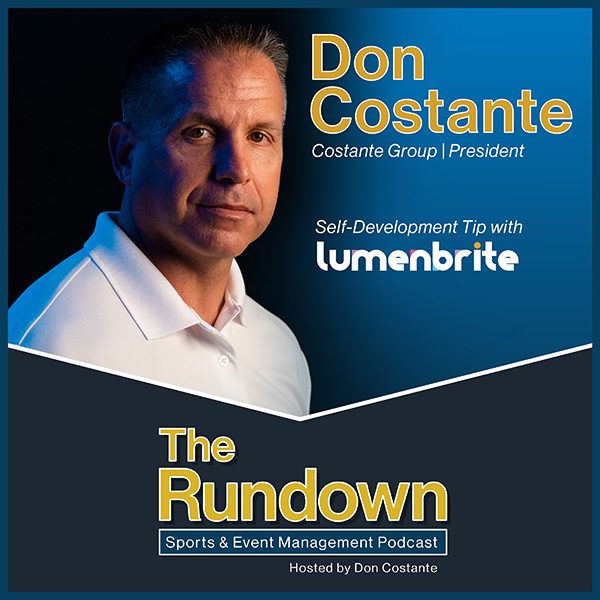
April’s episode has Don answering questions submitted by listeners. Hear Don’s insight on a variety of topics that include: issues switching from NBA to MLB, using activations from one sport to another, what to do if you can’t secure a full-time position, can’t get “hands-on” producing experience but want to be a producer, ideal skill set for a producer, suggestions for how to ideate in-game elements, finding alignment with team operations, and how to combat negative statements that prevent innovation and more.
Season 1 • Episode 4
Answers to Your Event Presentation Questions
Transcript
The transcript below has been lightly edited for readability and clarity. Click any starting timestamp to jump to that exact point in the YouTube video.
Podcast Introduction
[00:00] Don Costante:
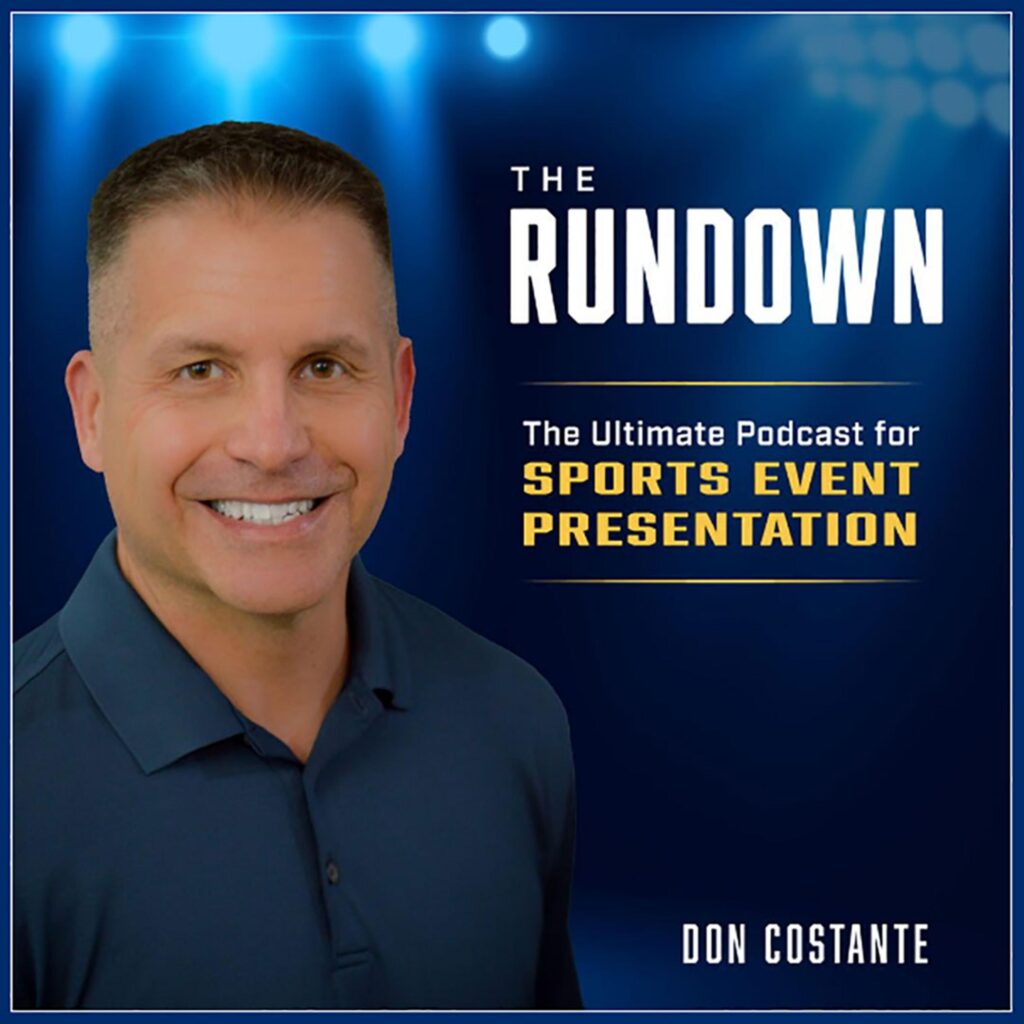
Welcome to the Rundown Podcast, hosted by Don Costante, a sports and event management expert with over 25 years experience. This unique podcast provides an opportunity to hear from some of the best professionals in the industry. You’ll get valuable insight and perspective on what it takes to deliver authentic experiences, activate brands, and most importantly, connect with audiences. All on the Rundown Podcast. Let’s get started.
Listener Questions and Episode Overview
[00:26] Don Costante:
Hi, I’m Don Costante and this is a special episode of the Rundown. Today, I’m answering questions submitted by you, the listeners. But before I begin, I want to thank everyone who sent in a question. From the response, I’m excited that this podcast is becoming a valuable resource. If there is a downside, it’s that I can only answer a portion of the questions received during this episode. Rest assured that those whose questions aren’t addressed here today, I will be reaching out to you directly with answers. Sound good? Great. I’m ready to get started. Let’s have my first question. Our first participant is Dylan from Louisville, Kentucky, and he has two questions. The first question is, I know you work with the Spurs in the NBA and then moved on now to work with the Royals in the MLB. I previously worked with an NBA team for four years and was wondering if you had any issues switching over from basketball to baseball. This is a good question. The primary issue that I was faced with coming from the NBA into major league baseball was tradition. Baseball is so rich in tradition and it’s primarily led by ownership and management groups who hold those traditional values very close to their heart.
Transitioning From the NBA to Major League Baseball
[01:36] Don Costante:
And I’m not saying that’s a bad thing, but it’s certainly a challenge when you’re talking about the event presentation department. With this type of mindset, they were less open to change. They want the product on the field to be the entertainment itself, meaning get rid of the contest and games and host and all of that. Let the players be the entertainment. So when I came to Kansas City, that was the mentality. They wanted it to be a very traditional approach. So right from the beginning, it was obvious that very little attention was given to enhancing the fan experience at Kauffman Stadium. So there lies the challenge I had. Obviously, this was a great situation for traditionalists because they could care less about all the distractions. They just wanted to see the game itself, but everybody else not so good. Let’s take my wife, for example. She’s not necessarily a fan of baseball. And if everything is baseball centric, if everything is just related to what’s happening on the field, she’s certainly not going to be entertained by that. So when I came to the Royals, I knew things had to be changed. I also knew it was very stagnant, very predictable. And I know that because one day I went up into the control room and I saw a three ring binder and the binder had these tabs and the tabs identified contest or promotions.
[02:54] Don Costante:
And so this was the book that they utilized every game. So what that told me was that they ran the same promotions at the same time every game. It was a very stagnant, very predictable event presentation. And on top of that, when they ran these contests, they didn’t believe in anybody losing. So they gave the answers to the participants. So everybody would walk away a winner. And what compounded the problem even more is that the performance on the field with the players wasn’t very good. So overall, what happened is you had this very disappointing environment. So my intent in coming to the Royals was to bring creativity and to bring that innovation that they so desperately needed. I wanted to create an immersive experience for the fans that would create added value for all the stakeholders, not just the fans, but the sponsors, the players themselves, and even the organization. I wanted everybody within the Royals to understand that we’re looking at every game as a blank canvas and each game, we’re going to paint a different picture to create new experiences. So when people come to Kaufman, they’re not feeling like they’ve been there before. So the immediate issue that I was faced with moving from the NBA into major league baseball with the Royals was breaking through that traditional mindset of our ownership and management group and getting them to understand that the fan experience had to be a priority and that changes were necessary.
Adapting to Outdoor Ballpark Conditions
[04:15] Don Costante:
Another issue that I was faced with was dealing with an outside ballpark. And what that meant was I had to now be dealing with mother nature. Quickly, I got adept to what it meant by working outside and simply put, I had to deal with rain delays and heat and cold temperatures and snow and wind. I’ll give you an example. Early one morning, we were doing a rehearsal for a hall of fame ceremony that was going to be taking place later that night. I had all of my staff there. We had all of our props, the podium, flowers, chairs, table, oversized images printed on core class material. And if you’re not familiar with what core classes, it’s a lightweight, very cost-effective visual solution for those types of presentations. And so we had all of our images on this core class and they were going to be positioned and held on easels. So we ran through all the timing. We got all of our transitions down and we did the execution of this ceremony over and over again. And everything was perfect. Later that night, about eight hours after rehearsing, guess what? The wind had picked up probably about 10 or 15 miles per hour stronger than what it was during our rehearsal that morning. And you know where I’m going with that. All of those images that we had on those core class signs that were positioned on those easels were blowing over. So I had to quickly adjust. I had to utilize my entertainment staff to hold those images on those easels, positioning them in a way that they would not distract from the presentation, but we would secure those images.
[05:46] Don Costante:
I got a quick one-on-one on wind and the importance of always being aware of mother nature. So in summary, overcoming a traditional mindset and an outside ballpark were two of the biggest issues I had to face in switching over from the NBA to major league baseball. Dylan’s second question is, did you ever take ideas from on-court activations and notice they too worked for on-field activations? Or did you notice there were more challenges in baseball and changed up the way you envisioned your show? Anytime you leave an organization and go start a position somewhere else, you’re going to take what you believe to be the best ideas that you feel can be transitioned into that sport. And I did that. When I left the Spurs, I brought with me several on-court activations to Kansas City, for example, inflatable races, uniform races, and many more. I didn’t stop there though. I didn’t stop with just on-court activations. I actually went further. I took what we did in terms of activating to create the best entertainment experience in San Antonio. And what I mean by that is that I also brought mascot skit ideas. I brought the approach to pregame that we took. I brought the formula for presentations and ceremonies. I added an MC where previously there wasn’t one here in Kansas City. I brought in an audio director versus just having an organist. When I came from San Antonio, I brought the setup that we utilized there with our game crew.
Transferring Basketball Activations to Baseball
[07:16] Don Costante:
I also brought the criteria for the selection of entertainment resources and the development of the communication documents that I had created down in San Antonio. I brought those along as well. I’m telling you, the list goes on and on and on. I like to view my event presentation with the Royals as an NBA-infused baseball game. And that’s because I have incorporated so many activations during my tenure in the NBA. Now, when you come to our game, it’s still a baseball game, but respectfully, I have pushed the boundaries of the traditionalists without crossing the line and becoming a distraction. As for the challenges that I had to face, gaining access to the field was a challenge that really shaped how I envisioned the show. What you have to understand is first and foremost, the grounds crew and baseball is very protective of the field and rightfully so that’s their profession and their livelihood is judged on the condition of the field. But it makes it very tough for the event presentation department because gaining access to go do rehearsals is hard. Even if you get approval to use the field, there are more challenges in the NBA. You have the whole court and it’s easy to access and get off. But in baseball, baseball fields are a little bit more difficult, at least in Kansas City, because we only have two access points, both of which you have to walk up and downstairs to get on and off the field.
Field Access and Execution Challenges in Baseball
[08:37] Don Costante:
And this can be especially challenging when you’re dealing with promotions that involve contestants being in costumes like our hot dog races. We also have limited space on the field that we can use. Traditionally, we’re we’re bound to just the warning track. And then we have tight timeframes for the execution of the promotion itself to get everybody onto the field, set up with the props, tell the fans what’s going on, have the promotion and then close it. We’re usually, if not out of time already, and we’re late and we’re holding up the game. Because of the difficulty accessing the field, a lot of our promotions have to be done elsewhere around the stadium. For example, we utilize an auxiliary field behind left field for many of our physical contests. This is okay. But for the majority of the fans watching from their seats, their point of view of the promotion is only through the lens of the camera operators taking the shots for the video board. We lose the ability to have that live performance in front of our audience because of the fact that we’re working through a camera. And in essence, what happens is that we’re working through a camera. And in essence, what happens is we lose connection. We lose emotion with our audience. So to sum up and to answer your question. Yes, I did notice that there were additional challenges in baseball specifically for certain activations that really influenced the execution and changed the way that I ultimately envisioned the show.
Should You Take Another Internship?
[09:56] Don Costante:
Share from Memphis, Tennessee submitted a scenario and a question. We’ll start with a scenario. You’ve worked as an assistant or intern for one to two seasons, and you start looking for a full-time role. Unfortunately, you do not land a full-time role. Should you take on another internship, part-time, or seasonal role to keep your resume current? Share a scenario raises a question by many who are out there right now. A lot of people are living this scenario. They’ve had one or two or even three internships, and that full-time opportunity just has not come about. So what do you do? This is happening more and more. And I believe that you need to look for any opportunity that allows you to continue to grow professionally. And if that means taking another internship, well, so be it. And I know, I know, I know, I can hear you yelling at me through the podcast already. Another internship? Really? Well, listen, I realize that everybody who finishes their internship feels like they’re ready, that they’re entitled, that they’re, they’re prepared for that full-time job. And guess what? It just doesn’t happen that way. At least not all the time. Sometimes people get lucky and they find their opportunity. Sometimes they’re in the right place at the right time. And I get that.
[11:09] Don Costante:
But if it doesn’t happen, then it just wasn’t meant to be. And at that point, you have two choices. Either give up on your dream to work in sports and find a job outside your area of interest or take another internship and continue to grow your experience. Let me give you an example. In 2012, I had a young lady who applied for my internship with the Kansas City Royals who had more than two or three internships. She actually had five internships under her belt. So instead of giving up, she continued to take internships that broadened her knowledge, philosophy, and experience in event presentation with a variety of organizations, both in professional and minor league, making her more marketable and attractive to hiring managers. Yes, I ended up hiring her and the Royals became her sixth internship. She was 25 years old at the time. She did a tremendous job for me. And at the end of her year long commitment, she took a full-time position with the Minnesota Timberwolves in the NBA. About a year after working with the Minnesota Timberwolves, I hired her back to serve the role of manager of event presentation. And about three years after that, I promoted her to director of event presentation where she currently serves the role of game director for the Royals. That’s pretty
[12:23] Don Costante:
incredible. She was 26 with six internships before her first full-time job, but by the age of 30, she was a game director in major league baseball. Think about that. There are only 30 major league baseball teams in the world. Only 30 people in the world can direct a major league baseball game. And she’s one of them. The point I want to make is you can’t look at your career path as a sprint. It’s a marathon. It’s all about gaining experience, developing your philosophy, broadening your knowledge and event presentation and production, putting yourself in the best position to get the opportunities you feel aligned with your career path. So going back to the original scenario, if you’re in that situation, yes, of course, take another internship, part-time job or seasonal job. I would do whatever is available in my area of interest that will allow me to grow professionally. Cher from Memphis also wants to know, what advice can you give to job-seeking individuals who work in organizations where there are not opportunities available to shadow the director or get hands-on experience producing? How can candidates get that experience to ensure they are an attractive candidate? This is a great question. One that many listeners right now are probably saying to themselves,
How to Gain Directing Experience
[13:42] Don Costante:
that’s me. I want to shadow. I want to sit in that director’s chair. I want to call a game, but I’m just not given that opportunity. Well, I do understand from a management perspective to a degree. If I had an intern or a coordinator come and say to me, Hey, listen, I want to direct a game. Although I would certainly appreciate their initiative. And unless they’ve received some hands-on training specific to the game director’s role, they’re just not ready yet. It’s going to take more than just wanting to do it. They’re going to have to develop not only the required skillset, but the knowledge necessary to do it. So the reality is that the person sitting in the director’s chair needs to be knowledgeable and well-versed in both production and event presentation to make those types of decisions that need to be made. This means having a complete understanding of the rules and regulations of your particular league, having the organization’s philosophy top of mind, and knowing the resources available, both production, as well as entertainment and staffing, and so on and so on. All that being said, it’s the responsibility of the game director to develop and groom staff who are interested in directing games by giving them opportunities to learn,
[14:50] Don Costante:
whether that’s through shadowing or by providing them with duties and responsibilities that will expose them to the types of knowledge and experience required to be successful in that particular role. If for whatever reason, the game director within your organization right now is not allowing you these types of opportunities, it doesn’t mean your ability to gain experience stops there. What I would recommend is reaching out to organizations around you, colleges, universities, minor league teams, professional teams. I would connect with the game directors at these organizations to see if you can go and shadow with them. This is a great opportunity to observe different event presentation philosophies, communication documents in play, game meetings, staffing, procedures, protocol, and much, much more. Another organization that I would recommend, and one that very few sports-minded individuals might look at, and that’s theaters. I highly encourage you to reach out and connect with a show director at a theater to see if you can attend one or more of their tech rehearsals. This is an incredible learning opportunity. Let’s face it, sports are rooted in storytelling, and nobody does a better job of telling a story than the theater. I personally love to bring a
[16:00] Don Costante:
theatrical approach to my event presentations. I always have, whether it’s in San Antonio, at the Royals, or anywhere else. Attending a tech rehearsal for a theater production will definitely open up your mind, expose you to possibilities that just might change your perspective on how you tell your team’s story in your arena or stadium moving forward. Another suggestion I have for you to gain practical experience is to look around your surrounding area and to see what activities and events might be taking place that you can lend support to, whether as a volunteer or as a freelance opportunity. It doesn’t matter. Both would be beneficial. Who knows what you’ll find? You might even find a directing role that will expose you to the type of experience you need to build your resume. I don’t care how small the event is. The principles of event presentation apply to any event, and the experience is certainly relevant. Yes, I realize that this might be a time management challenge for anybody currently working due to their daily schedule, especially if you work for a team in your in-season. Not to mention, when you get time off, I understand you want to relax. You want to spend time with your family and friends.
[17:04] Don Costante:
But what I’m telling you is if you want to be a game director and it’s important enough to you, then you need to do everything that you can to gain experience. And if that means getting involved with local activities and events, so be it. So reach out, see what’s available and how you might be able to get involved. That will help you to build your resume and put you in a better position. So when the next time comes around, you’ll be the more logical choice to be given that opportunity to. If you don’t have that experience, is there a key skill set one can highlight to convince a hiring manager that he or she can produce? Let me put you at ease right from the start. Many who get the opportunity to produce or direct a game for the first time, they haven’t gone through any kind of a formal training process. In fact, they have no previous directing experience at all. This isn’t necessarily something that I would recommend. However, I see this happening more in minor league and college sports. Not so much in professional sports, although in some cases it has happened. Now, I’m not saying that these individuals getting the opportunities aren’t worthy of being in these positions. I’m simply just trying to make a point. And the point that I’m trying to make is that you can still obtain an opportunity to produce, even if you don’t acquire hands-on experience producing.
Skills That Demonstrate Producing Potential
[18:17] Don Costante:
These people get their opportunity because they have developed their knowledge in production and event presentation and have showcased a unique skill set that’s required to be successful in the role of producer. So let’s break down the skill set required and identify the particular skills that are most important. First, problem solving. You need to have an ability to see past the problem, understand what resources are available to you and provide solutions that create a positive outcome. Another required skill is organization and time management. You need to be able to showcase the ability to multitask and work within specific timeframes. The third required skill, perseverance. You need to be able to showcase that you’re able to overcome adversity. In this business, you need to be steadfast in achieving your objectives despite all difficulties. And believe me, when you’re talking about event day on game days, there’s a lot of difficulties that you’re going to need to overcome. The fourth required skill, teamwork. You need to be able to show that you have the ability to collaborate with others in the most effective and efficient way. The fifth required skill is the ability to work under pressure. You need to have the right temperament and you need to show that you remain calm and focused on your task at all times in difficult situations. Now, the following four skills, in my opinion, are the most important. The first one is the most important.
[19:35] Don Costante:
The first key skill is communication. You need to be able to showcase that you have people skills, that you understand that although everybody should be treated the same, you interact with them differently based on their personality. And you also need to showcase that you can provide clear instruction and direction to all those who are responsible for the fulfillment aspects. The second key skill that I would like to highlight is preparation. You need to be able to show that you’re the type of person who will do what is required to ensure successful results and that you have the best. You need to have an understanding that each promotional element must be implemented seamlessly into the event presentation without any distraction to the original concept. And this can only be accomplished if everyone responsible for the execution has a total understanding of his or her role and the timing required for each element being implemented. So that means preparing your staff as well. Bringing together the required resources to conduct the rehearsals necessary to fully educate all those who are involved. The third key skill is leading You need to be able to showcase that you’re somebody that people will look up to, that you possess a clear vision and are able to lead a group of people towards a common goal.
[20:46] Don Costante:
You also need to be able to showcase that you’re able to provide your staff with latitude to make decisions. A leader believes that ideas can and should come from everyone and anyone. And lastly, the fourth key skill is confidence. You need to be able to show that you’re a confident person, that you’re confident in the decisions that you make. Even when the decisions might be wrong, you’re going to be wrong with confidence because people are always watching. And if you show a lack of confidence, then that’s going to cause your staff to lose confidence in you. So there you go. There’s the required skill set, in my opinion, that you can point to if you’re trying to convince a hiring manager that you have what it takes to produce. Melissa from Toronto, Canada was wondering if you have any tips, tricks, or suggestions for how to ideate in-game elements when there are a number of restrictions. For example, how do you do your best to ensure that ideas are passed through the approval process? First, let’s define what’s meant by ideate for the purpose of this discussion. Ideate is all about thinking big. It’s coming up with those big ideas that will resonate with our fans. Now, there’s no doubt that upper management, both on the business and on the upside, can sometimes be an obstacle to the creative and innovative thinking, simply by placing the restrictions on what we can and can’t do.
Generating Big Ideas Despite Restrictions
[22:03] Don Costante:
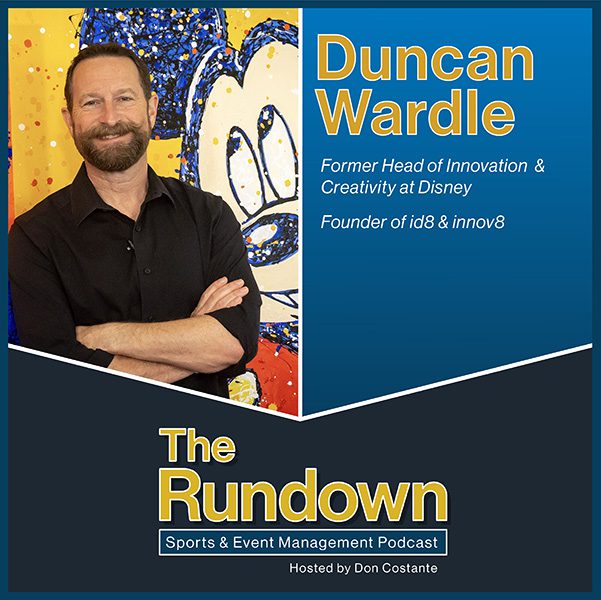
That being said, if we’re going to be fully innovative, we can’t allow restrictions to be a roadblock to creativity. Our job in the event presentation department is to develop those big ideas, push beyond the boundaries of restrictions, designed to create the most impact and value for our stakeholders. The fans, the sponsors, the players, and our organization. So, in your question you ask, what tip or trick do I have that can help you with the ideate process? Well, last year I had the privilege of attending a workshop that focused on innovation and creativity. The instructor was Duncan Wardle. Now, if you’re not familiar with Duncan, he was with the Walt Disney Company for over 30 years. He was head of innovation and creativity. He helped support franchises such as Lucasfilm, Pixar, Marvel, Disney, Imagineering, Disney Parks, and ESPN. During the workshop, he shared a lateral thinking tool that the Walt Disney Company still utilizes today to help generate big ideas during their IDA process. And we all know that there is no company more creative and innovative than Disney. The tool is called What If, and here’s how it works. First, you need to identify the challenge. What are you wanting to develop ideas for?
Using the What If Creative Thinking Tool
[23:14] Don Costante:
Next, from left to right on a sheet of paper, create three columns across. At the top of the first column, to the far left, write Rules. At the top of the second column, in the middle, write What If. And at the top of the third column, to the right, write the words Imagine If. So now that we have our columns and the headings all complete, let’s take a look at the steps in the process. Step one, list the rules of the challenge as quickly as possible. What do we know to be true about the challenge? Step two, take one or more of the rules and ask an absurd what if question. And step three, plot a world in which it could actually happen. To fully understand how to use this what if tool, I’m going to do the best I can to illustrate an example for you. First, we need to identify our challenge. And our challenge for this example is going to be Royals pregame. So everybody understands Royals pregame represents a time from when gates open to the start of the pregame ceremonies. So let’s take that first step. We’re going to list all the rules of our challenge as quickly as possible. So what do we know about the Royals pregame? Obviously, the rules that I’m about to list apply to Kauffman Stadium in Kansas City.
Applying the What If Tool to Royals Pregame
[24:23] Don Costante:
There’s an established set time for pregame. We have a one dimensional approach with our fans, meaning that we only utilize audio and video. We have no live programming. The content consists of just marketing, sponsorship, organizational and league initiatives. Fans really don’t pay attention to the programming and our fans are late arriving. Okay. Now that I’ve listed out all of the rules for pregame, let’s move over to the what if column and select one or more of those rules and ask an absurd what if question. The more provocative, the better. Okay. So looking at the rules, what if pregame wasn’t one dimensional, but it was two dimensional? What if we could get the fans excited and wanting to pay attention? And what if we could get the crowds in their seats earlier? So now it’s time to imagine it actually happening. Imagine if we had two hosts who could interact live with our fans, creating a two way relationship. Imagine if we incorporate fans into contests, conduct interviews, hold promotional spotlights, showcase entertainment, conduct live interviews and more. Imagine if we could utilize our pregame show as a countdown to create drama and awareness to the start of the game. I know we’ll call it Royals countdown.
[25:35] Don Costante:
Okay. So there’s our example. And as you can see, this is a great tool for anybody to use to generate that next big idea without allowing limitations and restrictions to hold you back. Yes. I realized that the example that I just illustrated, it wasn’t the most imaginative, but it’s still an example that provides you with a blueprint for navigating through the what if tool. As for how you can ensure the ideas you’ve generated are passed through the approval process, the biggest suggestion I can give you is communicate. I suggest that you invite the decision makers to join in on the creative process, whether that’s your direct supervisor, the partnership department, a client, upper management, or even the owner, depending on your position within the company. If they’re not able to participate, then communicate with them throughout the process. Keep them informed. That’s what’s most important. Once you’ve clearly identified what the challenge is going to be, ensure that the decision makers bought into the direction you’re about to go. Give them a taste of some of the ideas that are coming out of your creative sessions. When you’re ready to present that final idea to your decision makers, you need to make it as tangible for them as possible.
Getting Creative Ideas Through the Approval Process
[26:38] Don Costante:
I recommend that you lean on three particular learning styles when you’re presenting your new idea to ensure that you fully engage them. And those three styles are visual, auditory, and kinesthetic. You want to use models, visuals, and walkthroughs to help you bring the idea to life. So the next time that you’re about to ideate in-game elements with a number of restrictions, try that lateral thinking tool, what if. And remember, the key component to getting an idea through the approval process is getting other people as excited about the idea as you are. If you take my advice, not only will you be amazed at the ideas you and your staff will come up with, but the likelihood your ideas pass through the approval process will increase. Good luck. Jillian from Louisville, Kentucky has two questions. Her first question is, what tips can you offer to event presentation professionals who are struggling to find alignment with their operations team? So this question raises an issue that many event presentation departments struggle with each season. Over the years, I’ve seen and heard about team operation departments getting more and more involved in the business of event presentation. Sure, I can certainly understand why there would be an interest for a variety of reasons, but their involvement tends to go too far at times.
Finding Alignment With Team Operations
[27:49] Don Costante:
Don’t get me wrong. I’m all about collaboration and being a team player. I am. I certainly want to do what’s best for the organization. However, when operations gives directives that go against the event presentation philosophy, let the struggle begin. When I was in San Antonio with the Spurs, head coach Greg Popovich and general manager RC Buford, they created this players appearance committee called PAC for short. Basically, all departments were required to submit requests for players involvement to their committee once a year. This happened in August and all requests had to represent needs for the entire year. So anything and everything that involved the use of a player, meaning appearances, digital content, presentations, building images, et cetera, all had to be approved by this committee. Otherwise, we weren’t allowed to use the players. Allow me to give you a couple of examples to illustrate what I’m talking about. The first example illustrates using player content during the game. So in San Antonio with the Spurs, if we were going to use any type of player imagery or content with the player during a game, it was instructed to us through the PAC committee. If it got approved that we had to do this during a quarter break.
The Spurs Player Appearance Committee
[28:54] Don Costante:
And the reason being is during a quarter break, you have two minutes. And during the first minute, Pop usually goes and talks with his coaches somewhere around the free throw line area while the players are sitting on the bench. We had to execute the player content or the feature that we had during that first minute of the quarter break. And as soon as that ended and he started walking towards the player’s bench, we had to get out of it. The second example has to deal with player intro videos. And so every year we would get from basketball ops, a complete list of the players on the team. And they put a ratio to how many times that individual player should show up in the video. So for like Tim Duncan, Tony Parker, Manu Ginobili, you saw two to one ratio. The rest of the players had a one to one. That was our framework for how they had to show up or how many times we could utilize their image in the video. And to take it one step further, they would even go into great detail about each player and what type of shot or video image they wanted to see for that particular player. Meaning that if we were using Tony Parker, it had to be him driving to the right or Manu Ginobili. It had to be him doing a left-handed layup and so on and so on.
[30:03] Don Costante:
So they were very specific on the types of shots that they wanted. So once we completed the video and we thought, okay, we have a final product, I would take it over and give it to them. And they would take that video and then immediately start the video and put it on pause. Then from that point forward, they would take it one frame at a time to make sure that we had all of the ratios correct. So if we had a shot of Tim Duncan boxing out and in the background, you saw a picture of Malik Rose, that would count one for Tim Duncan, one for Malik Rose. And so that would go against the ratio. So we would have to go to great detail to make sure that we framed our shots and creative around the video so that we maintain the ratios that they provided. Having lived through the PAC committee, when I arrived in Kansas City, I was determined to have a healthier working relationship with the team operations department. So how did I go about finding alignment communication? I made sure to open up the communication channel between the event presentation department and the operation side right away. The first week on the job, I met with the assistant general manager to find out what’s important to them, understanding that they have clear objectives that I would be able to assist them with.
Building a Better Relationship With Operations
[31:09] Don Costante:
I’ll give you an example. Team operations had the desire of making fans aware of key players in the farm system, players to give them hope for the future. So our team, the event presentation department created a feature called down on the farm. And basically what we wanted to do to help them is highlight these key players each and every game. This wasn’t something that was sponsored, but it was something that was important to them. So it was important to us to do my objective in building this communication channel was to build trust and make them feel part of the process. I wanted to keep them informed as it pertained to them specifically. And I know this can be a slippery slope because you want to keep them involved, but you don’t want them to start dictating the process. I’m happy to say that the Royals event presentation department has a great working relationship with team operations. So if you’re listening to this and you’re struggling to find alignment with your operations department, set up a meeting with the appropriate personnel and begin developing a relationship. It might be hard in the beginning or even appear to be insurmountable, but give it a try. I promise it’s well worth the effort.
Overcoming the We Have Always Done It This Way Mindset
[32:08] Don Costante:
Jillian’s second question is how can someone who is new to their role or team combat? We’ve always done it this way or no, we’ve already tried that. That won’t work here. Statements and mindsets. You know, I think most of us have been in that position. I can tell you firsthand when I joined the Royals organization, I was hit with those statements repeatedly. That said, I knew upper management brought me into the organization for a reason. And that reason was they wanted change. The Royals event presentation was not in good shape. And when I arrived, people knew that their way of doing business was going to change. And it’s important to point out that I had the support of management. Let’s face it. Change can be tough for people. I get that. It’s easy for people to settle into a system and become comfortable and complacent. So there are two approaches that I can recommend to help combat this negative mindset. Both effective. You’ll just need to determine what works best for you. Let’s take a look at the first approach. The first approach is to ask the question. Why? Because you are new to the organization that gives you the benefit to ask the question. Why? Why won’t it work? Why have you always done it that way?
Approach One: Keep Asking Why
[33:15] Don Costante:
I recommend that you continue asking the question. Why? Until you get to the root of the problem. In some cases, their response just might sway your thoughts, but more often than not, the response will just illustrate how crucial change really is. Before bringing new ideas to their attention, do your homework. Be prepared to back up the creative ideas that you’re about to present with visual and tangible examples from other organizations who have successfully implemented what you are about to suggest. The second approach I would like to recommend is one that is less combative. It brings everybody together and transfers the power from my idea to our idea. The approach utilizes the yes and principle. Let me explain just how this yes and principle works. When bringing your thought or idea to someone, let them know right from the start that you want to have an expansive creative session. And what I mean by that is that you want to explore what can be done versus just accepting what’s always been done. Ask them to suspend judgment that you’re not looking for them to shoot down the idea, but rather greenhouse the idea. By greenhouse, I mean that they’re willing to grow the idea together.
Approach Two: Use the Yes, And Principle
[34:22] Don Costante:
The only hard, fast rule to this principle is that they must begin every pitch with the words yes and. And here’s what I mean by that. When somebody says the word yes, yes means that you’ll accept everything brought to you, regardless of who brought it to you, regardless of what it is, and regardless of what you think of it. You’ll accept everything at face value. And for the word and, and means that you take an idea and that you’re willing to build upon it. Building upon it doesn’t necessarily mean that you have to be complimentary. You can build upon something by taking it apart and you can build upon something by looking at it from a different angle. Just think of it in terms of yes builds openness while and is the reaction, the bridge to your thoughts. Listen, the moment you start forcing somebody to say yes and each and every time you pitch an idea, the idea will get bigger, not smaller, but far more important is the fact that you’ll transfer the power from my idea to our idea. And in a hierarchy culture, when you need to get everyone else on board, you need to transfer that power from mine to ours. The moment you do that, you accelerate the opportunity to get it done. Listen, we all know that there’s a thousand reasons why any given idea won’t work.
[35:33] Don Costante:
Just remind yourself and those that you’re involving in the process that you’re not green lighting the idea for execution today. You’re just green housing it together. You’ll see that by using the yes and principle, it will create an environment that fosters creativity that leads to innovation. You’ll be amazed at just how big your ideas can get. If you like what I’m telling you and you want to get more information on how to implement this principle, I suggest that you Google search improv. Yes, and and you’ll find the information that you need to get started. Well, that wraps up this episode of the rundown. I want to thank everyone once again for sending in your questions. I really enjoyed sharing my thoughts and opinions with you today. As always, I encourage you to reach out to me and let me know if you’re enjoying the podcast. Also, if you have any content ideas or thoughts and opinions on what you’ve heard to date, any questions, send them all to TheRundown@CostanteGroup.comEmail The Rundown. I’d love to hear from you again. That’s TheRundown@CostanteGroup.comEmail The Rundown. Also, I’d appreciate it if you would subscribe and share this podcast and follow us on LinkedIn and Instagram. That would be much appreciated.
Episode Closing
[36:37] Don Costante:
And until the next time I’m Don Costante.
Explore Seasons
Find us on your favorite platform
Listen to the latest episodes and stay updated!
Find us on your favorite platform
Listen to the latest episodes and stay updated!
More Episodes